
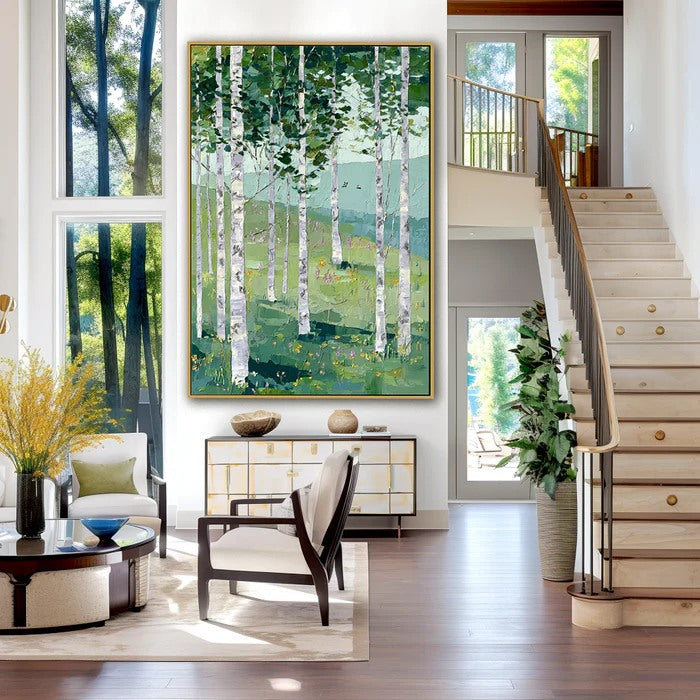
In a double-height great room, a flat winter photograph rarely holds its ground. Against rough-cut stone, aged timber, and mineral plaster, it reads as a thin, reflective sheet—more window glare than presence. Mountain landscape textured art answers a different need: it behaves like a continuation of the building’s geology. Thick, matte ridges catch side light, edges cast quiet shadows, and the surface carries visual mass that a print cannot. For owners and designers shaping modern rustic or chalet spaces, the question is not simply what image to hang, but what kind of physical surface can stand beside the architecture without disappearing.
Why flat winter prints feel out of place in timber and stone rooms
A glossy, framed photograph introduces two problems at once. First, the glass creates a moving mirror that competes with panoramic windows; morning light skims across it and breaks the scene into glare. Second, the image itself is visually “thin.” When everything else in the room—hewn beams, chiseled stone, micro-cement—has depth and grain, a flat picture reads like an afterthought.
Hand-painted winter landscape textured art reverses both issues. Matte surfaces absorb rather than reflect, and raised paint creates micro-shadows that remain legible from a distance. Instead of depicting mountains as a picture, the work builds them as relief. The result is less like a poster and more like a fixed element of the wall.
Geological hard-scaping on canvas
Think of a heavy texture mountain piece as geological hard-scaping translated to canvas. The language shifts from “image” to “material”: slate grays layered over warm underpainting, plaster fractures that mimic freeze-thaw breaks, palette-knife slashes that form ridgelines and wind-carved faces.
This approach changes how the artwork sits in the room. It does not hover; it anchors. Under angled daylight, the peaks brighten along their edges while recesses fall into soft shadow, giving the composition a slow, shifting life across the day. In evening light, warmer bulbs pull out mineral undertones that keep neutral palettes from feeling cold.
For designers seeking restraint, minimalist mountain peak art can still carry this depth—reduced composition, but not reduced surface. For bolder rooms, rugged palette-knife scenery with heavier relief creates a focal mass that balances oversized fireplaces and long timber spans.
Scale is not optional in cathedral rooms
In high ceilings, undersized art is the fastest way to make a wall feel unfinished. The canvas must relate to the architectural span, not just the furniture beneath it. As a working rule, the width of a primary mountain canvas should cover roughly 55% to 70% of the anchor below (sofa line or mantel). Height follows proportion, but the visual center should sit where the eye naturally rests when standing in the room—not at the top third of the wall.
A wide composition often reads better than a tall one above a fireplace, because it echoes the horizontal spread of the hearth and balances the vertical pull of the chimney breast. If you are considering options, you can browse our standard oversized horizontal statement canvases to see how proportion changes the room’s perceived scale.
How texture interacts with light in mountain homes
Mountain homes have strong, directional light. Large windows, snow reflection, and long shadows mean surfaces are constantly tested. Texture performs differently than print under these conditions:
-
Side light reveals relief. Raised ridges catch highlights while recessed areas stay matte, producing depth that remains visible from across the room.
-
Matte finishes reduce glare. Without glass, there is no sharp reflection competing with the view.
-
Color reads as material, not ink. Slate, ash, and off-white tones shift subtly with daylight, preventing the “flat gray” effect common in prints.
-
Distance strengthens the image. From far seating areas or upper walkways, the composition resolves into clear forms rather than dissolving into pixel detail.
This is why a heavy texture oil painting can feel calmer at scale than a busy photograph. The eye reads structure first, detail second.
A common installation failure and how to avoid it
A frequent misstep in chalet projects is pairing a monumental stone fireplace with a modest, glass-covered print hung too high. The result is a bright rectangle floating above the hearth, reflecting the window wall and amplifying the room’s sense of height without providing any counterweight.
Correcting this is less about changing the subject and more about changing the surface and placement. Remove reflective finishes from the primary wall, choose a canvas with real relief, and lower the center to align with the room’s visual horizon. The artwork should intercept the main sightline across the seating area, not hover above it.
From selection to installation in four precise moves
-
Map the wall’s true scale. Measure the full width of the fireplace or main seating span and target a canvas width of 55%–70% of that dimension to maintain balance.
-
Eliminate glare sources. Avoid glass, high-gloss frames, and polished metal on the feature wall so the artwork reads as a surface, not a mirror.
-
Choose a reinforced heavy-texture canvas. Look for thick, sand-infused gesso ridges and internal bracing capable of supporting substantial paint buildup without warping.
-
Set the center on the room’s horizon. Mount so the midpoint aligns with typical standing eye level across the space, allowing the textured topography to meet incoming light and primary sightlines.
Where a heavy mountain piece fits—and where it doesn’t
In double-height great rooms, stair landings, and long corridors with hard finishes, a substantial textured work provides needed visual gravity. It pairs naturally with stone fireplaces, reclaimed timber, and mineral plasters, and it can quiet the sense of “echo” that comes from expansive, hard surfaces by breaking up reflections with an irregular, matte face.
There are limits. In tight hallways, very aggressive relief can feel busy at close range. In rooms already dominated by patterned stone or heavily veined marble, an overly complex composition may compete rather than complement. In those cases, a quieter abstract mountain oil canvas—fewer forms, controlled palette—keeps the surface interest without adding noise.
Considering Artextured for mountain series commissions
For buyers who want the surface to carry as much intent as the subject, Artextured focuses on hand-painted 3D canvases where the mountain is constructed, not printed. Their mountain and landscape pieces use layered mineral mediums, deliberate plaster cracking, and decisive palette-knife work to simulate rock faces and snow build-up in relief. The emphasis is on matte, weighty surfaces that sit comfortably beside timber and stone rather than reflecting them.
If you are comparing options or planning a large wall, it helps to review a range of scales and finishes in one place. You can discover our full catalog of authentic 100% hand-painted 3D canvases to gauge how different compositions handle width, relief, and palette in real interiors.
Frequently Asked Questions
Why is a hand-painted mountain landscape better than a digital print in a chalet great room?
Because it introduces real surface depth and a matte finish, which reduces glare and holds its own against stone and timber. The raised paint creates shadows that remain visible at distance, giving the wall a sense of structure rather than a reflective image.
How does heavy texture change the way light behaves on the wall?
Directional light catches edges and recesses differently, producing highlights and soft shadows that shift throughout the day. This keeps neutral palettes active and prevents the flat, uniform look common in printed images.
What size should I choose for a large fireplace wall?
Aim for a width that spans about 55%–70% of the fireplace or sofa line beneath it. This proportion anchors the wall visually and prevents the artwork from feeling undersized in a tall space.
Can I use minimalist mountain art without losing impact?
Yes, if the surface still carries depth. A restrained composition with strong relief can feel calm yet substantial, especially in rooms where materials already have pronounced patterns.
Where can I order large, hand-painted mountain textured art online with confidence?
Look for brands that specialize in 3D textured canvases, show consistent surface detail across their collection, and offer sizes suited to large-scale interiors. Dedicated collections, like those from Artextured, make it easier to match composition, relief, and scale to your specific room.