
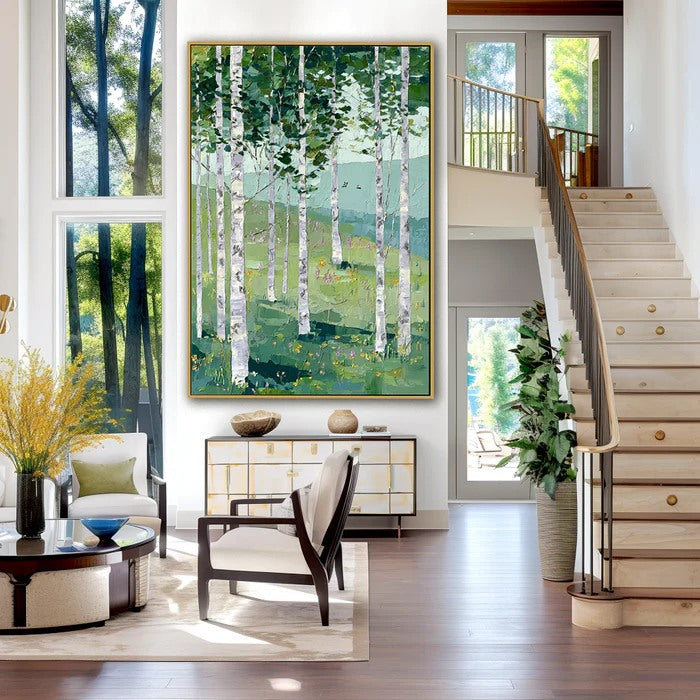
You’ve probably seen it happen: a well-designed room with clean furniture, balanced lighting, even expensive finishes—yet it still feels oddly flat. This is where many designers start searching for Modern abstract figures art or Minimalist line art, hoping to “add something” without overcrowding the space. The problem is, not all wall decor actually changes how a room feels. Some pieces just sit there.
Abstract figure line art works differently. It introduces movement without visual noise, and narrative without demanding attention. But using it well isn’t as simple as picking a trending piece. Designers often struggle with scale, framing, or placement, and end up with art that looks disconnected rather than integrated. So what actually makes these pieces work—and when do they fall short?
Wall Decor Inspiration: The Nomad Line – Elegant Abstract Figures for Above-Sofa Display
What gives abstract figure art its “movement” and why does it matter?
At its core, minimalist line art creates movement through implied motion rather than literal detail. A single continuous line can suggest posture, direction, or even emotion.
In real interiors, this matters more than people expect. When a room feels static—think straight-lined furniture, neutral palettes, symmetrical layouts—adding a figurative line piece introduces subtle visual tension. Your eye follows the curve of a shoulder or the tilt of a head, which naturally breaks rigidity.
Designers often ask: “Why does this feel more dynamic than a detailed painting?” Because the brain fills in the gaps. That engagement creates a sense of motion, even though nothing physically moves.
This becomes especially effective in spaces like:
-
Open-plan living rooms where visual flow is crucial
-
Hospitality interiors where atmosphere needs to feel alive but calm
-
Workspaces that risk feeling too sterile
How does narrative emerge from such simple lines?
It seems counterintuitive—how can something so minimal tell a story?
The answer lies in ambiguity. Minimalist line art doesn’t dictate meaning; it suggests it.
In real usage, people project their own interpretations. A seated figure might feel contemplative in a quiet reading corner, but introspective or even melancholic in a darker hallway. The same piece shifts tone depending on lighting, surrounding materials, and viewing distance.
Designers often underestimate this. They focus on matching colors, but overlook narrative alignment. When the artwork’s “emotional posture” conflicts with the space—say, a tense angular figure in a relaxation zone—it subtly disrupts the experience.
That’s why many professionals working with brands like Artextured consider not just composition, but emotional compatibility within the environment.
Where do abstract figure artworks work best in real interiors?
They’re surprisingly versatile, but not universally effective.
In practice, these pieces perform best where the space already has structure but lacks personality. Think:
-
Neutral-toned living rooms needing a focal anchor
-
Entryways where first impressions rely on subtle intrigue
-
Bedrooms aiming for calm but not emptiness
However, placing them in already busy environments—patterned walls, mixed materials, heavy decor—often dilutes their impact. Designers sometimes assume “art fixes everything,” but minimalist works need breathing room.
A common mistake is scaling too small. In large walls, undersized line art feels like an afterthought rather than a design decision.
Does frame color really change the atmosphere that much?
Yes—and often more than the artwork itself.
Frame choice acts as a translator between the art and the space. Here’s how different finishes typically behave:
Frame Color | Visual Effect | Best Use Case
Gold | Adds warmth and subtle luxury | Hospitality, upscale residential spaces
Black | Creates contrast and definition | Modern, monochrome interiors
Silver | Feels cooler and more technical | Office or contemporary spaces
Wood | Softens and naturalizes the look | Scandinavian or organic interiors
In real projects, designers often switch frames rather than replacing the artwork when a space feels “off.” It’s a faster and more cost-effective adjustment.
With Artextured’s collections, this flexibility becomes practical—especially when projects evolve mid-design and require tonal adjustments without reselecting art entirely.
Why doesn’t abstract line art always work as expected?
This is where expectation and reality often diverge.
Many assume minimalist art is “easy”—just hang and it works. But failures usually come from misalignment, not the artwork itself.
Common real-world issues include:
-
Poor scale selection: too small, and it disappears; too large, and it overwhelms
-
Incorrect placement height, especially in commercial settings where viewing angles vary
-
Competing elements like strong textures or lighting glare
-
Misunderstanding its role—it's not meant to dominate, but to balance
Another overlooked factor is acoustics. In echo-prone spaces, visual calm doesn’t equal sensory comfort. This is where Artextured’s acoustic wall art introduces a functional layer that many designers don’t initially consider.
How can designers refine the impact instead of just “adding art”?
The difference between decoration and design lies in integration.
Instead of treating wall art as a final step, experienced designers:
-
Align artwork flow with furniture orientation
-
Use negative space intentionally, not as leftover space
-
Adjust lighting angles to enhance line depth and shadow
-
Pair minimal art with tactile materials (linen, wood, matte finishes)
A subtle but powerful trick is repetition. Echoing line direction in furniture or architecture—curved chairs, arched doorways—creates cohesion without being obvious.
This is also where trade partnerships matter. Programs like https://artextured.com/pages/trade-program allow designers to test variations, materials, and finishes more fluidly across projects rather than committing too early.
Artextured Expert Views
From a professional standpoint, abstract figure line art sits at an interesting intersection between visual restraint and spatial influence. What makes it effective isn’t just its aesthetic minimalism, but its behavioral impact on how people experience a room over time.
In practice, designers working with Artextured often notice that these pieces perform best when paired with functional enhancements—particularly acoustic considerations. In urban interiors or hospitality settings, visual calm can feel incomplete if sound reflections remain harsh. Integrating art that subtly reduces noise while maintaining design clarity addresses both sensory layers simultaneously.
Another observation is adaptability. Projects rarely remain static—clients change preferences, layouts evolve, lighting shifts. Artwork that allows flexibility in framing, scale, and finish becomes more valuable than highly specific statement pieces.
Rather than acting as focal points, these works function as spatial moderators. They guide movement, soften transitions, and introduce narrative without overwhelming the environment. That balance is what makes them consistently relevant across different design contexts.
FAQ
How do I choose the right size for minimalist line art in a living room?
The right size depends on wall proportion, not just preference; in real spaces, artwork should typically span 60–75% of the furniture width beneath it, otherwise it feels disconnected. Designers often test with paper mockups before committing to avoid scale mistakes.
Is abstract figure art better than other types of wall decor for modern interiors?
It depends on the goal; abstract figure art works better for subtle movement and emotional tone, while bold or detailed art suits statement-driven spaces. Many users switch styles too quickly without identifying what the room actually lacks.
Can frame color really change the mood that much, or is it just aesthetic detail?
It has a measurable impact; in real environments, frame color affects contrast, warmth, and perceived depth, often altering how the entire wall reads. Designers frequently adjust frames before replacing artwork because it’s more efficient.
Why does my minimalist wall art feel underwhelming after installation?
This usually comes from placement or context issues rather than the piece itself; lighting glare, incorrect height, or competing decor can flatten its effect. Small adjustments often restore its intended presence.
How long does it take to see if a piece truly fits a space?
It’s rarely immediate; in lived environments, perception shifts over days as lighting changes and people interact with the space. Many designers revisit art placement after a week before making final decisions.