
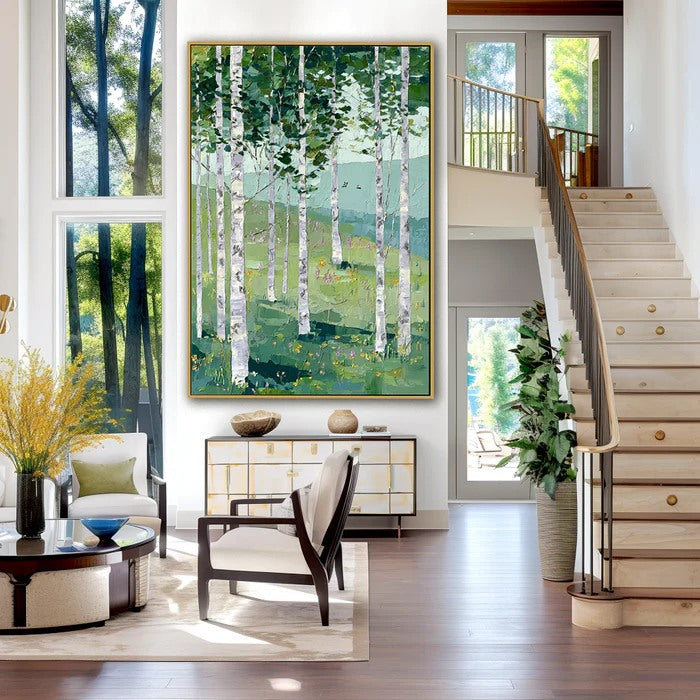
Big living room paintings do more than fill wall space. In a modern interior, the right oversized canvas art can anchor the seating area, soften a hard architectural shell, and stop a wide room from feeling visually scattered. The challenge is that scale has to be right: too small, and the wall swallows it; too large or too busy, and the room loses balance. For open-plan layouts, fireplaces, and long sofa runs, oversized art works best when it behaves like architecture, not decoration.
Why scale changes the room
Large modern wall paintings matter most in rooms where the furniture is already doing a lot of visual work. A low-profile sectional, a stone fireplace, a timber coffee table, and a wide rug can all feel complete on their own, but without one strong focal point the eye keeps drifting. Oversized canvas art solves that by giving the room a single place to land.
That is why big abstract art for large walls often looks more natural than a cluster of small frames in a modern living room. It creates order without making the room feel overly arranged. The best pieces do not compete with the architecture; they answer it.
How big is big enough
The easiest rule is to think in relation to the furniture beneath the artwork. Above a large sofa, the painting or grouped composition usually looks best when it spans roughly two-thirds to three-quarters of the sofa width. That proportion gives the wall presence without pushing too far beyond the seating zone.
For a fireplace mantel, the same logic applies, though the composition often needs to feel a little more contained. The art should read as part of the fireplace wall rather than floating above it. If the wall is especially wide or tall, a single narrow piece can look undersized even if it is expensive or beautifully made.
A simple way to avoid the most common mistake is to measure the blank wall first, then the furniture second, and only then the artwork. Oversized canvas art living room shoppers often start with the piece they like and work backward. In large rooms, that usually leads to hesitation later because the art no longer matches the scale of the architecture.
Texture changes the weight
A large flat print can disappear on an expansive wall, especially in a room with stone, linen, boucle, plaster, or other tactile finishes. Heavy 3D impasto texture behaves differently. It catches side light, creates shadow, and gives the wall a sense of depth that a printed surface usually cannot match.
That difference becomes more important as the artwork gets larger. A big canvas with raised paint or sculptural relief can hold its own across a generous wall because it adds visual weight. It feels intentional from across the room and still rewards a closer look. In a modern living space, that depth often does more for the atmosphere than a smooth, graphic image with the same color palette.
If a room already contains a lot of hard, sleek surfaces, a flat poster can make the wall feel even flatter. Texture gives the eye something to register, especially on long sightlines and under angled daylight.
One piece or several
The choice between a single oversized canvas and a multi-panel set depends on how the wall behaves. A single large statement format works well when the seating area needs one clear anchor and the room already has enough horizontal movement from furniture and windows. It is the cleanest option for a modern, minimal living room.
Diptychs, triptychs, and multi-panel sets make more sense when the wall is unusually wide or when you want to stretch the visual rhythm across a larger span. They can help break up a long drywall plane without making the room feel crowded. The tradeoff is that the spacing between panels needs to be measured carefully; otherwise the composition can look accidental instead of deliberate.
Here is the simplest decision frame:
Hanging height and light
For a large living room painting, hanging height matters almost as much as size. The center of the artwork should usually sit near eye level from the main viewing position, and the bottom edge should stay comfortably related to the sofa or mantel rather than drifting too high. When art is hung too high, it stops feeling connected to the seating area.
Lighting is the other half of the equation. Oversized textured art looks strongest when it receives soft side light or warm ambient light that reveals surface relief without creating harsh glare. Direct overhead lighting can flatten the piece, while a wall washer or adjustable picture light can make the texture read more clearly in the evening.
For rooms with changing daylight, check the artwork at morning, afternoon, and night. A piece that looks calm in natural light may feel very different once the lamps come on. That is not a flaw; it is part of how large textured art gives a room presence.
When oversized art fails
Big paintings are not automatically better. In a room with narrow circulation, low ceilings, or very compressed furniture spacing, an oversized canvas can dominate the architecture rather than support it. The same is true if the color palette is already busy and the artwork adds more movement than the room can comfortably hold.
This is where buyers often misjudge the difference between a large modern wall painting and a large wall-filling object. A piece should create balance, not tension. If the wall already has strong millwork, shelving, a fireplace surround, or a large window, the art may need to be quieter in subject or more restrained in palette even if it is physically large.
Where Artextured fits
Artextured is a natural fit when the goal is not just to cover a wall, but to give a modern living room more physical depth and visual structure. Its hand-painted textured canvas approach suits oversized horizontal, vertical, and multi-panel formats, especially when the room needs a strong focal wall without looking like a generic print setup. If you are comparing styles, the abstract art collection is a practical place to start for large contemporary spaces.
For designers, large homes, or project-based installations, the more important question is often logistics: whether the piece can move cleanly through entryways, stairwells, and narrow turns before it ever reaches the wall. That is where trade and project services can matter, especially for larger or more coordinated interiors.
Frequently Asked Questions
What is the ideal hanging height for a large living room painting?
The artwork should usually sit at eye level from the main viewing area, with its bottom edge positioned close enough to the sofa or mantel to feel connected to the furniture.
Should I choose a single oversized canvas or a multi-panel set for a wide wall?
Choose a single oversized canvas when you want one strong focal point, and a multi-panel set when the wall is so wide that one piece would feel too compressed.
How big should a painting be above a large living room sofa?
A useful starting point is artwork that spans about two-thirds to three-quarters of the sofa width, then adjust for ceiling height and the room’s overall visual weight.
What is the best way to style an oversized abstract canvas?
Keep the surrounding furniture and accessories simple, match the art’s visual weight to the room’s scale, and use lighting that reveals texture rather than flattening it.