
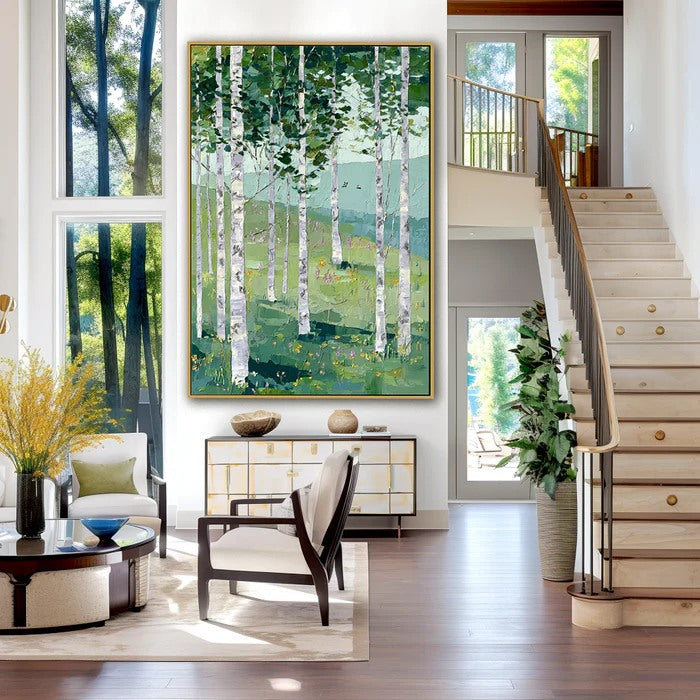
A large, echoing room often reveals itself the moment people start talking—voices bounce, conversations blur, and the space feels oddly hollow despite expensive finishes. Searching for acoustic wall art usually starts as a technical fix, but most solutions introduce a new problem: flat, fabric-wrapped panels that look like office equipment rather than part of a considered interior. The better approach is not to hide sound control behind decoration, but to let the artwork itself handle it. Hand-painted, high-relief surfaces—especially those built with mineral texture and irregular depth—can soften harsh reflections while still reading as gallery-level pieces. The result is a room that sounds calmer and looks intentionally complete, not retrofitted.
Why standard acoustic panels disrupt high-end interiors
In minimalist villas, open-plan living rooms, and executive meeting spaces, surfaces like polished concrete, glass, or wide drywall expanses amplify sound. The typical fix—foam grids or fabric panels—solves part of the echo problem but introduces a visual one.
Flat acoustic panels behave like visual placeholders. Their uniform surfaces absorb some sound, but they also reflect light evenly, which makes them stand out against materials like stone, wood grain, or limewash. Instead of blending in, they create a patchwork effect that feels closer to a call center than a private residence or curated workspace.
The deeper issue is that these panels operate as isolated add-ons. They are installed after the design is finished, not integrated into it. In daylight, their fabric skins can appear slightly synthetic. Under warm lighting, they lack depth, so the wall feels visually thin even if the room itself is large.
Acoustic wall art shifts the role entirely—from concealment to integration. Instead of adding a technical layer on top of a finished wall, it becomes part of the wall’s visual and spatial language.
The material difference behind textured sound diffusion
Not all wall art affects a room the same way. A flat canvas print—even a large one—has minimal interaction with sound. Its surface is too uniform, and when sealed or glazed, it behaves almost like a reflective plane.
Hand-painted textured work introduces a different physical structure. When built with layered mineral compounds, sand, and sculpted ridges, the surface becomes uneven in every direction. This irregularity matters.
Rather than allowing sound waves to bounce cleanly back across the room, the surface breaks them into smaller, scattered reflections. At the same time, the matte, unsealed finish prevents sharp glare, which helps the piece sit naturally under both daylight and artificial lighting.
This is where high texture art sound diffusion becomes more than a concept. The artwork is no longer passive—it actively reshapes how the room feels, both visually and acoustically.
What changes in a room when texture replaces flatness
The shift is subtle but immediate. Conversations feel more contained. The sharp “slap” of echo softens into a quieter, more controlled atmosphere.
Visually, the effect is just as important. Raised ridges and granular surfaces catch side light, creating micro-shadows that change throughout the day. This gives the wall a sense of depth that flat prints cannot achieve.
In a large living room, a wide horizontal piece can visually anchor a seating area while quietly reducing the sense of emptiness above it. In a boardroom, a restrained monochromatic textured work avoids distraction while improving clarity during conversation. In a home cinema or listening space, the same principle helps reduce harshness without introducing a studio-like aesthetic.
Choosing the right scale and format for acoustic wall art
Size is not just a visual decision—it directly affects how much of the wall participates in sound control. Small pieces rarely make a noticeable difference in echo-heavy rooms.
The relationship between artwork size and room scale can be approached more precisely:
If the artwork feels undersized, it will behave like decoration rather than a spatial element. If it is too dominant in a compact room, the heavy texture can feel visually dense. Balance is critical.
For large walls, many designers lean toward browse our standard oversized horizontal statement canvases, as these align naturally with seating lines and conversation zones.
Where placement quietly determines performance
Even the most textured piece loses impact if placed incorrectly. Acoustic wall art works best when it intersects with the path of everyday conversation.
The most effective placement typically aligns with eye level when seated, rather than standing. This is where most speech originates and travels across the room.
In practical terms, positioning the center of the artwork roughly to inches from the floor tends to intersect the primary sound path in living rooms and meeting areas. This allows the textured surface to interrupt reflections before they travel further across the space.
Avoid placing heavily textured works too high on the wall in echo-prone rooms—they may look balanced visually but contribute less to the acoustic experience.
A simple way to identify and improve echo-prone areas
-
Stand or sit in your main conversation area and clap once sharply.
-
Listen for where the echo returns—this is usually from a large, flat opposing wall.
-
Remove or reconsider any glossy, framed, or glass-covered pieces in that zone.
-
Introduce a large, matte, heavily textured artwork directly along that reflection path.
-
Re-test the space; the echo should feel softer and less defined.
This process does not require technical measurement tools. It relies on what the room actually feels like during use, which is ultimately what matters.
When acoustic wall art may not be the right solution
There are situations where textured artwork alone is not enough. Extremely large commercial spaces with very high ceilings may still require additional architectural treatments. Similarly, rooms dominated by glass on multiple sides can reflect sound in ways that wall-mounted solutions cannot fully address.
There is also a visual consideration. In very narrow hallways or tightly constrained spaces, heavy texture can feel too pronounced at close range. In these cases, a lighter relief or more restrained surface is often a better fit.
Acoustic wall art works best when it is part of a broader design approach, not expected to solve every acoustic challenge in isolation.
Integrating acoustic art into a refined design language
What distinguishes a well-resolved space is not just silence, but how that silence is achieved. When sound control is embedded into materials that already belong in the room, the result feels intentional.
Artextured approaches this through hand-painted 3D compositions built with mineral-based textures and layered relief. These pieces are designed to remain fully matte, allowing light to settle into the surface rather than bounce off it. That same irregular structure helps disperse sound in a way that feels natural rather than engineered.
For interior architects and design professionals working on larger residential or hospitality projects, this approach aligns more closely with material-driven design than with add-on acoustic treatments. Those specifying at scale can also join our exclusive architect and interior designer trade program to access collections suited to oversized installations and multi-piece layouts.
Frequently Asked Questions
Can acoustic wall art replace traditional soundproof panels?
It can reduce echo and improve perceived sound comfort, but it does not fully replace specialized soundproofing systems used for isolation. It works best for managing reflections and improving room feel rather than blocking sound between spaces.
Do textured paintings really affect room acoustics?
Yes, when the texture is deep and irregular. Raised surfaces scatter sound waves instead of reflecting them directly, which softens echo and reduces harshness in conversation.
Is bigger always better for acoustic wall art?
In echo-prone rooms, larger pieces are generally more effective because they cover more of the reflective surface. However, they still need to match the room’s scale to avoid visual imbalance.
What styles work best for subtle acoustic improvement?
Monochromatic textured art and neutral palettes tend to integrate most easily. They provide surface variation without overwhelming the room visually.
Can I safely buy large textured art online for this purpose?
Yes, if the work clearly shows real surface depth, matte finish, and scale references. Look for hand-painted pieces rather than printed imitations, as the physical texture is what makes the difference.