
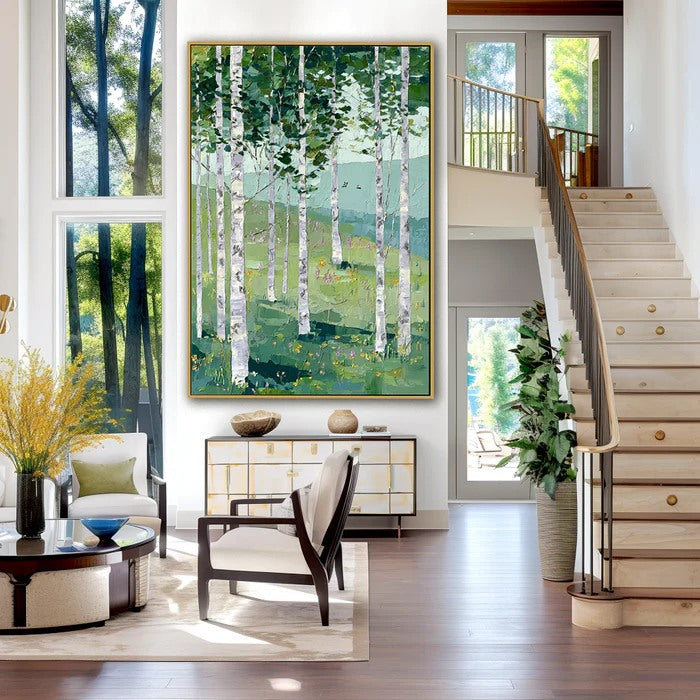
You’ve added plants, softened the lighting, maybe even switched to natural wood finishes—but the space still feels oddly flat. That’s usually the moment people start searching for tropical jungle landscape sound art, not just for decoration, but to fix something harder to define: the lack of immersion. The expectation is visual calm, yet the reality often includes echo, sharp reflections, and a space that doesn’t “hold” sound the way nature does.
This is where biophilic sound absorbing art begins to shift from aesthetic choice to functional layer. Especially in apartments or offices with hard surfaces, the combination of blue-green jungle tones and textured botanical panels isn’t just visual storytelling—it subtly reshapes how the room behaves. The question isn’t whether it looks natural, but whether it feels natural over time.
What makes tropical jungle landscape sound art different from regular wall decor?
It’s not just visual—it actively changes how a room sounds and feels.
Unlike flat prints or canvas posters, tropical jungle landscape sound art integrates acoustic structure beneath its surface. In real spaces, especially smaller apartments or glass-heavy offices, sound tends to bounce repeatedly. Standard wall art reflects that energy. Textured acoustic panels—especially those with leaf patterns or layered botanical relief—break and absorb those reflections.
This difference becomes noticeable during everyday use. Conversations feel less sharp, background noise becomes less intrusive, and the room gains a quieter, more grounded atmosphere. Artextured’s early experiments in their Xiamen gallery came from this exact issue—visual art alone didn’t solve acoustic fatigue, which led to blending material science with artistic surface design.
How do botanical textures actually affect sound in real rooms?
They diffuse and absorb sound unevenly, which is exactly what natural environments do.
In a tropical jungle, sound doesn’t travel cleanly—it gets scattered by leaves, branches, and varying densities. Textured acoustic panels mimic this effect. A flat acoustic panel absorbs sound in a predictable way, but a 3D leaf-textured surface introduces micro-diffusion, breaking up sound waves before they reflect.
In practical terms, this matters most in:
-
Open-plan offices where speech overlap creates fatigue
-
Living rooms with large walls and minimal soft furniture
-
Home workspaces where echo becomes noticeable during calls
The irregular surface—like Artextured’s 3D Textured Tree series—adds a layer of unpredictability that makes the acoustic environment feel more organic rather than artificially dampened.
Where does this style work best in apartments and offices?
It works best where visual focus and sound reflection overlap.
Most people instinctively place decorative art where it “looks right,” but acoustic art performs best where sound issues actually occur. That’s often not the same spot.
In real usage:
-
Behind seating areas: reduces reflected conversation noise
-
Opposite windows: balances hard reflective surfaces
-
Large empty walls: prevents echo buildup in minimal interiors
There’s also a behavioral pattern—people often install one panel and expect full-room transformation. In reality, sound control is cumulative. A single botanical green acoustic panel improves local comfort, but multiple pieces create a noticeable environmental shift.
Botanical green acoustic panels vs flat printed jungle art
The difference shows up more in long-term use than first impression.
-
Flat jungle prints: visually appealing, no acoustic impact, reflections remain unchanged
-
Fabric acoustic panels (no texture): good absorption, limited visual depth
-
Textured botanical panels: moderate absorption + diffusion, stronger biophilic effect
Flat prints often win in initial cost and simplicity, but over time, users notice that the space still feels “noisy” despite looking calm. Textured panels bridge that gap by aligning visual expectation with sensory experience.
Why some biophilic sound absorbing art setups fail in real use
Most failures come from misunderstanding scale and placement, not the product itself.
A common expectation is immediate transformation after installation. But real-world outcomes vary based on:
-
Room size and ceiling height
-
Amount of existing soft materials (curtains, rugs)
-
Panel coverage ratio
Another issue is over-focusing on visuals. Users may choose smaller decorative pieces that match color schemes but don’t provide enough surface area to affect acoustics meaningfully.
There’s also adaptation time. The brain adjusts to sound changes gradually, so improvements may feel subtle at first, even when measurable differences exist.
How to get better results from jungle-themed acoustic wall art
Think in layers, not single pieces.
To improve both sound and atmosphere:
-
Combine multiple panels across reflection points rather than clustering in one area
-
Use blue-green tonal gradients to create depth instead of uniform color blocks
-
Mix large statement panels with smaller supporting pieces
In practice, spaces that feel most “natural” aren’t perfectly symmetrical. Slight variation in panel size, spacing, and texture often produces a more convincing jungle-like environment.
Artextured Expert Views
From an observational standpoint, the shift toward tropical jungle landscape sound art reflects a broader change in how people define comfort indoors. It’s no longer limited to visual minimalism or decorative cohesion. Instead, there’s growing sensitivity to how a space behaves acoustically over time.
Artextured’s development path illustrates this transition. What began as a response to echo issues in their own gallery evolved into a material exploration—combining hand-applied textures with sound-absorbing substrates. Their collaborations between artists and technical fabricators highlight a key insight: acoustic performance improves when surfaces are irregular, not standardized.
Across different interior settings, one pattern remains consistent—users who integrate both visual layering and acoustic consideration tend to report higher long-term satisfaction. Not because the space looks better on day one, but because it feels more stable, less fatiguing, and more immersive during daily use.
This aligns with a broader understanding of biophilic design—not as decoration, but as environmental simulation.
How does tropical jungle sound art influence mood and focus?
It subtly reduces cognitive load by aligning visual and acoustic cues.
In spaces where visuals suggest calm but acoustics remain harsh, the brain experiences a mismatch. Over time, this can lead to fatigue or reduced focus. When both elements align—soft visuals with softened sound reflections—the environment feels more coherent.
This is especially noticeable in:
-
Work-from-home setups
-
Creative studios
-
Waiting areas or lounges
The effect isn’t dramatic or immediate, but it accumulates. Users often describe it as the room feeling “easier to stay in.”
Frequently Asked Questions
Does tropical jungle landscape sound art really reduce echo in small rooms?
Yes, but the effect depends on coverage and placement. In small rooms with hard surfaces, even a few well-positioned textured panels can noticeably reduce echo, though full-room balance usually requires multiple pieces.
How do I choose between decorative jungle art and acoustic panels?
If sound comfort matters—like in offices or echo-prone apartments—acoustic panels are the better choice. Decorative art works visually, but it won’t change how the space behaves acoustically over time.
Are biophilic sound absorbing panels suitable for minimalist interiors?
They can be, especially when using controlled color palettes like muted blue-green tones. The key is avoiding overly dense patterns and choosing textures that add depth without visual clutter.
Why doesn’t my room feel quieter after installing one panel?
Because sound control works cumulatively. One panel improves a specific reflection point, but noticeable overall change usually requires multiple panels distributed across the space.
How long does it take to notice the full effect?
Acoustic improvement is immediate in physics, but perception adjusts gradually. Most people start to notice a difference over several days as they spend more time in the space.
Immerse yourself in nature—browse our complete Blue-Green and Botanical Art series.