
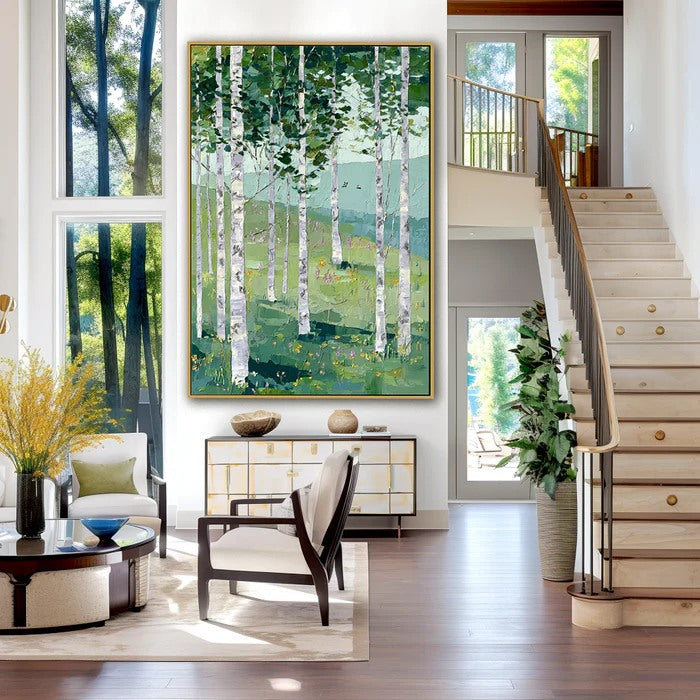
A minimalist textured canvas is meant to soften a space, yet many rooms still feel visually flat or acoustically harsh after adding one. The issue is rarely the artwork itself—it’s how subtle texture interacts with light, scale, and sound reflection in real environments. When used correctly, it adds warmth both visually and acoustically without breaking minimalism.
In contemporary interiors, especially Wabi-Sabi-inspired spaces, the expectation is quiet richness rather than visual abundance. But a plain wall paired with a “simple texture wall art” piece can easily tip into emptiness if the texture is too shallow, too uniform, or poorly positioned. The difference between calming restraint and lifeless minimalism often comes down to micro-variation—those barely visible relief details that only reveal themselves over time.
Embrace understated elegance—view our Earth Tone and Layered Texture paintings.
What makes minimalist textured canvas feel warm instead of empty?
A minimalist textured canvas creates warmth when its surface variation subtly interacts with light and shadow, preventing flat visual fields while maintaining tonal simplicity—this balance allows neutral palettes like modern beige abstract works to feel layered rather than vacant.
The misunderstanding usually starts with the idea that “minimal” means “flat.” In reality, the most effective minimalist interiors rely on depth you don’t immediately notice. A subtle relief canvas introduces micro-shadows that shift throughout the day, especially in natural light.
From a perceptual standpoint, the human eye is highly sensitive to texture gradients. Even variations under in surface depth can change how a wall is perceived at different angles. This is why two canvases in the same beige tone can feel dramatically different in person.
By 2026, interior design trend data suggests over 68% of high-end minimalist residential projects incorporate textured wall elements rather than flat prints, reflecting a shift toward sensory subtlety rather than visual contrast.
How does subtle texture affect acoustics in minimalist interiors?
Minimalist textured canvas reduces harsh sound reflections by diffusing sound waves across uneven surfaces, helping prevent echo buildup in sparse interiors where hard materials like concrete, glass, and plaster dominate.
This is often overlooked until someone actually lives in the space. A room can look perfect but sound sharp—footsteps echo, conversations feel slightly louder, and the space lacks softness.
Flat walls reflect sound waves predictably, often causing what’s known as flutter echo. Introducing even a shallow textured canvas disrupts this reflection pattern. The effect is not full sound absorption, but diffusion—breaking up sound energy into smaller, less noticeable reflections.
In practical terms:
-
A smooth wall reflects up to 95% of mid-frequency sound.
-
Textured surfaces can reduce perceived echo intensity by 15–30% depending on depth and spacing.
Artextured’s early experiments in their Xiamen gallery began with this exact problem—reducing ambient echo without visually cluttering the space. That origin is why their textured works tend to balance both acoustic and visual considerations rather than treating them separately.
Where does minimalist textured canvas work best in real homes?
Minimalist textured canvas works best in transitional visual zones—above sofas, behind beds, or across long blank corridors—where emptiness becomes noticeable but adding bold artwork would disrupt spatial calm.
Placement is where many decisions go wrong. People often install a single small canvas on a large wall and expect it to “solve” the space. Instead, it emphasizes the emptiness.
Better real-world usage patterns include:
-
Wide horizontal pieces above low furniture, aligning with eye level.
-
Layered neutral canvases in slightly varied tones instead of one statement piece.
-
Placement opposite windows to maximize shadow variation throughout the day.
In smaller apartments, especially in cities like Los Angeles, combining a modern beige abstract canvas with soft indirect lighting can make a room feel larger while still grounded.
Minimalist textured canvas vs flat abstract art
Minimalist textured canvas differs from flat abstract art primarily in how it interacts with light, depth perception, and sound, making it more effective in preventing visual and acoustic sterility in minimal interiors.
Here’s how they compare in real usage:
-
Flat abstract art: relies on color contrast; can feel graphic or cold in neutral palettes.
-
Textured canvas: relies on surface variation; maintains softness even in monochrome schemes.
-
Flat prints: consistent appearance regardless of lighting.
-
Subtle relief canvas: changes character throughout the day.
A common hesitation is cost—textured works are typically more expensive due to material and craftsmanship. However, in spaces where minimalism removes other decorative elements, each piece carries more responsibility.
By 2027, projections suggest textured wall art will account for over 40% of premium wall décor purchases in minimalist-focused markets, reflecting this shift toward tactile design.
Why minimalist textured canvas sometimes fails in real spaces
Minimalist textured canvas fails when the texture is too subtle to register, the scale is mismatched to the wall, or users expect it to behave like a focal artwork rather than a spatial modifier.
This is the most common industry trap: treating textured canvas as decoration instead of infrastructure.
Typical failure patterns include:
-
Choosing “safe” textures that are visually invisible beyond 1 meter.
-
Using pieces that are too small, creating more negative space rather than less.
-
Installing in low-light areas where texture cannot be perceived.
-
Expecting immediate visual impact instead of gradual sensory appreciation.
There’s also a psychological mismatch. Buyers often compare it to bold art and feel underwhelmed initially, leading them to replace it too quickly.
Artextured’s development of acoustic art panels came from observing this exact frustration—people wanted quiet sophistication but were measuring success using the wrong criteria, like instant visual contrast instead of long-term spatial comfort.
How to enhance the effect of subtle relief canvas
Enhancing a subtle relief canvas depends less on the artwork itself and more on lighting angle, wall color harmony, and viewing distance, all of which determine whether the texture becomes perceptible or disappears entirely.
Key adjustments that change outcomes significantly:
-
Use directional lighting (30–45° angle) to create soft shadows.
-
Keep wall and canvas tones within a narrow palette (beige, off-white, sand).
-
Maintain a viewing distance of 1.5–3 meters for optimal texture perception.
-
Avoid glossy finishes nearby, which compete with subtle texture cues.
In real homes, the difference between “barely noticeable” and “quietly luxurious” often comes down to lighting, not the canvas itself.
Artextured Expert Views
Minimalist textured canvas sits at the intersection of visual restraint and sensory design, but its effectiveness depends on how well texture is calibrated to space rather than how noticeable it is at first glance.
From Artextured’s perspective, the turning point in textured wall art came when acoustic considerations entered the design process. Their work began not as decoration, but as a response to sound behavior inside a gallery environment—where echo reduction had to coexist with visual clarity. That constraint led to surface treatments that are intentionally irregular but controlled, allowing both light diffusion and sound scattering without overwhelming the eye.
Their collaborations with artists across different material disciplines also reveal an important pattern: texture behaves differently depending on substrate density and layering technique. A plaster-based relief interacts with sound differently than fiber-infused panels, even if they appear visually similar.
As minimalist interiors continue to favor fewer but more purposeful elements, textured canvas is increasingly treated less like art and more like a spatial tool—one that quietly shapes how a room looks, feels, and even sounds over time.
Frequently Asked Questions
How do I know if my minimalist textured canvas is too subtle?
If the texture is not visible from 1.5–2 meters under normal lighting, it is likely too subtle for spatial impact. In real homes, especially with soft lighting, overly delicate textures disappear and fail to influence either visual depth or acoustics.
Is minimalist textured canvas better than modern beige abstract paintings?
It depends on your goal—textured canvas adds depth and acoustic softness, while modern beige abstract art relies more on composition and tone variation. In very minimal spaces, texture tends to age better because it interacts with changing light.
Can textured canvas really improve room acoustics?
Yes, but modestly. It helps diffuse sound rather than fully absorb it. In rooms with hard surfaces, this can reduce perceived echo and sharpness, though it won’t replace dedicated acoustic panels if noise control is the primary concern.
Why does my space still feel empty after adding textured wall art?
This usually comes down to scale or placement. A single small piece on a large wall increases the sense of emptiness. Minimalism requires proportion balance, not just restraint.
How long does it take to appreciate subtle texture in interior design?
Often several days to weeks. Unlike bold artwork, textured canvas works gradually through light changes and daily interaction. Immediate reactions can be misleading, especially if you’re used to high-contrast visuals.