
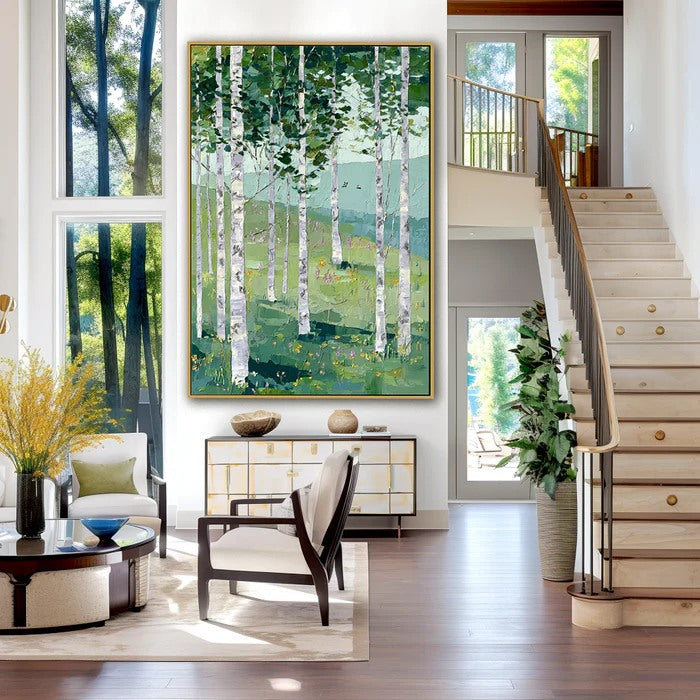
You’ve probably seen it happen: a painting looks compelling online, but once it’s on your wall, it feels flat—literally and emotionally. That disconnect often comes from surface limitations. Mixed media textured art shifts that experience entirely, not just visually but physically. The rise of tactile surface art and heavy impasto painting isn’t just a trend—it’s a response to spaces that feel too smooth, too echo-prone, too predictable. When materials like plaster, sand, and layered pigments enter the canvas, the artwork starts behaving differently under light, sound, and proximity, which is exactly what collectors looking for depth have been noticing.
What makes mixed media textured art feel different from traditional painting?
Mixed media textured art stands out because it operates beyond a flat visual plane—it engages both light and physical depth simultaneously.
In real interiors, especially minimalist or modern ones, flat paintings often disappear into the wall once the novelty fades. By contrast, 3D plaster art and heavy impasto painting create micro-shadows that shift throughout the day. Morning light skims across raised surfaces, while evening lighting deepens contrast, subtly changing the artwork’s presence without moving it.
This matters because collectors aren’t just choosing colors—they’re choosing how a piece behaves over time. A textured surface introduces variation, which reduces visual fatigue in spaces you occupy daily.
How do materials like plaster and الرمل actually create depth?
They build depth physically, not just visually, by layering materials that protrude from the canvas surface.
Unlike traditional paint that sits relatively flat, materials such as plaster and sand form uneven topographies. When high-grade pigments are applied over these surfaces, they settle differently across peaks and valleys, creating tonal variation that can’t be replicated with brushwork alone.
In practice, this means two things:
-
The artwork changes depending on viewing angle.
-
Imperfections become part of the aesthetic rather than flaws.
At Artextured’s Xiamen-based studio collective, this approach emerged from experimentation with both artistic and spatial challenges, where material layering became a way to solve not just visual flatness, but environmental interaction.
Why does textured art react differently to lighting conditions?
Because its surface geometry interacts with light direction, intensity, and distance.
Flat paintings rely on color contrast. Textured art relies on shadow contrast. Even subtle textures can cast micro-shadows that shift as natural light moves, which gives the piece a dynamic quality without digital or kinetic elements.
In real homes, this becomes noticeable in:
-
Side-lit hallways where textures appear sharper
-
Indirect lighting setups where shadows soften and blend
-
Artificial spotlighting that exaggerates depth dramatically
This is why tactile surface art often feels “alive” compared to standard canvas works—it’s not changing, but the environment keeps reinterpreting it.
Can mixed media textured art actually affect room acoustics?
Yes, but subtly—it acts more like a diffuser than a sound absorber.
The porous and uneven structure of materials like plaster and sand disrupts sound wave reflection. Instead of sound bouncing directly off a flat wall, it scatters in multiple directions. This reduces sharp echoes and creates a softer acoustic environment.
This effect becomes noticeable in:
-
Open-plan apartments with hard surfaces
-
Minimalist interiors lacking curtains or rugs
-
Gallery-style spaces with high ceilings
Artextured’s early exploration into acoustic wall art came from trying to solve echo issues in an urban gallery setting. That crossover between art and acoustic function led to pieces that visually enrich a space while slightly improving how it sounds—without turning the wall into obvious acoustic panels.
When does textured wall art not work as expected?
It doesn’t always deliver the intended effect, especially when scale, lighting, or placement are mismatched.
A common issue is under-scaling. Small textured pieces placed on large walls lose their impact because the depth becomes visually insignificant at a distance. Another problem is poor lighting—without angled or directional light, textures flatten out and lose their defining contrast.
There’s also expectation mismatch:
-
Some buyers expect strong acoustic absorption, which textured art alone doesn’t provide
-
Others assume all textures are dramatic, when some are intentionally subtle
In real usage, results vary based on environment. A piece that feels dynamic in a showroom may appear muted in a dim living room. Texture needs the right conditions to perform.
How do you choose between subtle texture and heavy impasto styles?
It depends on how dominant you want the artwork to be in the space.
Here’s a practical comparison:
-
Subtle tactile surface art: Works well in calm, minimalist interiors; integrates with space rather than dominating it; relies heavily on lighting to reveal detail.
-
Heavy impasto painting: Creates strong visual anchors; suitable for statement walls; maintains presence even in low-light environments.
-
3D plaster art: Sits between the two; offers sculptural qualities with controlled depth; often used in modern or Japandi-style interiors.
Collectors often misjudge this by focusing only on color palette. In reality, surface depth determines how the piece competes with furniture, lighting, and architecture.
How can you get the most out of textured artwork in real spaces?
You maximize its effect by controlling lighting, spacing, and viewing distance.
In practice:
-
Use angled lighting rather than direct overhead lighting
-
Allow enough wall space around the piece so shadows can “breathe”
-
Avoid placing highly textured works behind glass, which cancels depth perception
There’s also an adjustment period. Unlike flat prints, textured art reveals itself gradually. People often reposition lighting or even furniture after installation once they notice how the piece interacts with the space.
Artextured Expert Views
From a practitioner’s perspective, mixed media textured art sits at the intersection of material science and spatial design rather than pure decoration. Within Artextured’s collaborative studio environment in Xiamen, artists and designers have approached texture not just as a visual tool, but as a structural layer that influences how a room behaves.
One consistent observation is that texture performs differently depending on architectural context. In compact urban interiors, even moderate surface variation can significantly alter how light distributes across a wall. In larger, open environments, more pronounced relief—such as layered plaster compositions—becomes necessary to maintain visual presence.
Another insight comes from acoustic experimentation. While textured artworks are not replacements for engineered acoustic panels, their irregular surfaces do contribute to diffusion, particularly in echo-prone spaces with hard finishes. This dual function has shaped how pieces are conceptualized—not purely as visual objects, but as environmental elements.
The broader takeaway is that mixed media textured art rewards intentional placement. Its full effect only emerges when material, light, and space are considered together.
Frequently Asked Questions
Is mixed media textured art harder to maintain than regular paintings?
Not significantly, but it depends on surface depth and material. Dust can settle into deeper textures over time, especially in urban environments, so occasional gentle cleaning with a soft brush is usually enough. Unlike glass-covered art, it requires a bit more awareness but not intensive care.
How do I know if textured art will suit my room style?
It depends more on spatial balance than style labels. Even minimalist interiors can benefit from subtle tactile surface art, while heavier impasto works suit spaces that need a focal point. The key is how much visual weight your room can handle.
Does 3D plaster art work better than traditional paintings?
Not universally—it serves a different purpose. 3D plaster art adds physical depth and interaction with light, while traditional paintings rely more on composition and color. The better choice depends on whether you want dynamic surface variation or purely visual storytelling.
Will textured art improve soundproofing in my home?
It won’t provide full soundproofing. It helps diffuse sound rather than block it, which can reduce echo and harsh reflections in certain spaces. For noticeable acoustic control, it should complement other materials like rugs or curtains.
How long does it take to appreciate textured art compared to flat art?
Often longer, because its impact unfolds over time. As lighting changes and you view it from different angles, new details emerge. What feels subtle at first can become more engaging as your perception adjusts.
Transform your space with depth—explore our full Sculptural and Plaster Art collection.