
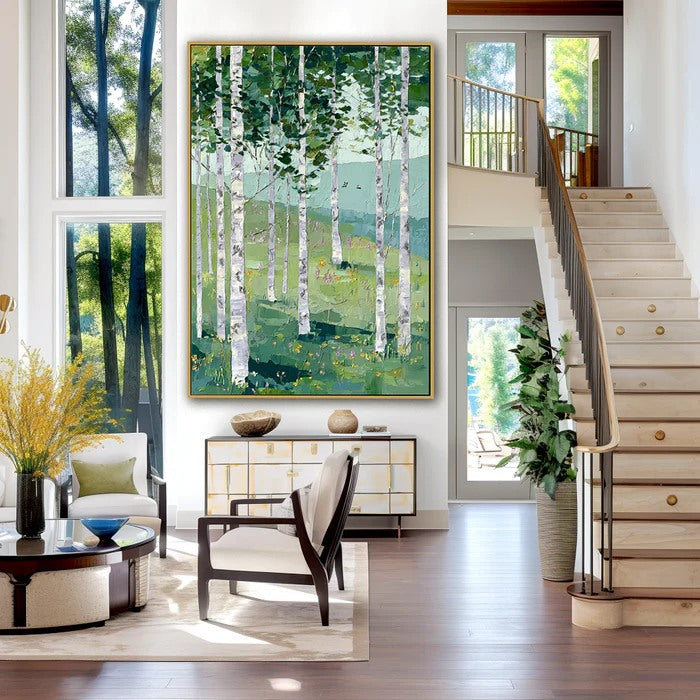
A tall wall can either feel architectural and intentional—or strangely empty and cold. That difference usually comes down to how you handle vertical wall decor. In spaces like double-height living rooms, narrow entryways, or staircases, the instinct to fill the wall with multiple small frames often makes the problem worse. The eye jumps around instead of moving upward. A single, tall, portrait-oriented artwork—especially one with visible texture—does something more powerful: it organizes the wall into a vertical axis, pulling the gaze up and giving height a purpose rather than leaving it exposed.
Why vertical orientation changes how a room is experienced
Vertical lines are not just visual—they are directional. When you introduce a large vertical abstract canvas or textured piece, you are effectively telling the eye where to travel. This matters most in rooms where height exceeds width, such as entry corridors or stairwells.
Flat, horizontal compositions tend to anchor a room outward, widening it. Vertical compositions do the opposite. They elongate perception. In a narrow hallway, that means the space feels less compressed. In a double-height room, it prevents the upper wall from feeling disconnected from the lived area below.
Texture amplifies this effect. Raised ridges, knife-applied grooves, or layered paint peaks catch light differently from top to bottom. Under downlighting or side lighting—common in staircases—these textures create a subtle column of shifting shadows. The wall stops being a blank plane and starts behaving like a surface with depth and rhythm.
The case for one dominant vertical canvas over multiple small pieces
Most mainstream advice for vertical wall decor leans toward stacking frames or building gallery arrangements. That approach works at small scales, but it breaks down quickly on taller walls.
Here is where proportion becomes critical:
-
Multiple small artworks fragment the wall and visually lower the ceiling.
-
Thin frames read as lightweight against heavy materials like stone, wood, or plaster.
-
Gaps between frames introduce visual noise in already narrow spaces.
-
Repetition creates decoration, not structure.
A single large tall wall painting avoids all of that. It gives the wall a center of gravity. Instead of filling space, it defines it.
In a 15-foot stairwell, a cluster of standard 24 x 36 inch prints often looks accidental—like temporary placeholders. One vertically scaled canvas, however, can align with the architecture, turning the wall into a deliberate vertical feature rather than leftover space.
Proportions chart for choosing the right vertical canvas size
To make vertical wall decor work, size must be calculated relative to wall height—not guessed.
The table below offers a practical framework used in interior styling to prevent undersized art.
Width should typically stay within about 1/4 to 1/3 of the wall width for narrow zones, or up to roughly 4/7 when placed above furniture or fireplaces. This keeps the piece tall and commanding without becoming bulky.
How lighting interacts with vertical texture
Lighting is where vertical texture art styling becomes visibly different from flat prints. In transitional spaces—hallways, staircases, entry walls—lighting often comes from above or at an angle.
With a flat canvas or poster, light simply reflects. With textured artwork, light grazes the surface. This creates micro-shadows along raised paint ridges, especially in neutral palettes like off-white, taupe, charcoal, or black.
The result is subtle movement throughout the day:
-
Morning light produces softer gradients.
-
Midday light flattens slightly but still reveals depth.
-
Evening downlights exaggerate shadow lines, making the piece feel more sculptural.
This is why a vertical textured piece can hold attention even with minimal color. It does not rely on bold imagery; it relies on surface.
Where vertical wall decor works best
Certain areas benefit more from vertical formats than others because of how people move through them.
Entryways are transitional and fast-paced. A tall piece creates an immediate focal point without cluttering the wall. It also visually lifts the ceiling right at the moment of arrival.
Staircases are naturally vertical pathways. A portrait orientation wall art piece mirrors that movement, especially when aligned with the stair run or landing.
High-ceiling living rooms often suffer from a “dead zone” above eye level. A large vertical canvas bridges the gap between furniture and ceiling, making the upper volume feel intentional rather than empty.
Narrow hallways benefit from vertical emphasis because width cannot be expanded. Instead, height becomes the feature.
When vertical art can go wrong
Vertical wall decor is powerful, but it is not universally forgiving.
If the artwork is too narrow relative to a wide wall, it can feel like a stripe rather than a focal point. If the texture is too aggressive in a tight corridor, it may feel visually heavy at close viewing distance. And if the piece is too small for a tall wall, it creates the exact problem it is meant to solve—excess negative space above and below.
Another common mistake is choosing highly detailed imagery for tall placements. The higher portions of the canvas are often viewed from a distance or angle, so overly intricate visuals lose clarity. Texture and broad composition tend to perform better than fine detail in these situations.
A quieter alternative to decorative clutter
Vertical wall decor does not need to mean more objects. In fact, the most refined interiors often reduce elements rather than multiply them.
Compared to shelves, metal wall hangings, or stacked frames, a single textured vertical abstract canvas offers visual depth without adding physical clutter. It also integrates more naturally with tactile interiors—spaces that already feature materials like linen upholstery, stone surfaces, or limewashed walls.
This is where hand-painted texture becomes especially relevant. Unlike printed surfaces that mimic depth, real layered paint introduces slight irregularities. Those imperfections prevent the artwork from feeling manufactured, which is important in modern interiors that aim to balance minimalism with warmth.
For those exploring options, a curated luxury vertical textured wall art collection can help narrow down formats designed specifically for these tall, narrow applications.
When a hand-painted vertical canvas makes sense
Not every wall needs heavy texture, but certain conditions benefit from it.
If your space feels too clean or flat—common in new builds with smooth drywall—textured art adds surface variation without requiring renovation. If your room already has strong materials (wood grain, stone, fabric), texture in art helps maintain consistency rather than introducing a flat visual interruption.
Artextured’s approach, centered on hand-painted 3D textured canvas work, is particularly aligned with these scenarios. The emphasis is not on imagery alone but on how the surface interacts with light and scale. This becomes more noticeable in larger vertical formats, where texture has enough area to develop a rhythm.
If you are comparing options or want to see how different styles translate into real scale, you can explore our premier hand-painted best sellers as a reference point for proportion and surface depth.
Frequently Asked Questions
How do you choose vertical wall decor for a double-height ceiling?
Start with height, not width. The artwork should cover at least half to two-thirds of the visible vertical space to avoid looking undersized. Texture helps maintain visual interest across that height, especially under changing light conditions.
What type of art works best on a narrow hallway wall?
Tall, simplified compositions with subtle texture work best. Avoid busy imagery or multiple frames, which can make the hallway feel tighter. A single vertical piece keeps the space visually clean and directional.
Should vertical wall art be centered or aligned with architecture?
It depends on the space. In entryways, centering is usually effective. In staircases, aligning the artwork with the slope or landing often feels more integrated with the architecture.
Is textured vertical art better than printed canvas for tall walls?
In most cases, yes. Printed canvases tend to look flat and can feel underwhelming at large scales. Textured surfaces interact with light, giving the artwork presence even from a distance.
How high should you hang a tall vertical painting?
The center of the artwork should still relate to eye level when possible, but in tall spaces, slight elevation is acceptable. The goal is to visually connect the lower living zone with the upper wall, not to strictly follow standard hanging rules.