
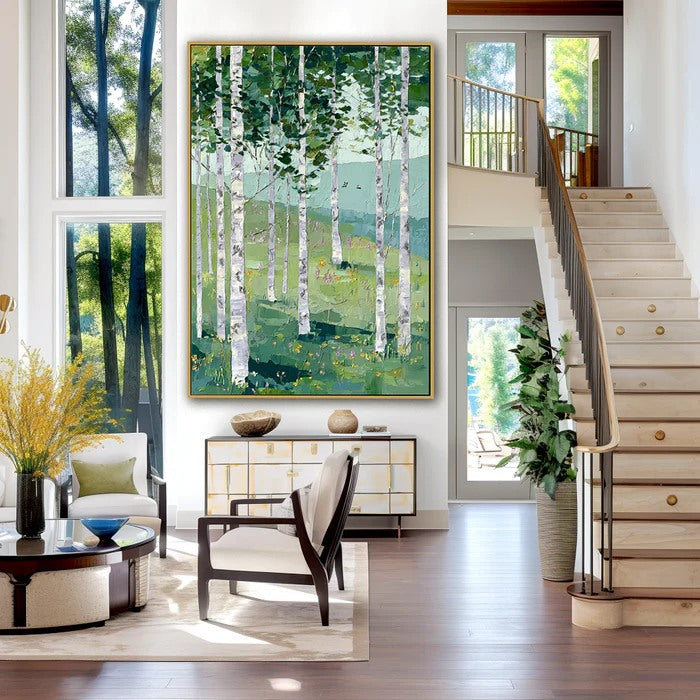
In 1883, the eruption of Krakatoa produced what is often described as the loudest ever noise, a blast so extreme it ruptured eardrums miles away and circled the planet multiple times. That event pushes us to a strange boundary: sound, as we normally experience it, has limits. Beyond a certain point, it stops behaving like “sound” at all. While your living room is not dealing with volcanic shockwaves, it is still shaped by smaller, constant collisions of sound energy. Understanding that shift—from planetary violence to everyday interiors—changes how you see walls, surfaces, and even art.
When sound stops being sound
The Krakatoa eruption is estimated at around , far beyond what the atmosphere can sustain as a typical sound wave. In physics terms, once sound pressure approaches about , the wave can no longer oscillate smoothly. It compresses air into a shockwave instead.
This matters because it reveals a core truth: sound is not just something we hear, it is physical pressure moving through space. At lower levels—conversation, music, footsteps—those pressure waves still behave predictably. They travel outward, hit surfaces, and reflect.
Inside a room, those reflections never stop. They bounce, overlap, cancel, and amplify. What feels like “noise” is often not volume alone, but how those waves interact with the surfaces around you.
The hidden noise problem in modern interiors
Ultra-modern spaces tend to look calm—clean lines, polished stone, glass, and large painted walls. Acoustically, they can behave the opposite way.
Flat, rigid surfaces reflect sound in a direct, almost mirror-like way. When a wave hits drywall or glass, it rebounds sharply, often returning along predictable angles. That creates:
-
Flutter echo between parallel walls
-
Harsh vocal reflections in open-plan spaces
-
A subtle sense of auditory fatigue even at moderate volume
These effects are especially noticeable in minimalist interiors where visual softness (like rugs or curtains) is limited. The room may look refined but feel slightly tense or “live” when you speak or play music.
Why flat walls amplify the problem
Sound waves “prefer” simplicity. A smooth wall gives them exactly that: a clean boundary to rebound from. The result is coherent reflection, where waves stay organized and reinforce each other.
In contrast, irregular surfaces disrupt that order. Instead of bouncing back in a single direction, the wave is broken into smaller fragments, each scattering at slightly different angles.
This is the principle behind acoustic diffusion used in concert halls and recording studios. But the idea itself is simple: complexity softens impact.
From volcanic force to living room physics
The same physics that explains the loudest sound in history also explains why your voice sounds sharper in an empty room. It is all about pressure, direction, and surface interaction.
In a residential setting, you are dealing with micro-versions of those forces. Not dangerous, but constant. Every conversation, every footstep, every piece of music generates waves that collide with your walls.
If those walls are uninterrupted and flat, the energy stays concentrated. If the surfaces introduce variation—depth, ridges, uneven planes—the energy disperses.
This is where material choice becomes more than visual.
Geometric deflection and the role of textured art
Heavily textured wall art introduces what can be described as geometric deflection. Instead of acting like a mirror, the surface behaves more like a landscape.
Raised ridges, palette-knife strokes, and layered gesso create micro-topography. When sound hits this kind of surface, it is redirected in multiple directions rather than reflected straight back.
The effect is not silence. It is a reduction in sharpness.
A flat print, even on canvas, remains largely acoustically inactive. Its surface is too smooth to meaningfully disrupt wave patterns. In contrast, hand-built texture—especially thick, sculptural compositions—adds physical complexity that subtly changes how a room feels.
If you want to see how this translates visually, you can browse our full gallery of hand-painted multi-dimensional art, where surface depth is not just aesthetic but structural.
Comparing flat surfaces and textured relief
The difference becomes clearer when you look at how each surface treats incoming sound energy.
Surface type | Wave behavior | Perceptual effect
---|---|---
Flat drywall or glass | Direct reflection | Sharper echoes, more buildup
Printed canvas | Slight absorption, mostly flat reflection | Minimal change from wall behavior
Lightly textured paint | Mild diffusion | Slight softening
Heavy textured art with relief | Multi-directional scattering | Reduced echo sharpness, more balanced sound field
The key distinction is not material alone, but geometry. Depth and irregularity drive the change.
Where this matters most in real spaces
The impact of acoustic reflection is not uniform across a home. It becomes more noticeable in certain layouts.
Open-concept living areas often struggle the most because sound travels freely and reflects off multiple large surfaces. A single large textured piece can break that chain reaction, especially when placed opposite seating areas or along long walls.
Dining spaces with hard flooring and minimal textiles can also benefit. Conversations become easier when reflections are less aggressive.
In private media rooms or gallery-style corridors, textured surfaces help prevent that hollow, overly bright acoustic feel that often accompanies minimal design.
A realistic limitation to understand
Textured wall art is not a substitute for full acoustic treatment. It will not eliminate noise or fully control reverberation in highly reflective spaces.
What it does offer is subtle correction. It reduces the intensity of reflections rather than removing them entirely. That distinction matters.
If a room has extreme echo due to large glass expanses or double-height ceilings, additional interventions may be needed. But in most residential settings, even modest geometric disruption can noticeably improve comfort.
When texture becomes part of architectural thinking
Once you understand sound as movement rather than just volume, walls stop being passive. They become active participants in how a space feels.
Textured art sits at an interesting intersection. It is visual, tactile, and spatial at the same time. In design-forward interiors, especially those that avoid clutter, it can carry more responsibility than decoration alone.
Artextured’s heavy palette-knife and impasto works align naturally with this idea. They introduce depth that interacts with both light and sound, making them relevant not just stylistically but spatially.
For readers interested in the deeper design logic behind this approach, you can view our technical architectural design journals, which explore how surface, light, and structure intersect in modern interiors.
Frequently Asked Questions
What is the loudest ever noise recorded on Earth?
The eruption of Krakatoa in 1883 is widely considered the loudest ever noise, estimated around . At that level, it functioned as a shockwave rather than a conventional sound.
Can sound really not exceed 194 dB in air?
Yes. Around , sound waves reach a physical limit in Earth’s atmosphere and transition into shockwaves, where air is compressed rather than oscillating normally.
Why do modern homes sometimes feel acoustically harsh?
Because they often use flat, hard materials like glass, stone, and drywall, which reflect sound directly instead of diffusing it, leading to sharper echoes and overlapping reflections.
Does textured wall art actually reduce noise?
It does not eliminate noise, but it can soften reflections by scattering sound waves in multiple directions, making a room feel less echo-prone and more balanced.
Is textured art better than printed canvas for acoustics?
From a physical standpoint, yes. Printed canvas remains relatively flat, while heavily textured, hand-built surfaces introduce depth that disrupts and diffuses sound more effectively.