
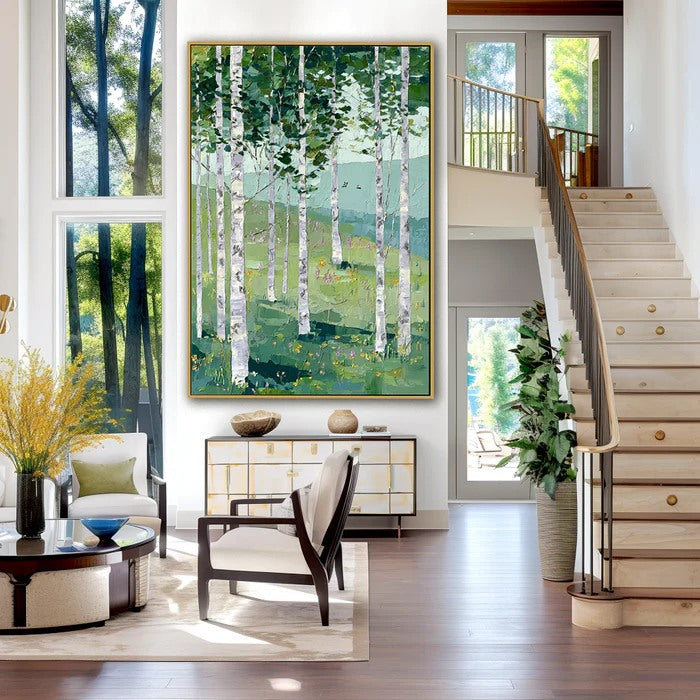
A large canvas black often worries buyers for one reason: it seems like it will swallow light and make a room feel smaller. That fear usually comes from experience with flat, printed black art that looks dull, reflective, or lifeless once it hits the wall. But a hand-painted, heavily textured black-on-black canvas behaves completely differently. Instead of absorbing the room, it interacts with it—catching light along raised ridges, shifting tone throughout the day, and creating depth where a blank wall once felt empty. In contemporary interiors, especially those built around contrast and restraint, this kind of artwork does not darken a space; it anchors it.
Why flat black fails and textured black succeeds
The difference is not subtle. A printed black surface is visually static—it reflects light evenly, often producing glare or a washed-out grey cast. There is no variation, no depth, and no reason for the eye to stay.
A hand-painted black canvas, especially one built with palette-knife impasto, introduces micro-architecture across the surface. Matte charcoals absorb light while slightly glossy ridges bounce it back. Deep graphite layers sit beneath sharper strokes, creating tonal shifts that are only visible when you move through the space.
In a high-end living room, a flat black print can look like a placeholder. A textured black painting, by contrast, behaves like a wall sculpture—its shadows changing from morning to evening, quietly altering the atmosphere without ever changing color.
This is why black, in this context, is not emptiness. It is controlled shadow.
The optical mechanics behind black impasto art
What makes black-on-black texture art feel luxurious is not just color—it is physics. Thick paint creates elevation. Elevation creates shadow lines. Shadow lines create contrast, even within a single color family.
When light hits a textured canvas:
-
Raised areas catch highlights.
-
Recessed areas deepen into near-matte darkness.
-
Edges between strokes become visible transitions rather than flat gradients.
This layered interaction is what gives a large monochrome wall canvas its presence. It reads differently from every angle, which keeps it visually active even in minimalist spaces where decoration is intentionally limited.
In rooms with polished concrete, black marble, or matte leather, this effect becomes even more pronounced. The painting does not compete—it echoes and amplifies the material language already in the space.
Styling a canvas black in real interiors
A black canvas only feels heavy when it is disconnected from its surroundings. When placed with intention, it becomes the visual center that organizes everything else.
In a high-contrast minimalist living room, a large canvas black works best when it spans a significant portion of the wall behind a low-profile sofa. The goal is not decoration but proportion. The artwork should feel architectural—wide enough to relate to the furniture, tall enough to hold the wall.
In a moody bedroom, the same approach becomes more intimate. A textured black piece above the bed replaces the need for multiple smaller elements. Soft textiles—linen, wool, or suede—balance the visual weight, while the painting adds depth without introducing color noise.
Executive spaces and boardrooms benefit from the authority of black-on-black work. Here, the artwork functions almost like a visual signature: restrained, confident, and deliberate.
For those exploring refined options, IrisLee Gallery’s black and white wall art collection offers examples where texture—not contrast—does the heavy lifting.
Finish decisions that quietly change everything
Not all black paintings feel the same, even when they share a monochrome palette. The finish determines how the artwork behaves in light and how it influences the room’s mood.
A matte charcoal base tends to feel grounded and soft. It absorbs excess brightness and works well in spaces that already have reflective materials like glass or polished stone.
Gloss-inflected obsidian highlights introduce sharper reflections. These are more dramatic and work best when you want the artwork to actively respond to lighting shifts.
Below is a simplified comparison to guide selection:
Framing also matters more than expected. A stretched canvas with a slim black floating frame creates a seamless edge that feels intentional rather than decorative, especially in ultra-modern spaces.
Lighting is what unlocks the artwork
Dark artwork does not reveal itself under ambient lighting alone. Without directional light, even the best textured surface can appear muted.
A simple but effective approach is to use warm 3000K LED spotlights angled toward the canvas. This creates controlled highlights across the raised paint, emphasizing depth without introducing harsh glare.
Placement matters:
-
A slightly angled overhead light will create downward shadow lines.
-
Dual side lighting can exaggerate texture for a more sculptural effect.
-
Avoid overly cool lighting, which can flatten the tonal richness of black surfaces.
This is one of the most overlooked reasons people feel disappointed with dark art—it is not the artwork, but the lighting that fails to activate it.
When black canvas becomes more than visual
In media rooms and home theaters, a canvas black can serve a dual purpose. Beyond aesthetics, heavily textured surfaces can subtly reduce echo by breaking up sound reflections, especially when integrated into acoustic art panel designs.
This makes black textured work particularly suitable for cinema-style spaces where both visual depth and sound control matter. The artwork blends into the environment while quietly improving how the room feels and sounds.
Where IrisLee Gallery fits into this decision
Not every buyer needs a black canvas, and not every room benefits from one. But when the goal is to create a space that feels intentional, minimal, and materially rich, hand-painted black work becomes one of the few elements that can carry that weight alone.
IrisLee Gallery focuses on textured, hand-painted canvases that emphasize surface depth rather than printed imagery. For buyers who are unsure about scale, palette balance, or how dark is “too dark,” custom painting options can help refine those variables before committing.
If a full black composition feels too heavy, transitional palettes can offer a softer entry point. The gallery’s grey textured hand-painted canvases explore that middle ground, where shadow and light begin to separate without losing the monochrome discipline.
The most common mistake with dark artwork
The biggest misstep is choosing a piece that is too small or too flat. A small black canvas reads as an afterthought, while a flat one reads as a void.
Scale and texture must work together. Large walls require substantial presence, and black requires dimensionality. Without both, the effect collapses.
A well-chosen canvas black does the opposite. It stabilizes the room, absorbs visual clutter, and introduces a quiet complexity that reveals itself over time.
Frequently Asked Questions
How do you style a large black-on-black textured canvas in a modern living room?
Start by matching the artwork’s width to the furniture beneath it, typically a sofa or console. Keep surrounding decor minimal so the texture remains the focal point, and use directional warm lighting to bring out surface depth.
Why does heavy texture matter for monochrome black artwork?
Texture creates light variation. Without it, black appears flat and uniform. With it, the surface develops highlights and shadows, giving the artwork movement and visual richness.
Will a black canvas make a room feel smaller?
Not when scaled correctly and paired with proper lighting. A large textured black piece can actually make a space feel more cohesive by anchoring the wall and reducing visual fragmentation.
Can a black acoustic art panel improve a media room?
Yes, textured surfaces can help diffuse sound reflections while maintaining a clean visual aesthetic. This makes them a practical choice for home theaters or entertainment spaces.
Is black-on-black art suitable for bedrooms?
It works especially well in bedrooms designed with a moody or calming palette. Choosing a softer matte finish and pairing it with warm lighting keeps the atmosphere restful rather than heavy.