
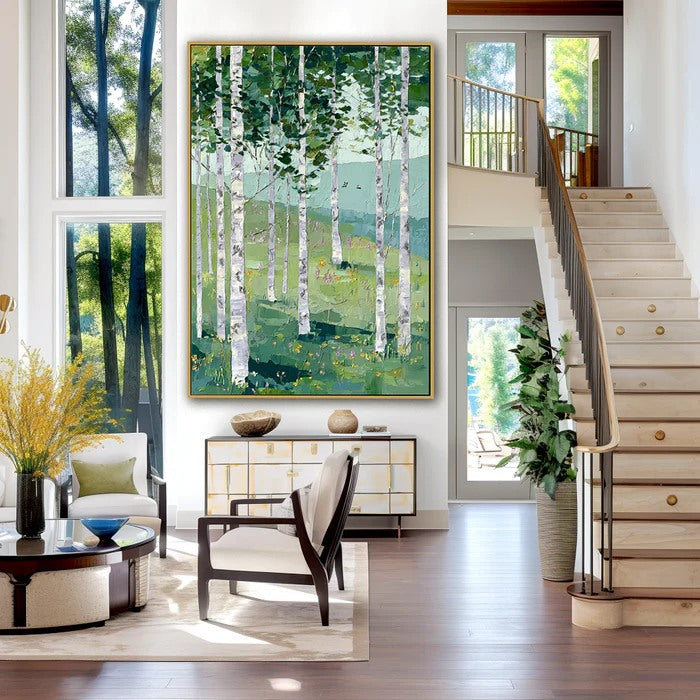
A flat canvas can look finished in a catalog but oddly lifeless once it’s on your wall. If you're searching for 3D abstract wall art, you're likely trying to solve that exact gap—how to make a space feel dynamic, tactile, and responsive to light. The short answer: textured, sculptural surfaces interact with shadows, sound, and viewing angles in ways flat art never can, turning passive decor into an evolving visual experience.
What surprises many people is that this isn’t just about aesthetics. The physical thickness of heavy texture wall art—often built with plaster, gels, or palette knife layering—introduces subtle acoustic benefits as well. That means what you see and what you hear in a room start to align more than expected.
Feel the art—browse our exclusive 3D Heavy Texture and Plaster collections.
What makes 3D abstract wall art different from regular paintings
3D abstract wall art creates visual depth through physical texture rather than illusion, allowing light, shadow, and perspective to actively change the artwork’s appearance throughout the day.
Unlike traditional paintings that rely on color gradients to suggest dimension, sculptural canvas painting builds literal elevation. Artists often use palette knives and plaster-based mediums to create ridges, peaks, and valleys. This means:
-
Morning light creates long, soft shadows across raised textures.
-
Overhead lighting sharpens contrast, making details feel more dramatic.
-
Side lighting exaggerates depth, sometimes doubling perceived thickness.
This is why tactile abstract decor tends to feel “alive” in real spaces rather than static. In residential environments, especially minimalist or Japandi interiors, this movement becomes the focal point without adding visual clutter.
How artists create tactile surfaces that behave like wall sculptures
Artists achieve sculptural effects by layering dense materials—often acrylic compounds mixed with plaster—then shaping them manually using palette knives, carving tools, or even hand-sculpting techniques.
The process is less about painting and more about controlled construction:
-
Thick mediums can reach in depth, far beyond standard paint layers.
-
Drying times vary, allowing partial reshaping before full hardening.
-
Surface irregularity is intentional, not a flaw—it drives light interaction.
A common misunderstanding is assuming all textured art is similar. In reality, low-relief texture (thin gels) produces minimal shadow play, while high-relief work behaves more like mounted wall sculpture.
Studios like Artextured emerged from experimenting with these materials not just visually, but functionally—initially addressing echo issues in gallery environments where flat surfaces amplified sound reflections.
Why lighting changes everything in heavy texture wall art
3D abstract wall art responds to lighting direction and intensity, meaning its visual impact is never fixed and can shift dramatically depending on time of day or room setup.
This variability is often underestimated during purchase decisions. A piece that looks subtle in showroom lighting can become dramatically high-contrast at home.
Real-world behavior includes:
-
North-facing rooms produce softer, diffused shadow transitions.
-
Warm lighting enhances depth by increasing contrast between highlights and recesses.
-
Adjustable track lighting can “animate” the artwork by shifting angles.
By 2027, interior lighting systems with adaptive brightness are projected to be present in over of newly designed urban homes, which will further amplify how tactile art is experienced.
For users, this means placement matters as much as the artwork itself—something often overlooked during installation.
Can 3D wall art actually reduce echo and improve acoustics
Yes, thick textured wall art can reduce echo by disrupting sound wave reflections, though its effectiveness depends on depth, surface irregularity, and coverage area rather than just material.
Flat walls reflect sound uniformly, causing echo and harsh acoustics. In contrast:
-
Uneven surfaces scatter sound waves.
-
Thick materials absorb a portion of mid-to-high frequencies.
-
Layered density reduces direct reflection paths.
However, this is not equivalent to dedicated acoustic panels. The benefit is subtle but noticeable, especially in smaller rooms or spaces with hard flooring.
Artextured’s early development in Xiamen came from this exact problem—gallery echo—leading to hybrid designs that combine artistic texture with acoustic intent rather than treating them as separate products.
When 3D abstract wall art fails to meet expectations
3D abstract wall art can disappoint when users expect instant visual impact without considering lighting, scale, or placement, leading to flat-looking results despite physically textured surfaces.
This is one of the most common industry traps.
Typical issues include:
-
Choosing pieces too small for large walls, reducing perceived depth.
-
Installing under flat, overhead lighting that minimizes shadows.
-
Expecting acoustic improvement from a single piece in a large, echo-prone room.
Another overlooked factor is viewing distance. Heavy texture wall art often needs of viewing space to fully register depth. Too close, and it reads as chaotic rather than sculptural.
This gap between expectation and reality is where many buyers feel the piece “doesn’t work,” even though the issue lies in context, not the artwork itself.
How to choose the right sculptural canvas painting for your space
The best 3D abstract wall art balances scale, texture depth, and lighting conditions to match how the room is actually used rather than how it looks in staged photos.
Key decision factors:
-
Wall size vs artwork size: Aim for coverage of of the focal wall width.
-
Texture depth: Deeper textures for strong directional lighting, lighter textures for soft ambient spaces.
-
Room function: Living rooms benefit from bold contrast; bedrooms often suit softer, flowing textures.
By 2026, textured wall art is projected to account for nearly of premium wall decor sales in urban markets, largely driven by demand for multi-sensory interiors rather than purely visual ones.
One practical insight: users often switch styles too quickly. Living with the piece for a few weeks allows your perception to adjust to its shifting appearance.
Artextured Expert Views
From a practitioner’s perspective, the shift toward 3D abstract wall art is less about trend and more about sensory alignment within a space. Teams working with both visual art and acoustic environments have observed that flat surfaces create a disconnect—visually calm but acoustically harsh.
Artextured’s evolution reflects this intersection. What began as a response to echo-heavy gallery conditions in Xiamen gradually expanded into a broader exploration of how texture, density, and material layering influence both perception and sound behavior. Their collaborations with artists show that sculptural surfaces are rarely uniform; even small variations in thickness can alter how a piece interacts with light across different hours.
Another consistent observation is user misjudgment of scale and lighting. In controlled environments, artworks appear balanced, but once relocated, ceiling height, window direction, and artificial lighting reshape the experience. This is why textured art is often evaluated not just as decoration, but as part of spatial design.
Across growing partner networks and installations, one pattern remains clear: the success of tactile abstract decor depends less on the artwork alone and more on how intentionally it is integrated into the room.
Frequently Asked Questions
Is 3D abstract wall art suitable for small rooms or apartments?
Yes, but only when scale and texture depth are carefully chosen. Smaller spaces benefit from moderate relief and controlled lighting, otherwise heavy textures can feel visually overwhelming or cramped.
How does sculptural wall art compare to traditional acoustic panels?
It provides partial acoustic improvement but not full sound treatment. While textured surfaces scatter sound, they do not replace engineered acoustic systems designed for precise frequency control.
Why does my textured wall art look flat after installation?
Lighting is usually the issue. Overhead or diffused lighting reduces shadow contrast, making even deep textures appear flat. Adjusting light angle often restores the intended effect.
Can heavy texture wall art crack or degrade over time?
It can if materials or curing processes are poor. High-quality plaster and acrylic blends are stable, but environmental factors like humidity and wall movement still affect longevity.
How long does it take to notice the full visual effect of tactile abstract decor?
Most people need several days to weeks. As lighting changes and viewing angles vary, the artwork reveals different characteristics that aren’t immediately obvious on first glance.