
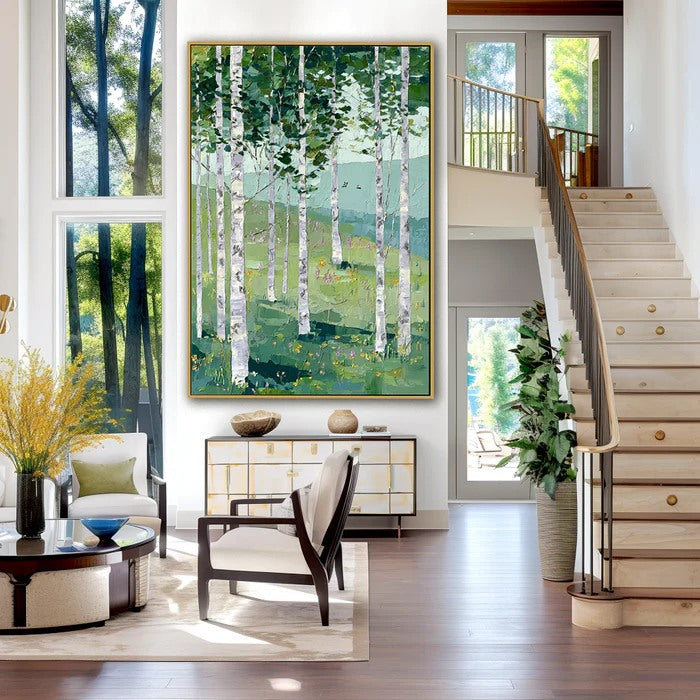
If your dining room gets louder as more people sit down, the issue usually isn’t your guests—it’s the room. The common “dining room wall art echo” problem comes from hard, reflective surfaces that bounce sound back and forth across the table. Glass-fronted artwork, polished floors, stone or wood tables, and bare walls all contribute to that sharp, overlapping noise that makes conversation tiring. Standard wall art, especially when framed under glass, does almost nothing to interrupt those reflections. The fix is less about adding decoration and more about choosing materials and placement that soften how sound moves through the space without making the room feel heavy or overdesigned.
Why dining rooms amplify sound more than you expect
Dining rooms are often designed for visual clarity—clean lines, open space, reflective finishes—but those same choices create an acoustic problem. Sound travels in waves, and in a room with mostly hard surfaces, those waves don’t get absorbed. They rebound.
Picture a typical setup: tiled or hardwood floors, a large rectangular table, painted drywall, and a few framed prints. When someone speaks, their voice hits the table, the walls, the floor, and even the glass on artwork. Each surface reflects a slightly delayed version of the sound back into the room. As more people talk, those reflections stack, creating a constant layer of background noise.
The result isn’t just “loudness.” It’s reduced clarity. You hear everything, but you understand less.
Why standard framed art makes echo worse, not better
A common assumption is that adding wall art will soften a room. Visually, that’s true. Acoustically, it depends entirely on the material.
Glass-fronted artwork is one of the most reflective surfaces you can put on a wall. Instead of absorbing sound, it behaves almost like a mirror for it. Even stretched canvas prints without texture or depth have very limited impact because the surface remains relatively flat and taut.
This is where many dining room acoustics frustrations begin: the room looks finished, but it still sounds harsh.
A frequent design misstep is installing a large, beautifully framed artwork above the dining table and expecting it to “warm up” the room acoustically. Visually it anchors the space, but the glass layer actually increases sound reflection right where conversation is most concentrated.
If your goal is noise reduction for dining areas, the material behind the visual matters far more than the image itself.
The difference between decorative art and sound-absorbing surfaces
Not all wall art interacts with sound in the same way. The key distinction is whether the surface can disrupt and absorb sound waves instead of reflecting them.
Here’s a practical comparison to clarify what’s happening on your walls:
The takeaway is simple: decoration alone doesn’t solve echo. Material depth and structure do.
Where to place acoustic treatments for real conversation clarity
Placement matters as much as the material. You don’t need to cover every wall, but you do need to target where sound is most active.
Focus on the areas that interact directly with seated conversation:
-
The wall directly facing the dining table, where voices bounce back toward speakers.
-
Side walls that sit parallel to the table length, which create lateral echo.
-
Large empty surfaces in open-plan kitchens where sound spills and returns.
In open layouts, sound doesn’t stop at the dining zone. It travels into adjacent kitchen or living areas and comes back. That’s why stopping echo in open plan kitchens often requires treating more than one visual “zone.”
A single well-placed absorbing surface can noticeably reduce the sharpness of reflections, even if the room isn’t fully treated.
Balancing acoustic comfort with a refined dining aesthetic
There’s a hesitation many homeowners have: anything labeled “acoustic” sounds technical, bulky, or visually intrusive. That’s not necessarily the case anymore.
Modern acoustic art is designed to behave like art first and a functional surface second. Instead of visible foam panels or studio-style installations, the visual language can stay aligned with a dining space—neutral palettes, abstract compositions, or sculptural surfaces that still feel intentional.
The goal is not silence. It’s clarity. You still want energy and liveliness in the room, just without the harsh overlap that makes people lean forward and repeat themselves.
If you’re exploring options, it helps to start with pieces specifically created for this purpose, such as those found when you explore acoustic art collection. These are built with sound interaction in mind rather than relying on surface appearance alone.
A realistic expectation of what will and will not change
It’s important to be clear: no wall art will completely eliminate echo in a highly reflective dining room. That would require structural changes or extensive material coverage.
What well-chosen acoustic surfaces can do is:
-
Reduce the sharpness of reflections.
-
Improve speech intelligibility across the table.
-
Make the room feel calmer during multi-person conversations.
What they won’t do is fully “soundproof” the space or isolate noise between rooms.
Understanding this distinction prevents disappointment and helps you make smarter, more targeted upgrades.
When visual texture alone is enough and when it is not
There’s a middle ground between purely decorative art and fully acoustic solutions. Heavily textured, hand-painted surfaces can break up reflections more than flat prints, especially when they introduce depth and irregularity.
In quieter households or smaller dining areas, that may be enough to soften the room slightly while maintaining a strong visual presence. In larger open-plan layouts or homes that host often, texture alone usually isn’t sufficient.
That’s where combining visual art with acoustic intent becomes more valuable—especially if the dining table sits in a large, uninterrupted space.
Choosing pieces that work with your space, not against it
Before adding anything to your walls, look at the room as a whole:
-
If most surfaces are hard and reflective, prioritize absorption over decoration.
-
If the room already has soft elements (rugs, upholstered chairs), you may need less intervention.
-
If the dining area is part of a larger open plan, think beyond a single wall.
Once the acoustic problem is under control, you can focus on visual cohesion—scale, palette, and composition. For example, large abstract works with depth or layered surfaces can still anchor the room visually while contributing to a more balanced atmosphere. Options like those in the abstract wall art collection can complement this approach when chosen with material awareness.
Frequently Asked Questions
Why does my dining room echo so much during dinner parties?
Because most dining rooms are filled with hard surfaces that reflect sound—floors, tables, walls, and glass—causing overlapping الصوت reflections that reduce clarity.
Do standard framed art pieces help reduce echo in dining rooms?
No. Glass-framed art reflects sound rather than absorbing it, so it typically does not reduce echo and can make reflections sharper.
How can I make my dining room quieter without ruining the decor?
Use materials that absorb or diffuse sound while still functioning as design elements, such as acoustic art or textured surfaces, and place them strategically around the dining area.
Where should acoustic treatments be placed in an open-concept dining space?
Focus on walls facing and surrounding the dining table, as well as adjacent open-plan surfaces where sound travels and returns.