
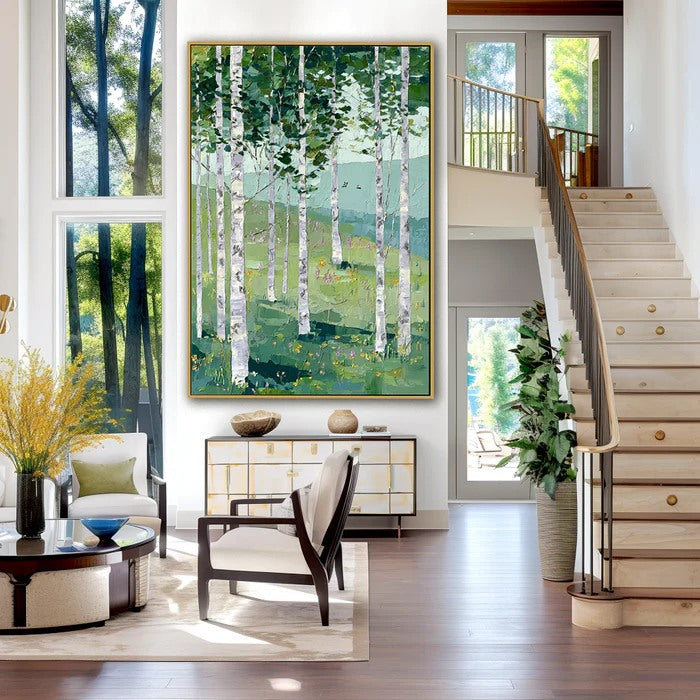
A large wall in a new-build living room can expose a quiet problem: the artwork looks expensive at first glance, then turns into a reflective sheet that catches every downlight and window glare. If your goal is to buy original art online safely, the core decision is not price or trend—it is material truth. Hand-painted 3D textured canvases behave like part of the architecture, absorbing and shaping light. Flat digital prints, especially on PVC or low-grade polyester canvas, tend to read as glossy surfaces that sag, yellow, and visually thin out over time. The difference shows up within months, not years, and it determines whether your wall gains depth or becomes a mirror.
The cheap poster trap on high-end walls
In high-spec interiors—stone floors, limewash walls, matte cabinetry—a flat print under glass or with a slick coating can feel out of place. The surface reflects like a window, doubling light sources and fragmenting the composition. This is why even well-chosen images can look “noisy” once installed.
The issue is structural. Machine-printed canvases rely on inks bonded to synthetic fabric; under daylight exposure, the surface can shift in tone while the canvas relaxes, creating slight ripples. Those ripples catch light inconsistently, so the image loses clarity at an angle. In contrast, a true hand-painted surface builds relief. Instead of bouncing light back at you, it breaks light into soft gradients, which keeps the wall calm even under strong spotlights.
Tactile gravity and why it changes the room
Designers often describe certain artworks as having presence. With textured painting, that presence comes from what can be called tactile gravity—the sense that the surface has weight, like plaster or stone, rather than sitting on top of the wall.
In monochromatic textured art or a white abstract canvas wall art piece, this effect is amplified. Without color contrast doing the work, the eye reads shadow depth, edge softness, and the spacing between raised ridges. When mineral aggregates and gesso are layered and hand-shaped, the surface can hold micro-shadows that stay visible from across the room. That is why a simple textured canvas can anchor a double-height space without relying on bold color.
Material build determines lifespan
A quick comparison clarifies why some pieces age quietly while others deteriorate:
For buyers commissioning custom large scale art, these differences become more visible as size increases. A three-meter-wide print magnifies every surface flaw; a three-meter textured painting amplifies depth.
The lighting dividends rule
A useful way to judge value is to watch how a piece behaves across a day. Textured canvases pay “lighting dividends”: they change character as the light moves.
Morning side light grazes the ridges, revealing fine lines. Midday flattens the relief slightly, making the composition feel quieter. Evening track lighting reintroduces contrast, carving deeper shadows. The result is not a different artwork, but a different reading of the same surface—something a flat print cannot replicate because its depth is simulated, not physical.
A practical way to buy original art online safely
When you cannot touch the surface in person, verification matters. Use this tactile inspection checklist before committing:
-
Ask for close-up video under raking light (light from the side) to reveal real surface height, not printed texture.
-
Check edge finishing; hand-painted works typically continue texture over the sides rather than stopping at a clean printed boundary.
-
Look for variation in ridge height and irregular transitions; perfectly uniform “texture” often indicates a print effect.
-
Confirm the support; a stable, kiln-dried wood stretcher is less likely to warp in climate-controlled homes.
-
Request pre-shipment imagery of the exact piece, not a mockup, to verify scale and surface behavior.
-
Review packaging approach; rigid, protective crating reduces risk of compression damage to raised areas.
This process filters out most mass-produced pieces and aligns expectations before the artwork arrives.
Where oversized textured canvases make sense
Large, minimal compositions work best where furniture is low and the wall has room to breathe: behind a sectional, along a stair landing, or on a dining wall with controlled spotlighting. In tighter corridors, heavy relief can feel busy at close range; a calmer, lower-relief surface reads better at one to two meters viewing distance.
For neutral interiors, monochromatic textured art avoids color conflict while still delivering visual weight. In more expressive rooms, deeper relief can carry subtle tonal shifts without introducing additional hues.
A grounded look at Artextured’s approach
For buyers comparing sources, Artextured focuses on hand-painted 3D canvases built with layered mineral mixtures and slow curing, then mounted on kiln-dried wood stretchers. The aim is structural stability and consistent surface relief rather than a printed illusion. You can browse our complete portfolio of authentic hand-painted 3D canvases to see how different levels of texture read at scale.
Their workflow emphasizes made-to-order sizing for large walls and a protective wood packaging system to safeguard raised surfaces in transit. The tradeoff is time: artisan production and curing are slower than print-on-demand, so planning ahead matters for project timelines.
When textured originals are not the right choice
Texture is not universally better. In very narrow spaces, high relief can crowd the eye. In rooms with already complex materials—heavy veining, patterned stone, or busy textiles—additional surface activity may compete rather than complement. And if you prefer a crisp photographic image or typography, a print serves that intent more directly.
Moving from comparison to specification
If your priority is a calm, non-reflective focal point that grows more interesting under changing light, a hand-painted textured canvas is the safer long-term decision. It avoids the glare and surface fatigue common to synthetic prints and integrates with architectural materials instead of sitting on top of them.
For projects that require consistent sizing across multiple rooms or coordination with architectural plans, consider engaging through a structured procurement path; Artextured offers options to join our exclusive architect and interior designer trade program, which can simplify specification for larger developments.
Frequently Asked Questions
What makes real hand-painted 3D abstract art a better investment than flat canvas prints?
It performs better over time and under light: real surface relief diffuses glare, maintains structure, and creates depth that a printed image cannot replicate.
How can I safely buy original large-scale textured artwork online without getting a cheap print?
Verify with close-up videos under side lighting, inspect edge continuity, confirm stretcher quality, and request images of the exact piece prior to shipment.
Will a white or monochromatic textured piece look too plain?
Not if the relief is well built; shadow and highlight carry the composition, so the work remains visually active without relying on color.
Do large textured canvases work in dining rooms with spotlights?
Yes, when the surface is matte and the lighting is angled; the texture softens reflections and creates controlled shadow rather than glare.