
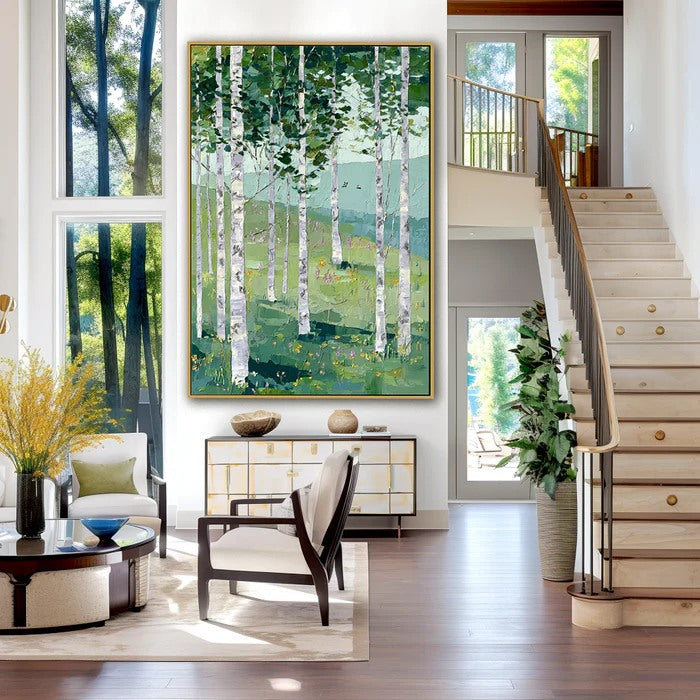
Luxury textured wall art light interaction is what turns a wall piece from a static object into something that feels present in the room. The surface stops behaving like a flat image and starts reading like a shallow sculpture, with raised paint ridges, soft shadow lines, and changes in tone that shift from morning to evening. That is the real difference between a textured canvas and a smooth print: one reflects light uniformly, while the other breaks it up and lets the room change how the art is seen throughout the day.
Light is what reveals the work
A textured canvas only shows its full character when light reaches it at an angle. The raised areas catch brightness first, while the recessed parts hold shadow, which is why the same piece can look quieter in one setting and far more dimensional in another. That contrast is especially important in luxury interiors, where materials like plaster, stone, linen, and timber already depend on surface variation to feel complete.
This is also why flat posters often disappear in refined spaces. They may carry the right color, but they do not interact with daylight in a meaningful way. Luxury abstract wall decor with sculptural relief has a different job: it adds visual weight, softness, and motion without needing movement in the literal sense.
If you are comparing ready-made pieces and more tactile work, it helps to start with a collection built around surface depth, such as Artextured’s abstract art collection. In that context, the art is not only about the subject. It is about how the surface behaves when the room changes around it.
Morning, afternoon, evening
Natural daylight changes the reading of impasto painting light dynamics more than many buyers expect. In the morning, lower-angle light can sharpen the relief and make edges feel crisp. By afternoon, especially in brighter rooms, the same artwork may look smoother and more even because the light is more direct and less directional.
Evening is often when the texture feels richest. Warmer lamps and softer ambient light create longer shadow lines, which can make sculptural wall art depth feel more architectural and grounded. If a room is meant to feel calm after dark, that warmer, shadowed quality is often the most flattering version of heavily textured work.
A useful way to judge a piece online is to imagine where the light comes from, not just what the art looks like in a product photo. A wall that faces a bright window behaves differently from one lit mainly by lamps or ceiling washers. The artwork itself may not change, but the visual effect absolutely will.
How to light textured work well
Textured canvas art lighting works best when it is intentional rather than overpowering. Picture lights can be effective for smaller or more focused compositions because they create a direct wash across the surface. Track lighting offers more flexibility in open-plan rooms, especially when the art is part of a larger wall composition or positioned over furniture.
Indirect architectural washers are often the quietest solution in contemporary interiors. They allow the art to read softly, without creating harsh hotspots on the high points of the texture. For deeply sculpted canvases, that softer approach usually looks more refined than a strong frontal beam, which can flatten detail or make the surface feel overexposed.
If the art sits directly opposite a window, the strongest daylight may create glare on some surfaces and reduce the visibility of the relief. In that case, slightly shifting the placement or choosing a more controlled light source often improves the piece more than changing the artwork itself.
Why depth feels different from print
The difference between 3D canvas art and a flat print is not just visual complexity. It is the physical way the surface receives light. A print can suggest texture through image alone, but it cannot cast the subtle shadows that make a room feel more layered and grounded.
That is why people often notice hand-painted relief more quickly in person than on a screen. Online, the piece may read as calm or neutral. In the room, once side light begins to skim across the surface, it becomes clear that the work is changing throughout the day. That is the quality many buyers want when they choose a premium piece for a living room, entryway, or primary wall.
For minimalist interiors especially, that difference matters. A smooth image can feel decorative, but a textured surface gives the wall a physical presence that matches the material honesty of the space around it.
Where it fits best
Luxury textured wall art light interaction is most compelling in rooms with layered finishes and controlled lighting. Contemporary living rooms, dining spaces, bedrooms with soft side light, and entryways with a clear focal wall are all strong candidates. These settings let the texture breathe instead of competing with clutter or overly bright, uneven light.
The cleanest pairings are usually with restrained interiors. Minimalist rooms, warm modern schemes, and contemporary spaces with neutral upholstery often allow the relief to stand out without feeling busy. The art can then act as the room’s tactile counterweight, especially when the rest of the scheme relies on smooth surfaces.
When heavy texture is not the right choice
Deep impasto and heavily sculpted finishes are not ideal everywhere. If a wall gets direct glare all day, some of the finer relief can be hard to read. In a very narrow hallway or a cramped room with little viewing distance, the same amount of texture may feel visually dense rather than elegant.
This is where buyers sometimes overestimate what “more texture” will solve. If the room is already busy, a flatter surface or a quieter composition may work better. The goal is not to force dimension onto every wall. It is to choose the amount of surface activity that the room can actually support.
That judgment matters even more with luxury abstract wall decor, because the piece is usually meant to feel intentional rather than loud. A well-chosen textured canvas should add atmosphere, not strain the eye.
A better fit for tactile interiors
If your space already includes stone, limewash, plaster, boucle, linen, matte paint, or other tactile finishes, textured canvas art often feels more resolved than a smooth print. It continues the same material conversation instead of stopping it. That is one reason hand-painted 3D work can feel especially convincing in modern interiors that depend on quiet detail rather than ornament.
Artextured fits naturally in that setting because the work is designed around physical surface depth, not printed imitation. For readers who want to explore a broader range of abstract compositions and texture-forward pieces, the trade and project services path can also be useful when the wall size, room layout, or finish selection needs a more tailored approach.
Frequently Asked Questions
What is the best way to light textured wall art in a modern living room?
The best approach is usually indirect lighting or a softly aimed picture light that skims the surface without creating glare.
Why does heavy impasto art create shadow play that flat prints lack?
Because the raised paint physically blocks and catches light, which creates real shadows that change with the viewing angle and time of day.