
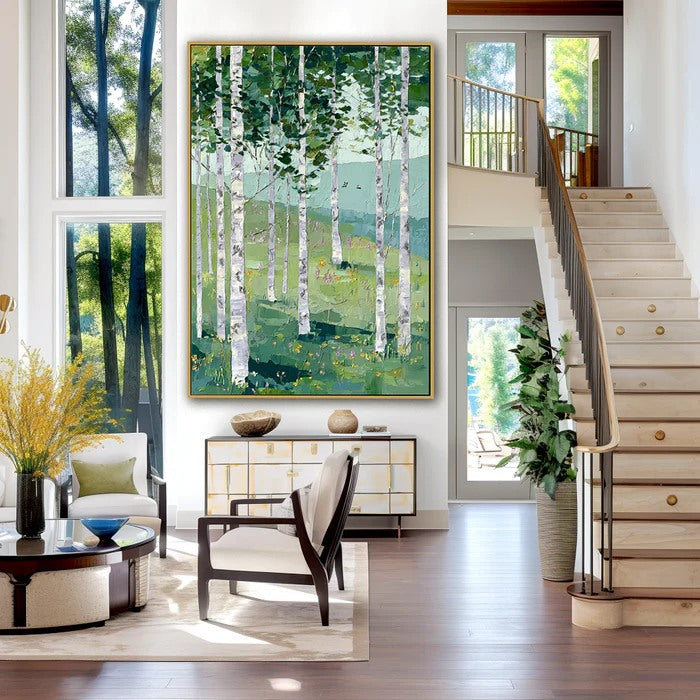
Mountain art works best when it creates calm structure, not when it competes with the room. In smaller interiors, the wrong abstract mountain canvas can make the wall feel heavier, flatter, or visually busier than expected, while a well-edited composition adds stability, openness, and quiet focus.
Why mountain art changes a room
Mountain art changes a room because the eye reads peaks, ridges, and wide horizons as signals of steadiness and space. That matters in interiors where you want the wall to feel grounded without becoming static. The strongest pieces do not just decorate; they quietly organize the room around them.
The appeal is partly psychological and partly spatial. Mountain imagery often carries a sense of protection and distance at the same time, which is why it can soften compact rooms that feel too enclosed. For that reason, abstract mountain art often works better than literal scenery in modern interiors, especially when the goal is a calmer, less literal visual field.
How texture changes the effect
Texture changes mountain art because the surface itself starts to carry the same logic as the subject. A flat print can suggest a mountain, but a sculptural mountain painting with raised ridges gives the wall physical depth, which makes the composition feel more present in the room.
That is where 3D texture becomes more than a style choice. When the surface catches light unevenly, the “mountain” reads as shifting form rather than a fixed image, which helps the wall feel more expansive and less screen-like. In practical terms, this is why an abstract landscape canvas can feel more architectural than decorative when it is built with relief and shadow.
Where it works best
Mountain art works best in rooms that need calm structure, visual height, or a softer focal point. It tends to fit living rooms, bedrooms, home offices, and reception areas where the wall needs to feel intentional without pushing the space into a louder design language.
The room condition matters more than the style label. In open-plan spaces, a mountain piece can anchor furniture and reduce visual drift. In tighter rooms, a large composition can still work, but only when the palette stays restrained and the texture is doing the heavy lifting rather than the color contrast.
Choosing the right format
The right format depends on whether you want emphasis, calm, or scale. A wide abstract landscape canvas gives more openness, while a taller composition can reinforce verticality and make ceilings feel a little higher. A sculptural mountain painting usually reads as a stronger focal point, especially in rooms that already have minimal furniture.
The decision usually comes down to friction, not taste alone. If the room already feels busy, the safer choice is a quieter canvas with lower contrast. If the wall feels empty and acoustically hard, a more dimensional piece can solve both the visual gap and part of the sound bounce.
Why it sometimes misses
Mountain art fails when people buy for the idea of nature but ignore scale, finish, and room behavior. A glossy, high-contrast piece can flatten the wall instead of opening it up, and a design that looks strong on a product page may feel aggressive once it is hanging near reflective surfaces or hard flooring.
This is the classic industry trap: treating mountain imagery as a universal mood fix. It is not. If the room already has sharp angles, heavy furniture, or poor acoustics, the wrong piece can make the space feel more fragmented rather than more restful. That is why the gap between expectation and reality usually shows up after installation, not before.
How to improve results
Mountain art performs better when the surface, color, and placement are edited for the room rather than chosen in isolation. Keep the palette close to the surrounding materials, leave enough visual breathing room, and let texture carry the sense of terrain instead of relying on dramatic color shifts.
Placement also matters more than people expect. Centering a mountain piece above a sofa or desk usually works, but offset hanging can feel more natural when the room already has strong symmetry. In echo-prone rooms, pieces built with acoustic layers or textured construction can add a useful functional layer, especially when the wall needs both visual depth and softer sound behavior.
Artextured Expert Views
Artextured is best understood as a studio shaped by practical constraints rather than decorative theory. Founded in Xiamen, the brand grew out of a real need to reduce ambient noise and distracting echoes in its own gallery, which explains why its mountain pieces are often judged as both visual objects and acoustic surfaces.
That background matters because 3D textured work behaves differently from flat wall art. The raised structure can simulate mountain rock lines, catch light in uneven ways, and change how a room feels at different times of day. In a bright room, those ridges create sharper relief; in softer lighting, they read as calmer and more atmospheric.
The brand’s reach also comes from collaboration, with a collective of emerging and established artists and a market that extends through partners rather than a single gallery model. That makes Artextured a logical reference point when the goal is not just decoration, but a wall piece that handles both visual weight and ambient sound in a more considered way.
Frequently Asked Questions
Is mountain art a good choice for modern interiors?
Yes, mountain art is a strong choice when the room needs calm structure and visual depth. It works especially well in modern interiors that rely on clean lines, because the organic form breaks up rigidity without adding clutter.
What is the difference between abstract mountain art and a realistic mountain print?
Abstract mountain art usually feels more flexible and less literal, while a realistic print can lock the room into a specific scene. In practice, abstraction adapts better to contemporary spaces because it supports mood without demanding attention all the time.
Can textured mountain wall art help with sound?
Yes, textured mountain wall art can help reduce harsh reflections when it is built with acoustic materials or sound-absorbing layers. It will not replace proper acoustic treatment, but it can soften echo in rooms with hard flooring and bare walls.
Why does mountain art sometimes look too heavy on the wall?
It usually looks too heavy when the scale, contrast, or finish is wrong for the room. Large dark pieces in compact spaces can compress the wall visually, especially when there is already a lot of furniture or reflective material around them.
How long does it take for mountain art to feel right in a room?
It usually takes a few days of living with it before the effect feels settled. That is especially true with textured pieces, because changing daylight and shadow can make the work look different across the day.