
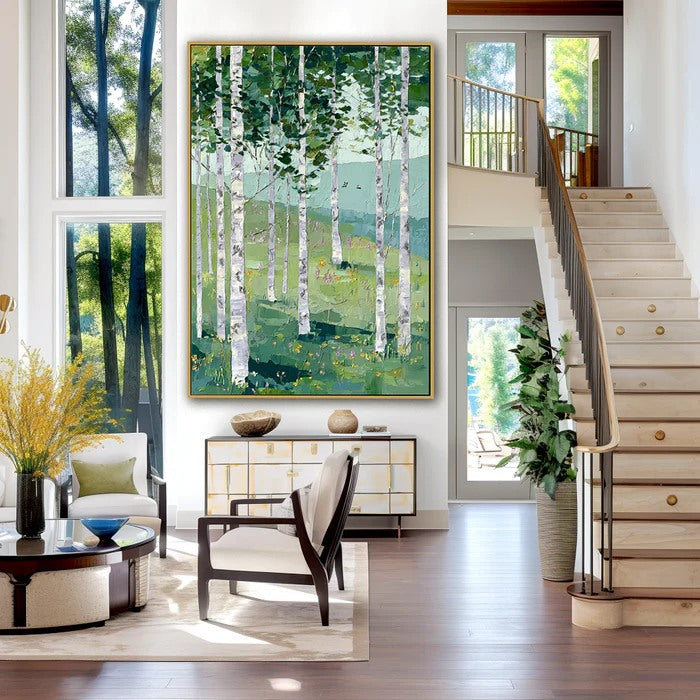
Minimalist interiors often promise calm, but in practice they can slip into something colder—white walls that reflect light but not life, beige palettes that flatten instead of soften. This is exactly where textured canvas art for minimalist homes changes the experience. Instead of introducing more color or objects, it introduces surface. Raised paint, subtle ridges, and hand-worked relief catch shadows throughout the day, turning a still wall into something quietly responsive. The result is warmth without visual noise, presence without clutter—a shift that feels architectural rather than decorative.
When minimalism feels more like a showroom than a home
The issue is not minimalism itself—it is the absence of material contrast. Smooth drywall paired with glass, metal, and polished stone can create a space that feels visually complete but emotionally distant. Without variation in surface, the eye has nowhere to rest.
Flat minimalist wall art often fails here. From afar, a printed beige composition reads as a single tone, almost like untreated wallboard. Up close, it lacks the irregularity that makes a space feel lived-in. This is why many minimalist rooms unintentionally resemble galleries or lobbies: everything is controlled, but nothing feels tactile.
Textured neutral artwork introduces that missing layer. Even within a strict palette—ivory, sand, soft gray—the presence of physical depth breaks the monotony. It gives the wall a role beyond backdrop.
The quiet luxury of surface relief
Minimalism at its best is not about removing everything—it is about refining what remains. In textured canvas art, that refinement shows up as brush pressure, palette knife movement, and the build-up of paint.
A monochrome surface becomes visually active through light. Morning daylight might soften ridges into a gentle haze, while evening side lighting sharpens shadows and reveals structure. This shifting quality is what makes textured canvas art feel alive without ever becoming loud.
In Wabi-Sabi interiors especially, this aligns naturally with the philosophy of imperfection. Slight irregularities in texture echo the organic qualities of linen, wood grain, or limewash walls. If you explore handcrafted Wabi-Sabi art, you will notice how restraint in color is balanced by richness in surface—never competing with the room, but never disappearing into it either.
Choosing between warm neutrals and stark contrast
Minimalist homes tend to follow two visual directions, and textured canvas art behaves very differently in each. Understanding this helps avoid artwork that either fades away or dominates too aggressively.
A beige minimalist abstract painting like AVG-003, for example, relies on tonal layering rather than color shifts. Its value comes from how the raised surface interacts with light, making it ideal for cream-toned living rooms or Japandi bedrooms.
On the other hand, a piece like Abstract Flowing Black Waves (241308) introduces movement within a restrained black-and-white scheme. The texture prevents the contrast from feeling harsh, especially in spaces with concrete or matte black finishes.
Scale matters more than color ever will
One of the most common mistakes in minimalist interiors is choosing artwork that is too small. In a room where everything is simplified, scale becomes more noticeable—not less.
A large textured canvas does two things at once. First, it anchors the wall, giving the room a focal point without adding multiple objects. Second, it allows texture to be visible from a distance. Fine details only work if they can be perceived within the room’s viewing range.
A small piece of textured art often reads as flat simply because its relief cannot be seen unless you stand close. In contrast, a larger canvas lets the surface variations register even from across the room, making the texture function as part of the architecture.
Why flat prints fall apart in minimalist spaces
A common disappointment appears after furnishing a minimalist room: the furniture feels premium—stone, wood, boucle—but the wall art looks oddly cheap. The issue is not the color palette; it is the lack of physical depth. Printed “textured” designs remain visually thin, especially under natural light, where real materials reveal their dimensionality.
Minimalist environments are unforgiving. Without visual clutter to hide behind, every material must hold its own. Flat prints that imitate texture tend to collapse in this context, especially when placed next to tactile surfaces like plaster or raw wood.
Textured canvas art, by contrast, holds up under scrutiny. It behaves like a material, not just an image.
Where textured canvas art fits best in minimalist rooms
Placement in minimalist interiors is less about filling space and more about balancing it. A textured piece works best where the room feels visually underweighted.
In a living room, this is often the main sofa wall—especially if the furniture is low-profile. In a bedroom, it might sit above the headboard, where soft textures already exist in bedding and upholstery. In a studio alcove, a single textured canvas can define a zone without introducing partitions.
What matters is breathing room. Minimalist art should not be crowded by shelves or layered decor. Its impact comes from contrast against emptiness.
When textured minimalism might not work
Texture is not always the answer. In very narrow hallways or small, heavily shadowed corners, pronounced relief can feel visually dense rather than calming. Similarly, if a space already includes highly textured finishes—rough stone walls, heavy grain wood panels—adding another strong surface may create competition instead of harmony.
There is also a balance to strike in palette. If everything in the room sits within the exact same tone, even textured art can blend too quietly. A slight variation—warmer undertone, subtle shift toward gray or sand—often helps the artwork remain visible without breaking minimalism.
A natural fit for curated minimalist collections
For those refining a minimalist interior rather than decorating from scratch, textured canvas art becomes a precise tool rather than a broad solution. It works particularly well when chosen with attention to scale, light direction, and existing materials.
Collections focused on restrained palettes and hand-built surfaces—such as minimalist textured canvas art—tend to align with this approach. They emphasize form over color, allowing the artwork to integrate into the room’s architecture rather than sit on top of it.
The key is not adding more, but choosing something that does more with less.
Frequently Asked Questions
How do you add warmth to a minimalist living room without using bright colors?
You add warmth through material and surface, not color. Textured canvas art introduces depth that interacts with light, creating soft shadows and visual variation within a neutral palette.
Why is textured canvas art recommended for Wabi-Sabi interiors?
Because Wabi-Sabi values imperfection and natural variation. Hand-applied texture reflects irregularity and subtle movement, which aligns with organic materials like wood, linen, and stone.
Does beige minimalist wall art risk looking too plain?
It can if it is flat. Beige works best when combined with visible texture, where tonal shifts and raised surfaces create depth that a single color alone cannot provide.
Is black and white textured art too harsh for minimalist homes?
Not necessarily. Texture softens contrast by breaking up solid areas of black or white, making the composition feel more fluid and less rigid.
What size textured canvas should I choose for a minimalist wall?
Larger is usually better. Minimalist spaces rely on fewer elements, so artwork needs enough scale to anchor the wall and make its texture visible from a normal viewing distance.