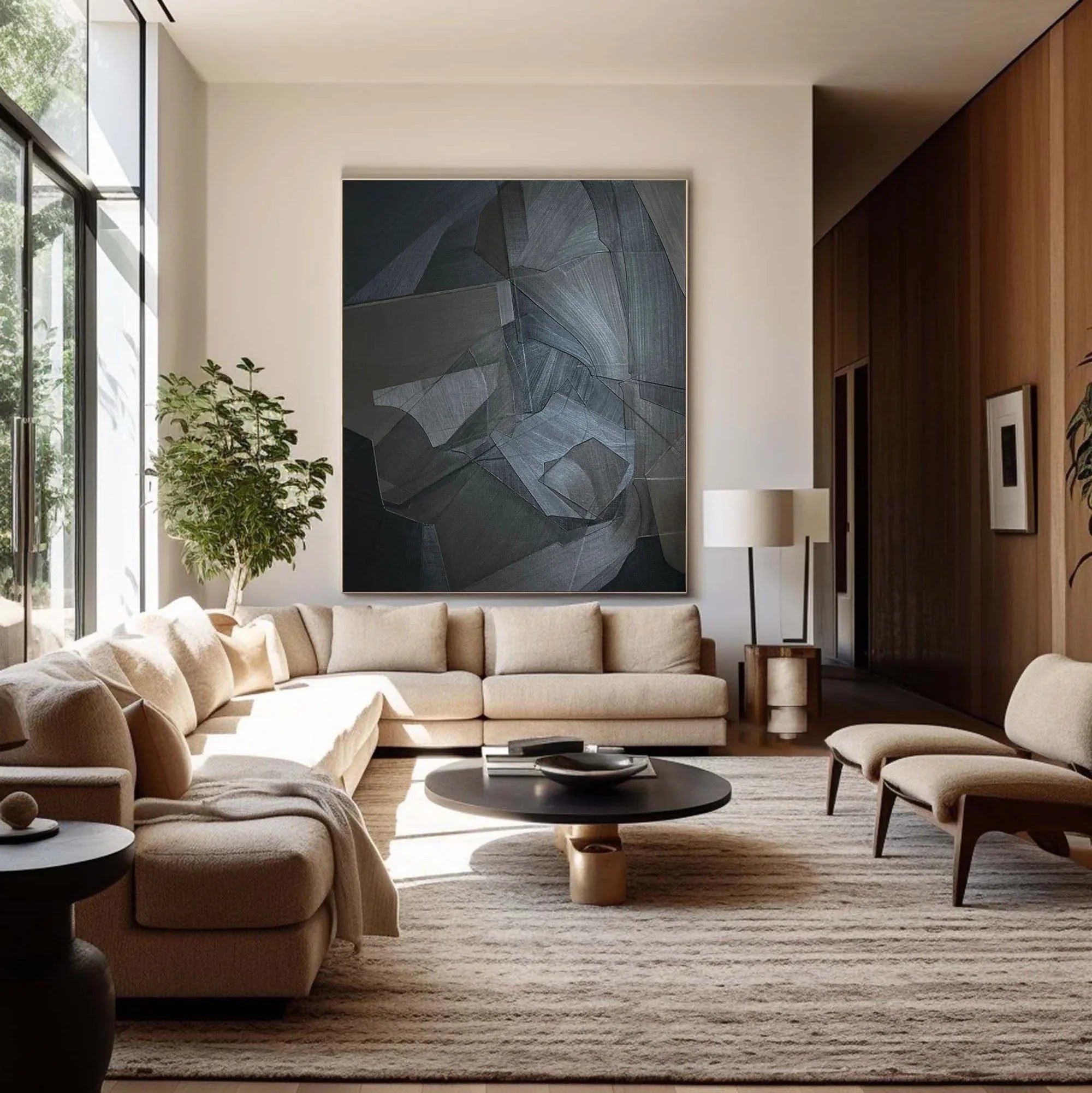
Dark academia decor thrives on the tension between intellectual depth and sensory calm, yet the very libraries and studies that define this aesthetic often suffer from harsh acoustic reflections that disrupt concentration. The solution lies in integrating sculptural canvas art with deep impasto textures, which serves as both a visual anchor for the scholarly atmosphere and a functional sound-dampening element. By selecting pieces featuring rich charcoal, vintage obsidian, and caramel tones with irregular rock-like surfaces, designers can capture the warm glow of task lighting while simultaneously reducing mid-to-high frequency flutter echoes that plague rooms filled with hard bookshelves and polished wood. This approach transforms a cluttered study into a true literary sanctuary where the visual richness of gothic library wall art coexists with the acoustic serenity required for deep reading and writing.
The Acoustic Paradox of the Scholarly Study
The quintessential dark academia room is a visual masterpiece: floor-to-ceiling bookshelves, heavy velvet drapes, dark wood desks, and the warm, flickering light of brass lamps. However, from an acoustic perspective, these spaces are often nightmares. The sheer volume of hard surfaces—leather-bound books, glass display cases, polished wooden floors, and plaster walls—creates a highly reflective environment. Sound waves bounce rapidly between parallel bookshelves, generating a specific type of noise known as "flutter echo." This rapid repetition of sound degrades speech clarity and creates a subtle, persistent background hum that fatigues the brain during long sessions of reading or writing.
Traditional soundproofing solutions like industrial foam panels or fiberglass batts are aesthetically unacceptable in this context. They clashes violently with the gothic and vintage academic room aesthetic, turning a dignified study into something resembling a recording booth or a basement utility room. The challenge for the discerning designer is to introduce sound absorption without compromising the historical integrity or the moody, sophisticated visual language of the space. The answer is found in the materiality of the art itself. Heavy, hand-applied textures do not just hang on the wall; they disrupt sound wave patterns, breaking up the energy of reflections before they can bounce back into the room with full force.
How Impasto Texture Creates Visual and Acoustic Depth
The defining characteristic of the perfect dark academia artwork is its physical depth. Unlike flat prints or smooth canvas paintings, works featuring heavy impasto technique possess an irregular, three-dimensional surface that mimics natural rock formations or weathered stone. This topography is critical for two reasons. Visually, the deep valleys and high peaks of the texture catch light from multiple angles. In a room with limited natural light, where a single desk lamp or a few sconces provide the primary illumination, these textured surfaces create dynamic shadows that shift as the light changes. This adds a layer of living drama to the wall, making the art feel like a carved artifact rather than a printed image .
Acoustically, this same irregularity is a powerful tool. When a sound wave hits a flat, hard surface, it reflects at a predictable angle, contributing to the room's echo. When it hits a surface with deep, random variations—such as the thick layers of paint in a sculptural canvas—the wave scatters in multiple directions. This scattering effect, known as diffusion, reduces the intensity of the reflection. Furthermore, the porous nature of the canvas and the air pockets trapped within the thick paint layers allow some sound energy to penetrate the surface, where it is converted into a tiny amount of heat through friction. This dual action of diffusion and absorption helps to soften the harsh acoustic environment of a study without the need for bulky, visible soundproofing equipment.
The Color Palette of Silence
The color scheme of dark academia is not merely an aesthetic choice; it sets the psychological tone for the space. The most effective acoustic artworks for this style utilize a specific palette of deep, light-absorbing hues that mirror the visual weight of the room's function.
This combination ensures that the artwork does not fight against the room's lighting but rather enhances the intimate, enclosed feeling essential to the dark academia vibe. The dark tones absorb excess light, preventing the "cave" effect from feeling too cold, while the warm accents keep the space inviting rather than oppressive .
Curating the Literary Sanctuary with Sculptural Canvas
Selecting the right piece for a dark academia study requires looking beyond the image and considering the physical presence of the artwork. The goal is to find a piece that acts as an "invisible sound barrier," seamlessly blending into the decor while performing the critical function of noise reduction. Large-scale sculptural canvas art is particularly effective because it covers a significant portion of the reflective wall surface. A single small frame will do little to tame the echo of a room lined with bookshelves; the treatment must be substantial enough to interrupt the sound path.
When evaluating potential pieces, look for works that explicitly mention "thick堆" (thick stacking) or "heavy body" application. The texture should be palpable, even from a distance. The surface should feel like a landscape, with ridges and troughs that suggest geological time. This is where the concept of "deep charcoal textured canvas" becomes more than a keyword; it describes a specific material reality that dictates the room's acoustic performance. The artwork should feel like it belongs in a gothic library, perhaps resembling a fragment of a ruined cathedral wall or a close-up of a weathered manuscript binding.
Artextured, an artist collective founded in Xiamen, has pioneered this intersection of fine art and acoustic function. Their approach began with a real-world problem in their own urban gallery: how to reduce ambient noise and distracting flutter echoes without compromising the visual purity of the exhibition space. The result is a collection of acoustic wall art that ranges from subtle minimalist textures to bold, expressive abstract designs, all engineered to merge aesthetic beauty with hidden sound-absorbing technology. For the dark academia enthusiast, their portfolio offers pieces that specifically utilize the rich, earthy textures and deep tones required to anchor a scholarly sanctuary .
Real-World Placement and Lighting Strategies
The effectiveness of textured acoustic art in a dark academia setting depends heavily on placement and lighting. Because the aesthetic relies on low, warm lighting, the position of the artwork relative to the light source is crucial. Placing a heavily textured piece directly in the path of a strong, low-angle spotlight can create dramatic, long shadows that enhance the "rocky" feel of the texture. However, if the angle is too severe, it can create visual noise that distracts from reading. The ideal setup involves a warm, diffused light source—such as a brass desk lamp with afabric shade or a wall sconce with a frosted glass bulb—positioned to graze the surface of the art gently. This highlights the texture without creating harsh glare.
Placement should also consider the room's acoustic geometry. In a rectangular study, the most problematic echoes often occur between parallel walls. Hanging a large, textured piece on the wall directly opposite the primary seating area or the main bookshelf can significantly break up the sound path. If the room has a high ceiling, consider placing art higher up to disrupt vertical sound reflections. Avoid the mistake of hanging only one small piece in a large room; the coverage must be sufficient to make a measurable difference in the room's reverberation time.
A common error in acoustic design is assuming that a single decorative element can solve all noise issues. While a large sculptural canvas can soften the middle and high frequencies that cause fatigue, it cannot stop low-frequency vibrations from traffic or structural noise. Understanding this boundary is essential for managing expectations. The artwork creates a zone of calm and focus, but it is not a substitute for structural soundproofing in environments with extreme noise sources.
Limitations and Misconceptions in Acoustic Art
While textured wall art offers a sophisticated solution for the dark academia study, it is important to understand its physical limitations to avoid disappointment. The most common misconception is that hanging an acoustic panel will completely soundproof a room. Surface-mounted art panels are designed to absorb sound within the room, reducing reverberation and flutter echo. They do not block sound from traveling through the wall to adjacent rooms or from stopping heavy structural vibrations like subway rumble or construction noise. For those needs, mass-loaded barriers and decoupled wall cavities are required, which are structural modifications far beyond the scope of decor.
Another potential pitfall is the over-application of sealants or varnishes. Some owners, concerned about dust or the durability of the texture, may attempt to coat the artwork with a thick layer of glossy acrylic or polyurethane. This can seal the porous surface of the canvas and the air pockets within the impasto, effectively turning the acoustic panel into a hard, reflective surface. The sound absorption properties are lost, and the artwork becomes just another source of echo. If protection is needed, a matte, breathable sealant designed for acoustic fabrics should be used, or the piece should be left in its natural, unsealed state to maintain its functional integrity.
Finally, there is the risk of over-dampening. While the goal is to reduce echo, a room that is too dead can feel unnatural and claustrophobic, stripping the space of its liveliness. The best dark academia spaces balance absorption with diffusion. The textured art should soften the harshness of the hard surfaces without eliminating all ambient sound. The result should be a space that feels quiet and focused, not like a recording studio booth.
Frequently Asked Questions
How does textured canvas art actually reduce noise in a study?
The irregular, three-dimensional surface of impasto art scatters sound waves (diffusion) while the porous canvas and air pockets within the thick paint absorb mid-to-high frequency energy, reducing flutter echo and reverberation. This dual mechanism softens the harsh reflections common in rooms with hard bookshelves and wood floors.
Can dark academia decor acoustic art block noise from outside the room?
No, surface-mounted acoustic art is designed to improve the sound quality inside the room by reducing echo, not to block sound from entering or leaving. Structural soundproofing (like added mass or decoupled walls) is required to stop external noise transmission.
What size of artwork is best for acoustic improvement in a home library?
Larger pieces are significantly more effective because they cover more reflective surface area. A single small frame will have negligible impact; aim for a piece that covers at least 15-20% of the main wall surface to noticeably reduce reverberation.
Is the texture of the art difficult to clean or maintain?
Heavy impasto textures can trap dust, so regular maintenance involves gentle dusting with a soft, dry brush or a low-suction vacuum attachment. Avoid using liquid cleaners or sealants that could clog the porous surface and reduce acoustic performance.
Does the dark color of the art affect the room's lighting?
Yes, dark colors like charcoal and obsidian absorb light rather than reflecting it, which enhances the intimate, moody atmosphere of dark academia. This is desirable for the aesthetic but requires adequate task lighting (like a desk lamp) to ensure the texture remains visible and the space remains functional for reading.