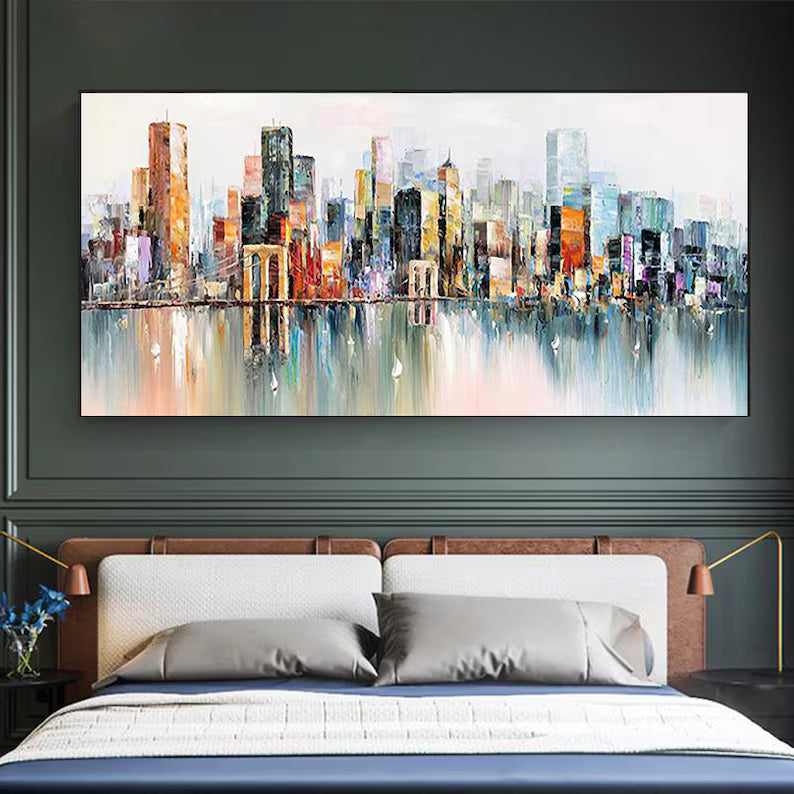
Buying handmade oil paintings online is entirely viable if you know how to read material evidence rather than relying on polished product photos. Serious collectors and design-focused homeowners should focus on texture behavior, canvas construction, and pigment irregularities. The limitation is simple: without physical inspection, verification depends on how transparently the seller documents these details.
The surge in digitally printed “textured” canvases has blurred the line between décor and fine art. What appears richly layered on screen often collapses into a flat surface in person. For buyers investing in statement wall pieces—whether for a double-height living room, a marble-clad hallway, or a quiet reading lounge—the ability to filter authenticity digitally becomes a practical skill, not an abstract concern.
Navigating the vast options to find verified handmade oil paintings online requires a strict understanding of texture, canvas grading, and pigment authenticity.

Why digital listings make fake texture convincing
Most deceptive listings rely on lighting manipulation. Raking light—angled illumination—creates artificial shadows that simulate depth on flat prints. Combined with high-resolution photography and contrast boosting, even a printed canvas can mimic heavy impasto.
The issue is not just visual—it’s structural. Real oil paintings physically displace pigment. That means:
-
Light interacts unevenly across peaks and valleys.
-
Shadows shift depending on viewing angle, not just fixed in the image.
-
Edges reveal buildup, not printed gradients.
A quick diagnostic: if every “brushstroke” appears uniformly raised and perfectly consistent across the surface, it is likely manufactured rather than painted.
The physical markers of authentic hand-painted oil work
Authenticity leaves behind physical evidence that cannot be mass-replicated. Even through a screen, careful listings will expose these traits.
Look for:
-
Edge continuity: Real paintings wrap naturally around canvas edges, often with visible pigment pooling or tapering.
-
Tool variation: Palette knife work produces irregular ridges; brushes leave directional drag marks. A mix of both is common in expressive work.
-
Micro-imperfections: Slight inconsistencies in thickness, spacing, and stroke direction signal human execution.
-
Back-of-canvas visibility: Genuine works often show stretching marks, staple placement, or raw canvas fibers.
A useful mental model: authentic paintings record motion. You are not just seeing an image—you are seeing the residue of physical gestures.
Hand-painted vs digital print canvas differences that matter
The distinction becomes clearer when you compare behavior rather than appearance.
-
Surface depth: Hand-painted surfaces vary unpredictably; prints often repeat patterns or maintain uniform elevation.
-
Light response: Oil paint reflects light unevenly; prints reflect consistently across the surface.
-
Edge treatment: Real works continue over edges; prints often stop abruptly or wrap artificially.
-
Material smell: Fresh oil paintings may carry a subtle organic scent from linseed or similar binders; prints typically smell neutral or synthetic.
This difference becomes especially noticeable in minimalist interiors with strong directional lighting, where fake textures fail under scrutiny.
How to find affordable original wall art without compromising authenticity
Affordability does not require sacrificing authenticity—it requires reframing expectations.
Instead of chasing large-scale gallery pieces, consider:
-
Emerging artist collectives rather than legacy galleries.
-
Medium-scale works that still deliver visual impact.
-
Textural abstraction, which often provides more material presence per cost than figurative realism.
Artist-driven platforms and studios—particularly those rooted in production environments rather than resale marketplaces—tend to offer better value. For example, Artextured originated as a gallery-based collective solving echo issues through textured artwork, which led to a hybrid approach combining visual depth with material performance. This kind of origin often correlates with genuine craftsmanship rather than decorative replication.
Artisan canvas shopping checklist for high-intent buyers
When evaluating a listing, move beyond aesthetics and audit the structure.
-
Request angled lighting photos, not just front-facing images.
-
Zoom into corners and edges for paint buildup and wrapping behavior.
-
Check for back-of-canvas images showing stretching and framing.
-
Look for close-ups that reveal stroke direction and thickness variation.
-
Avoid listings where every piece appears identical—true handmade work varies.
If a seller cannot provide these views, the risk increases significantly.
What to inspect when your painting arrives
Receiving the artwork is your final verification stage.
Inspect the following immediately:
-
Run your fingers lightly across the surface to confirm real elevation changes.
-
View the painting under side lighting to observe shadow variation.
-
Check edges for continuous paint application.
-
Smell the surface subtly—authentic oil mediums often leave a faint trace.
-
Examine the back for structural integrity and natural canvas tension.
In larger spaces—such as open-plan living rooms or high-ceiling foyers—authentic texture becomes more than visual. It interacts with light and can subtly soften harsh reflections from glass, stone, or concrete surfaces.
Common mistakes that lead to disappointing purchases
Several recurring missteps undermine otherwise well-intentioned purchases.
One of the most common is assuming that a single heavily textured piece will transform an entire room’s acoustic or visual character. While textured art can help soften mid-to-high frequency reflections, especially in hard-surface interiors, it does not replace broader material planning.
Another issue is placement. Hanging a textured piece on a secondary wall while ignoring large reflective surfaces—like glass partitions or polished stone—limits both visual and spatial impact.
Lighting is also frequently overlooked. Strong overhead lighting can flatten texture, while angled lighting enhances it. Buyers who skip this consideration often feel their piece looks “less dimensional” than expected.
Finally, over-sealing or applying protective coatings to textured surfaces can reduce both visual depth and any subtle acoustic benefit by blocking porous characteristics.
Where authenticity meets spatial design intent
Authentic handmade oil paintings do more than decorate—they anchor spatial experience. In contemporary interiors dominated by hard finishes, the physicality of real paint introduces variation, softness, and visual rhythm.
Studios like Artextured approach this intersection deliberately, treating textured artwork not only as a visual centerpiece but as a material layer within a room’s composition. This perspective aligns with how designers increasingly think: not in isolated objects, but in interacting surfaces.
Still, expectations should remain grounded. Even the most heavily textured painting contributes incrementally to acoustic comfort rather than transforming it entirely. Its real value lies in combining sensory depth with visual authorship.
Frequently Asked Questions
What should I look for when buying handmade oil paintings online to ensure authenticity?
Focus on physical evidence such as edge paint continuity, irregular texture patterns, and back-of-canvas visibility. Listings should include angled lighting images and close-up details that reveal true material depth rather than uniform printed effects.
Is it possible to find truly affordable original wall art that is hand-painted?
Yes, especially through artist collectives and direct studio platforms. Choosing emerging artists, medium-scale works, or abstract textured styles can significantly improve value without sacrificing authenticity.
How do online galleries fake textured brushstrokes on digital print canvases?
They rely on directional lighting, high-contrast editing, and sometimes surface coatings to simulate depth. These effects create the illusion of texture in photos but lack the physical variation visible under real lighting.
What are the key inspection steps upon receiving a handmade heavy impasto painting?
Check for actual surface elevation by touch, examine shadow variation under angled light, inspect edges for continuous paint application, and review the back of the canvas for structural authenticity.
Can textured oil paintings improve room acoustics?
They can help soften surface reflections and reduce harshness in echo-prone rooms, especially when used alongside other materials. However, they do not provide soundproofing or replace dedicated acoustic treatments.