
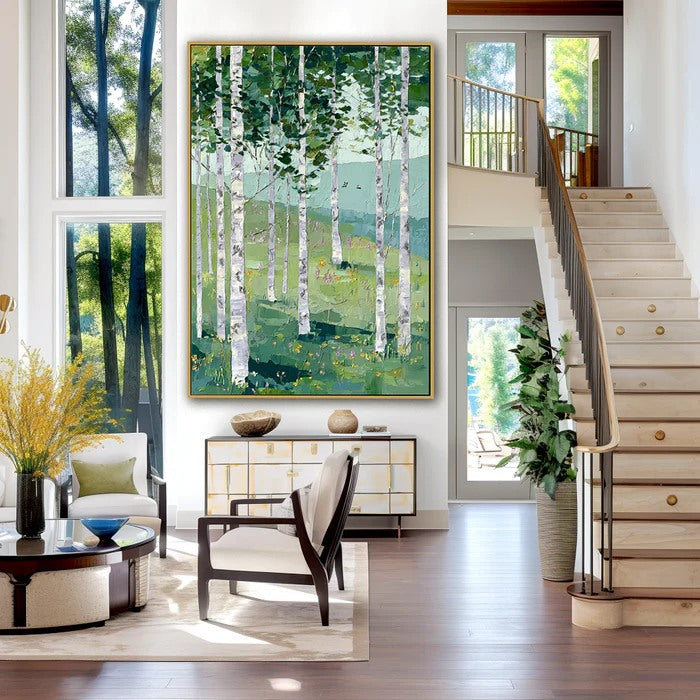
Painting trees from below challenges traditional landscape composition and introduces a dynamic sense of scale, light, and drama. When you learn how to paint trees from this upward perspective, you’re not just adding foliage—you’re building an immersive world of towering shadows, cascading leaves, and luminous skies. In this guide, you’ll explore how to capture nuanced depth, perspective, and structure to bring your vertical landscapes to life.
Understanding Perspective When Painting Trees
When painting trees from below, perspective anchors everything. The viewer looks upward, and the canopy seems to stretch toward infinity. Branches fan out in radial lines, guiding the eye to the vanishing point high above. Mastering perspective requires identifying your horizon line, mapping trunk angles, and translating foreshortening to realistic proportions. Using soft blending and controlled contrast can help simulate the natural distortion created by looking up at tall trees.
Artists often begin with rough compositional sketches—simple directional lines radiating from the base of the trunk. From there, build your shapes upward. Allow smaller limbs to twist and converge toward the sky. As light filters through, use value shifts to communicate distance: darker tones near the base add grounding, while lighter sky tones near the crown introduce depth and air.
How Light Defines Dimensional Depth
Light defines space when painting trees, especially from below. Observe how sunlight penetrates the canopy—some leaves glow translucent while others cast complex shadows. The contrast between bright sky breaks and dense leaf layers gives the illusion of true three-dimensional form. Try glazing thin layers of paint to achieve atmospheric transparency. Cool blues and greens in shadow areas can make the warmer highlights feel more alive.
When you focus on the relationship between canopy light and the darker ground plane, depth naturally increases. The human eye expects brighter, cooler hues in the distance and darker, warmer tones in the foreground. This visual rule, known as aerial perspective, transforms flat compositions into realistic environments.
Capturing Tree Texture and Movement
Texture brings authenticity. To recreate a tree’s intricate bark and flickering leaves, experiment with dry brushing, palette knife techniques, or stippling. Bark patterns change with height—thicker textures near the base and smoother transitions upward reinforce the “from below” view. Use shorter, broken strokes for leaves closest to the viewer and softer, blurred motion for those higher up to mimic focus depth.
Adding movement enhances realism. Wind-blown leaves, angled branches, or shifting shadows infuse your painting with energy, reminding the viewer that nature is alive, not static. These rhythmic cues amplify the sense of being physically beneath the trees, enveloped by their scale.
Color Strategies for Vertical Landscapes
Color planning determines emotional tone. When painting trees from below, shifting from rich earth tones to ethereal canopy hues captures the sensation of looking upward. Warm tones such as burnt sienna and ochre create stable, earthy bases, while cool greens, turquoise, and pale gold bring breathing space near the top. Glazing soft sky gradients between branches enhances depth and curvature.
Color temperature also guides focus. Cooler shades recede, while warmer ones advance. By controlling the relationship between trunk warmth and canopy light, you create the illusion of vertical expansion—a powerful technique for any tree painting aspiring to realism.
Core Techniques for How to Paint Trees from Below
Break down your process to manage complexity. Start with composition, then apply underpainting to block major masses. Build layers from dark to light. Emphasize directional brushwork following natural tree growth. Gradually introduce smaller details, ensuring highlights align with your light source. Consistency in shadow direction and tone will strengthen realism and cohesion.
One useful practice is painting from reference photos captured directly beneath trees. Notice how branches overlap unpredictably, and how sunlight fractures through layers. Observing photographic distortions helps translate dimensional tension into brushwork.
Real Artists, Real Results
Artists adopting the “from below” perspective often report stronger emotional impact and more immersive compositions. Scenes appear to envelop viewers rather than sit passively on the wall. This approach can transform even small canvases into large-feeling landscapes by emphasizing skyward perspective. Many report improved engagement, sales, and exhibition interest when incorporating vertical compositions into their portfolios.
At Artextured, we believe art should do more than decorate—it should transform spaces and inspire experiences. Founded in Xiamen, our collective brings together emerging and established artists who push creative boundaries, blending craftsmanship with cutting-edge materials. Our signature acoustic wall art merges beauty with function, turning every piece into a harmonious union of sound and sight.
Future Trends in Tree Painting Composition
The “looking upward” perspective is gaining momentum among modern painters using digital realism and immersive techniques. As environmental themes dominate contemporary art, the idea of towering nature—viewed from a small human vantage—has become symbolically powerful. Moving forward, expect tree paintings to feature increasingly exaggerated perspectives, layered media, and hybrid textures combining paint with natural materials.
This evolution reflects a cultural desire to reconnect with nature’s vastness. Painters who master the “from below” technique position themselves at the frontier of future art movements, blurring technical precision with emotional storytelling.
Frequently Asked Questions
Why focus on painting trees from below instead of straight-on?
The upward angle introduces energy, motion, and psychological tension. It transforms a simple subject into a breathtaking study of light and form.
How do you achieve realistic depth when painting trees?
Layer distant and close elements using tonal contrast, correct perspective lines, and color temperature shifts to produce convincing space.
What colors create balance between earth and sky in a tree painting?
Combine warm neutrals at the base with cooler, lighter transitions near the canopy. Adding subtle reflected light enhances harmony.
Can beginners learn how to paint trees from below effectively?
Yes. Starting with simplified forms and high-contrast lighting helps beginners grasp structure before tackling detailed foliage and texture.
Final Inspiration and Artistic Path
Learning how to paint trees from below is more than a technical exercise—it’s a way to convey emotion through perspective. By exploring dynamic viewpoints and dimensional layering, your art gains narrative power and visual depth. Every brushstroke becomes a journey through light, space, and scale.