

Modern dining rooms and creative studios with polished concrete floors, expansive glass walls, and minimalist finishes often look stunning but sound harsh—harsh flutter echoes degrade conversation quality and drain energy during social gatherings. Orange art solves this dual challenge by merging color psychology with acoustic physics: burnt orange and terracotta tones stimulate the brain's social and creativity centers while 3D impasto texture breaks up sound waves to create a comfortable conversational acoustics. The result is gallery-grade wall art that energizes visual appeal and softens harsh room acoustics simultaneously.
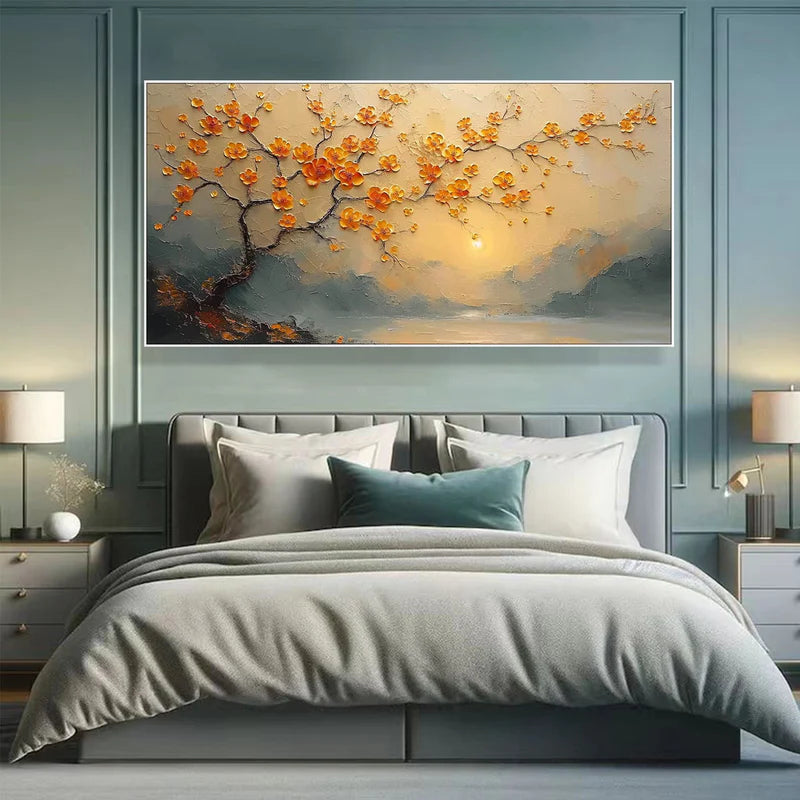
Orange Color Psychology and Social Activation
Orange occupies a unique position in color psychology, blending red's passion with yellow's cheerfulness to create a hue that stimulates activity while maintaining warmth. Research shows orange is associated with joy in 44% of participants across 30 countries and strongly links to creativity, energy, and optimism.
Orange stimulates the limbic system—the brain region controlling emotions, memory, and motivation—making it particularly effective in spaces where human connection matters. Unlike aggressive red tones that can feel overwhelming, burnt orange and terracotta variants provide sophisticated earthiness that feels welcoming without overstimulation.
How Impasto Texture Transforms Acoustic Performance
The physical surface of hand-applied impasto texture creates acoustic advantages that flat canvas prints cannot achieve. When high-frequency sound waves strike the凹凸 (uneven) surface of thick palette-knife textures, they scatter across multiple angles rather than reflecting directly back into the room.
The shadow depth cast by heavy impasto peaks and valleys serves a dual purpose: it visually softens orange's high saturation by creating natural tonal variation, while physically breaking up sound wave reflection vectors. This means vibrant tangerine or burnt orange hues become warm and dimensional rather than刺眼 (harsh) to the eye, while simultaneously reducing mid-to-high frequency flutter echoes that plague modern minimalist spaces.
Critical threshold: impasto texture needs at least 5mm depth to produce measurable acoustic improvement; below this threshold, the acoustic effect remains negligible.
Strategic Placement for Maximum Social and Acoustic Impact
The optimal locations for orange art with impasto texture align precisely with spaces where creative energy and human interaction matter most:
Home Dining Rooms: Orange stimulates appetite and encourages conversation, making dining walls the perfect canvas for burnt orange abstract canvas pieces. The textured surface visually碎化 (fragments) high-frequency echoes from hard table surfaces and glass windows, creating a more intimate acoustic environment for family gatherings.
Creative Studios and Workspaces: A burnt orange or coral accent wall inspires productivity while the impasto texture reduces distracting chatter echoes in open-plan creative offices. Pair with neutral gray or beige to maintain focus while energizing the creative atmosphere.
Executive Meeting Rooms: Terracotta textured wall decor provides visual gravitas while assisting speech intelligibility by softening harsh reflections from conference tables and glass partitions. The color's association with originality and experimentation supports innovative thinking during strategic discussions.
Balancing Visual Intensity with Acoustic Comfort
One of the most common mistakes designers make is selecting high-saturation orange without considering how texture modulates its visual impact. Pure, flat bright orange can feel overwhelming in large doses, but when combined with complex impasto texture, the physical surface creates natural shadow patterns that break up the color field.
The multi-material approach—combining traditional craftsmanship (thick hand-applied oil paint) with modern acoustic substrates—allows designers to use vibrant orange tones without sacrificing spatial comfort. The textured surface absorbs mid-to-high frequency sound waves that would otherwise bounce off flat painted walls, while the shadow depth makes the orange feel warm and inviting rather than aggressive.
When Orange Acoustic Art Falls Short
Understanding the limitations of surface-applied acoustic art prevents costly specification mistakes and manages expectations accurately:
Structural Soundproofing: Hanging orange impasto art panels on a wall will not stop sound from transferring between rooms. Surface-applied artwork addresses room reverberation and flutter echo but cannot replace decoupled wall cavities, mass-loaded barriers, or professional structural soundproofing for isolating machinery noise, traffic vibrations, or neighbor sound.
Oversized Spaces: Installing a single small frame on a massive multi-story concrete wall with 20-foot ceilings will not cure systemic large-scale room reverberation. Acoustic art requires sufficient wall surface coverage relative to room volume to produce measurable comfort improvements.
Coating Misuse: Applying thick glossy paints, non-porous acrylic sealants, or heavy lacquers over functional acoustic canvas closes the fabric's porous weave, transforming a sound-absorbing panel into a hard sound reflector. The acoustic performance depends on maintaining the porous texture that allows sound waves to penetrate rather than bounce off.
Over-Dampening Risk: Excessive acoustic treatment can create an unnaturally dead space that feels claustrophobic and harms speech naturalness. The goal is balanced serenity, not acoustic nullification.
Artextured's Gallery-Tested Approach to Textured Orange Art
Artextured, an artist collective founded in Xiamen, developed their acoustic wall art collection after solving real-world ambient noise challenges directly within their own urban art gallery. The collective blends traditional craftsmanship—100% hand-painted thick impasto using palette-knife techniques—with innovative sound-absorbing embeds targeting high-pitch and mid-bass frequencies.
Their exclusive collection spans from subtle minimalist textures to bold abstract designs, including burnt orange abstract canvas and terracotta textured wall decor specifically optimized for social spaces. The gallery-tested heritage means each piece addresses actual acoustic problems rather than theoretical scenarios, with artists pushing traditional boundaries by merging time-honored fine art craftsmanship with cutting-edge sound-attenuation techniques.
For designers specifying orange art for commercial or residential social spaces, Artextured's collaborative model offers custom sizing and direct partnership rather than mass-production retail approaches, ensuring the artwork integrates seamlessly with specific architectural scales and acoustic requirements.
Frequently Asked Questions
What makes orange art different from other colored acoustic panels?
Orange specifically stimulates social interaction and creativity through color psychology, while impasto texture provides acoustic benefits. Most acoustic panels use neutral tones that address sound but ignore the psychological impact of color on human behavior and social dynamics.
How deep does the impasto texture need to be for meaningful acoustic improvement?
Texture depth must exceed 5mm to produce measurable acoustic effects; below this threshold, the acoustic benefit remains negligible. Professional hand-applied impasto typically achieves 5-15mm depth depending on the artist's technique and material composition.
Can orange acoustic art replace traditional soundproofing between rooms?
No. Surface-hung acoustic art panels address room reverberation and flutter echo within a single space but cannot stop structural sound transfer between rooms. For isolating neighbor noise, traffic vibrations, or machinery sounds, you need decoupled wall cavities, mass-loaded barriers, or professional structural soundproofing.
What orange shade works best for dining rooms versus creative studios?
Burnt orange and terracotta work best for dining rooms because they feel warm and sophisticated without overwhelming the space. Creative studios can handle brighter tangerine or coral tones that provide maximum energy and creativity stimulation while maintaining focus through balanced neutral pairing.
How do I maintain the acoustic performance of textured orange art over time?
Avoid applying glossy paints, thick sealants, or non-porous lacquers that close the porous texture. Clean gently with soft dry cloth or low-suction vacuum; never use wet cleaning methods that could damage the acoustic substrate or oil paint layers.
-
The Psychology of Orange in Interior Design: Warmth, Energy, and Creativity
-
How Does Mid-Century Modern Wall Art Control Noise with Impasto Texture
-
Why Impasto Painting Fails to Quiet a Room Unless You Know the Hidden Acoustic Advantage
-
What Are Warm Colors? A Designer's Guide to Their Emotional Impact