
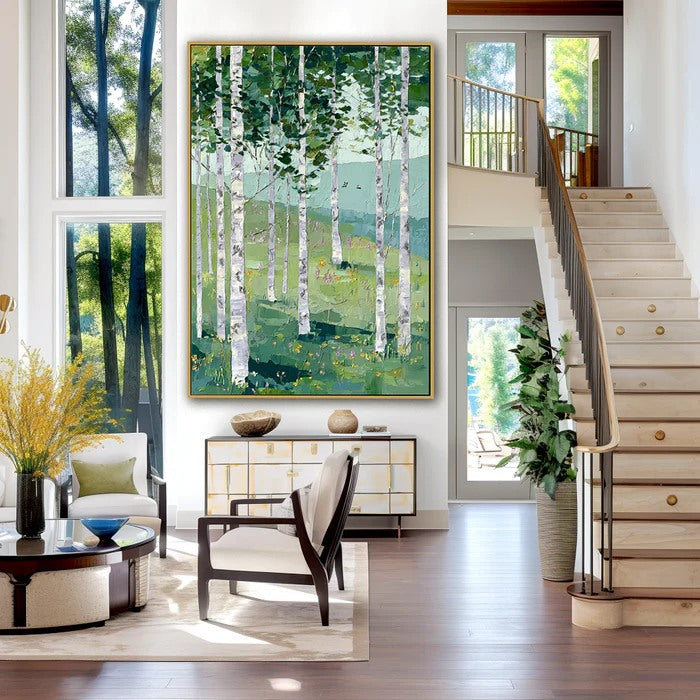
White magnolia flower art works best when it does more than depict a bloom. In modern interiors, its value comes from how the petals are built up, how light grazes their surface, and how subtle shadows give the wall a sense of depth that flat prints simply cannot provide. A textured magnolia painting introduces form without relying on strong color, which is exactly what many minimalist rooms lack. The result is not decoration for its own sake, but a quiet focal point that responds to architecture, materials, and lighting throughout the day.
Why texture matters more than color in white floral compositions
In a monochromatic palette, color stops carrying the visual load. What replaces it is structure. Raised paint, layered brushwork, and sculptural edges create a surface that changes as you move through the room or adjust the lighting.
White magnolia flower art leans into this principle. The petals are naturally curved and layered, which translates well into textured execution. Instead of reading as a flat silhouette, the flower gains dimensional presence. Under side lighting, even subtle ridges in the paint produce soft shadows that outline each petal.
This is why minimalist botanical art in white often feels more complete when it is physically textured. Without that relief, the artwork risks blending into the wall or feeling decorative but visually weak—especially in spaces that already feature tactile materials like linen upholstery, wood grain, or stone.
How directional lighting reveals sculptural floral detail
Directional lighting is what activates a textured magnolia painting. Without it, the artwork still reads clean and minimal, but much of its depth remains understated.
When light comes from the side—whether from a nearby window or a wall-mounted fixture—it skims across the raised surface. This creates small, shifting shadows that define the edges of each petal. Warm bulbs tend to soften these contrasts, while cooler light can make the texture appear sharper and more graphic.
A simple adjustment in placement can change the entire effect. For example, placing white wall art for a modern home opposite a window will flatten the surface visually. Moving it to a perpendicular wall allows natural light to reveal its relief throughout the day. In the evening, a single angled spotlight can recreate that same dimensionality.
A common disappointment occurs when buyers install textured art under direct overhead lighting only. The result looks unexpectedly flat, leading them to question the artwork rather than the lighting. A slight shift to angled illumination usually resolves this instantly.
Where white magnolia art fits best in modern layouts
The placement of sculptural floral wall art should align with how the room is used and where visual weight is needed.
In dining areas, a textured magnolia painting works well on the main wall adjacent to the table rather than directly behind it. This allows side lighting—often from windows or pendant fixtures—to interact with the surface without glare.
Bedrooms benefit from the softness of magnolia imagery, but scale matters. A single large canvas above the headboard tends to feel more intentional than multiple smaller pieces, especially in minimalist settings where clutter is quickly noticeable.
Entryways are another strong match. A white-on-white floral composition introduces detail without overwhelming a narrow or transitional space. Here, the artwork acts as a visual pause between exterior and interior environments.
In open-plan living areas, placement should consider sightlines. A textured magnolia painting often performs best where it can be seen from multiple angles, allowing the light-shadow interaction to evolve as people move through the space.
Textured magnolia paintings versus flat floral prints
The difference between 3D flower art and printed alternatives becomes most obvious in rooms that already have material richness. Flat prints can appear visually disconnected when placed near textured walls, woven textiles, or natural finishes.
A quick comparison clarifies where each approach works:
This does not make prints irrelevant, but it explains why sculptural floral wall art tends to hold attention longer in modern interiors where restraint is paired with material contrast.
Scale and restraint in smaller or tighter spaces
White magnolia flower art can work in small spaces, but proportion and texture density need careful control. Oversized pieces with heavy relief may feel too dominant in narrow hallways or compact rooms, especially if viewed at close range.
A more restrained composition—fewer blooms, softer relief, and balanced negative space—keeps the artwork readable without crowding the wall. Vertical formats often perform better in tight areas because they follow the natural proportions of doors and wall segments.
The key is distance. If the viewer stands close to the artwork, the texture should feel refined rather than aggressive. In larger rooms where the piece is viewed from afar, deeper texture helps maintain visibility and presence.
When a textured magnolia piece makes sense for your space
If your room already leans heavily on neutral tones, smooth finishes, and clean lines, a textured magnolia painting introduces variation without disrupting the palette. It is especially relevant in interiors where white wall art for a modern home risks disappearing due to lack of contrast.
For those exploring options, it helps to start with collections that emphasize surface depth rather than color complexity. You can View our collection of textured abstract art to see how similar techniques translate across different subjects and scales, including floral-inspired compositions.
Artextured’s approach focuses on hand-painted surface relief, which aligns well with magnolia imagery because of its natural layering. This is most suitable for buyers who value subtle material variation over bold color statements. If your space relies more on strong color contrast or graphic patterns, a different direction may feel more cohesive.
Letting the artwork settle into the room over time
Unlike flat pieces, textured magnolia art is not static. Its appearance shifts with daylight, evening lighting, and even seasonal changes in natural light angles. This makes it less about immediate impact and more about long-term integration into the space.
Before finalizing placement, it is worth observing the wall at different times of day. Notice where shadows naturally fall and how the surface reacts. Small adjustments—just a few centimeters—can significantly change how the petals are perceived.
When you are ready to explore current pieces that reflect this approach to texture and form, you can Explore our latest textured wall art arrivals and compare how different compositions handle light, scale, and surface detail.
Frequently Asked Questions
Is sculptural magnolia art suitable for small spaces?
Yes, but it depends on scale and texture intensity. Smaller rooms benefit from controlled compositions with moderate relief and sufficient negative space so the artwork does not feel crowded or overly dominant.
How does directional lighting enhance textured floral art?
Directional lighting skims across the raised surface, creating shadows along the edges of petals. This reveals depth and structure that would otherwise remain subtle under flat, overhead lighting.
Why is monochromatic white art effective in minimalist design?
Because it emphasizes form and material over color. In minimalist interiors, this allows the artwork to add interest without disrupting a restrained palette.