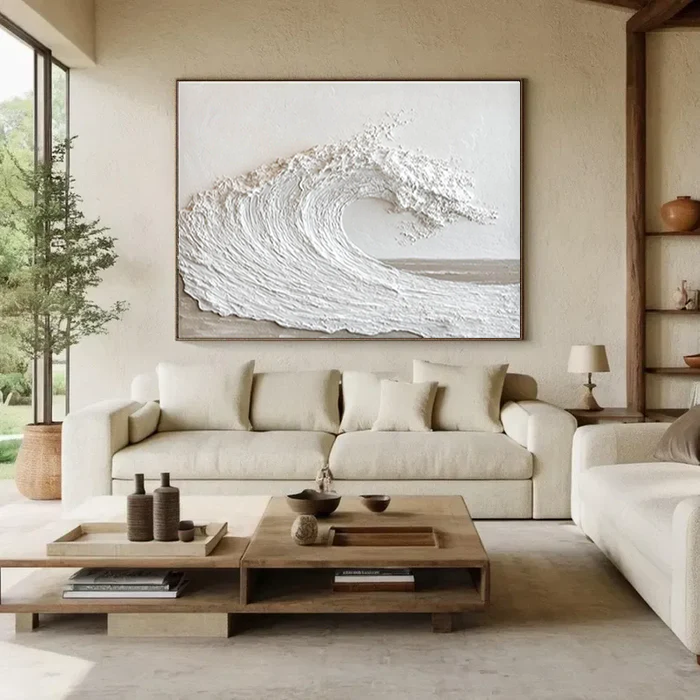

An aerial beach view acoustic canvas improves open-concept room sound by introducing irregular, sculpted surfaces that help scatter mid-to-high frequency reflections while visually anchoring large coastal spaces. It works best in high-ceiling living rooms, waterfront condos, and hospitality suites with hard finishes. However, it cannot replace structural soundproofing or correct severe echo issues on its own without sufficient coverage and placement strategy.
In expansive seaside interiors filled with glass, stone, and polished wood, sound tends to travel uninterrupted, creating a persistent brightness in speech and ambient noise. The appeal of an aerial coastal artwork is not just visual calm—it is spatial intervention. When executed with physical depth rather than flat imagery, the canvas becomes a subtle acoustic moderator embedded within a design narrative.
To introduce the refreshing clarity of the ocean into an architecture plagued by cold, echoic marble, an aerial beach view acoustic canvas offers an elite visual and acoustic upgrade.
Why aerial coastal imagery works beyond decoration
Most coastal wall art is treated as surface-level styling—prints, photographs, or lightly textured canvases that sit passively on the wall. An aerial beach view, when translated into sculptural form, behaves differently.
The shifting contours of sandbars, foam trails, and tidal edges create natural irregularity. When this is physically built into the canvas using layered materials, it disrupts the predictable path of reflected sound waves. Instead of bouncing directly between parallel walls, sound energy is diffused in multiple directions.
This matters most in rooms where:
-
Ceiling heights exceed typical residential scale.
-
Large uninterrupted walls face each other.
-
Flooring is reflective, such as marble or polished concrete.
-
Furniture is minimal or low-profile.
Flat artwork cannot meaningfully alter this behavior. A 3D ocean wave textured painting, however, introduces micro-topography that begins to break up these reflections at a perceptible level.
The micro-topography principle behind acoustic art
The key difference lies in surface geometry. Smooth surfaces reflect sound coherently, while uneven ones scatter it.
In a coastal abstract heavy impasto composition, thick palette knife applications create ridges, troughs, and fragmented peaks that mimic ocean movement. These features function similarly to natural coastal formations:
-
Wave crests act like miniature deflectors.
-
Foam clusters create porous, irregular edges.
-
Layer transitions interrupt linear reflection paths.
This is not full acoustic absorption in the engineering sense, but it contributes to diffusion and partial energy reduction, especially in the higher frequency range associated with speech clarity and ambient sharpness.
In practical terms, this can make a large living room feel less “ringing” and more controlled, particularly when multiple pieces are used across key reflection zones.
Material depth and the illusion of moving water
A convincing aerial coastal topography canvas depends on more than color gradients. The realism—and acoustic benefit—comes from material layering.
Thicker applications of acrylic or mixed media are manipulated while still wet, then built upon in stages. The result is a tactile surface where light and shadow continuously shift throughout the day.
This has two spatial effects:
-
Visual: The artwork appears dynamic, almost like water in motion when viewed from different angles.
-
Acoustic: The uneven surface prevents consistent reflection angles, subtly dispersing sound.
Artextured, an artist collective originating from a gallery environment with echo challenges, developed this approach as a response to real acoustic discomfort. Their work merges fine art techniques with layered construction methods that allow the canvas to contribute to both atmosphere and sound moderation.
Placement strategy in large coastal rooms
Even the most sculptural blue green sound dampening art will underperform if placed incorrectly. Position matters as much as the artwork itself.
Key placement considerations include:
-
First reflection zones: Walls directly opposite seating areas or conversation clusters are critical.
-
Parallel surfaces: If two large walls face each other, treating at least one reduces flutter echo.
-
Height alignment: In double-height spaces, placing art too low limits its acoustic reach.
-
Distribution: One oversized piece is less effective than multiple works spaced across the room.
In waterfront condos or resort suites, placing aerial compositions behind sofas, along dining walls, or across entry corridors helps intercept sound paths early.
Lighting also plays a role. Grazing light from angled spotlights enhances the perceived depth, which reinforces both visual texture and the sense of acoustic softness.
Why heavy impasto outperforms flat coastal prints
Flat photography—even high-resolution drone imagery—fails in two key ways:
-
It reflects sound almost identically to the wall behind it.
-
It lacks material interaction with light, making large spaces feel visually static.
By contrast, a coastal abstract heavy impasto piece introduces both depth and variability. This matters in luxury environments where stillness can quickly become sterility.
A textured aerial beach view does not just depict the shoreline—it behaves like one. The comparison to a breakwater is useful: just as jagged coastal edges dissipate wave energy, sculpted surfaces disperse acoustic reflections.
This distinction is often overlooked in commercial listings that prioritize imagery over material performance.
Common mistakes and unrealistic expectations
Acoustic wall art is frequently misunderstood, especially in high-end residential and hospitality projects.
Common issues include:
-
Expecting soundproofing: These artworks do not block external noise such as traffic or neighbors. They address internal reflections only.
-
Undersizing the solution: A single panel in a large open room will have minimal impact.
-
Ignoring surrounding materials: Glass walls, marble floors, and ceilings still dominate acoustic behavior if untreated.
-
Over-sealing the surface: Applying thick varnishes or coatings can reduce the micro-porosity and alter performance.
-
Misjudging lighting: Poorly angled lighting flattens texture, reducing both visual and perceived acoustic benefit.
There is also a balance to maintain. Overusing textured acoustic art in a confined space can dampen liveliness, making the room feel acoustically dull rather than refined.
Daylight interaction and evolving perception
One of the more subtle advantages of a 3D ocean wave textured painting is how it evolves throughout the day.
Morning light tends to soften shadows, emphasizing color gradients—turquoise, seafoam, deep blue. Midday light flattens contrast slightly, making the piece feel expansive and calm. Evening lighting, especially from angled sources, sharpens every ridge and crest.
This constant shift prevents visual fatigue in large rooms where occupants spend extended periods. It also reinforces the psychological sense of movement and openness—an important factor in corporate wellness spaces and executive suites.
In acoustic terms, while the physical structure does not change, the perceived softness of the space often increases as visual texture becomes more pronounced under directional lighting.
When to specify an aerial beach view acoustic canvas
This type of installation is particularly suited for:
-
Open-plan beachfront living areas with minimal soft furnishings.
-
Luxury condos with glass curtain walls.
-
Resort executive lounges where speech clarity matters.
-
Corporate wellness spaces seeking calm without visual clutter.
-
Gallery-like interiors where traditional acoustic panels would feel intrusive.
It is less effective in heavily furnished rooms where carpets, curtains, and upholstery already dominate acoustic behavior, or in environments requiring strict acoustic control such as recording studios.
Frequently Asked Questions
How does an aerial beach view acoustic canvas improve open-concept room sound?
It improves sound by scattering mid-to-high frequency reflections through its uneven, sculpted surface. In open rooms with hard finishes, this helps reduce sharp echo and improves speech comfort, especially when multiple pieces are used across key wall areas.
What materials create the realistic 3D foam and wave effect in coastal art?
The effect is typically created using layered acrylics or mixed media applied with palette knives to build physical depth. These layers form ridges and textures that mimic ocean movement while also contributing to sound diffusion.
Why should luxury beach homes use heavy impasto art instead of flat prints?
Heavy impasto art introduces both visual depth and acoustic function, while flat prints remain purely decorative. In large coastal interiors, this added dimensionality helps break up reflections and prevents the space from feeling visually and acoustically flat.
How do lighting conditions affect a blue-green ocean textured painting?
Lighting changes how shadows interact with the textured surface, making the artwork appear more or less dynamic throughout the day. Angled lighting enhances depth, which strengthens both visual impact and the perception of acoustic softness.
Can one acoustic canvas fix echo in a large room?
No, a single piece is rarely sufficient. Effective improvement depends on coverage, placement, and the overall balance of materials in the room. Multiple artworks positioned across reflection points are typically needed for noticeable results.
Capture the power of the sea—view our museum-quality, hand-sculpted Ocean Wave and Blue-Green Coastal Abstract series.