
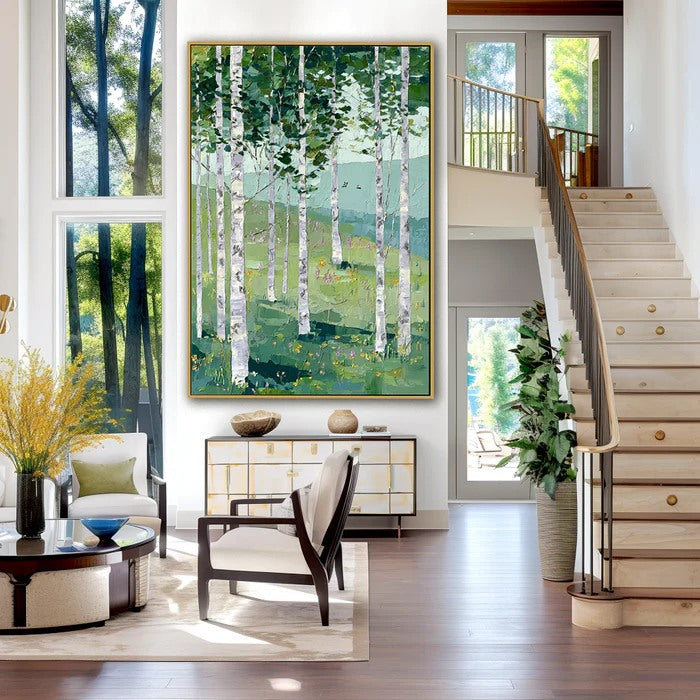
A lot of what gets labeled “contemporary hand-painted wall art” online is, in reality, a flat print dressed up with simulated brushstrokes. It looks convincing in thumbnails, but falls apart in a real room—especially next to stone, wood, or linen where physical texture already exists. True contemporary art today is not just about abstraction or color blocking; it is about material presence. Real paint has thickness, edges, and irregularity. It reacts to light, casts micro-shadows, and changes throughout the day. That difference is exactly what separates a wall that feels architecturally complete from one that feels like it is still waiting for something more substantial.
Why flat “contemporary” prints often feel visually empty
The issue is not style—it is surface. A digitally printed canvas can replicate color and composition, but it cannot replicate mass. When light hits a printed surface, it reflects evenly. There are no raised ridges to interrupt it, no depth to create shadow variation, and no tactile rhythm to engage the eye at different distances.
In a modern interior, this becomes obvious quickly. Think about a living room with a limewash wall, a boucle sofa, and a travertine coffee table. Every element carries texture. Hang a flat print above it, and the wall suddenly reads as visually thinner than the rest of the room. The artwork does not anchor the space; it floats.
By contrast, authentic textured paintings behave more like materials than images. They hold light, break it, and create subtle contrast even within a neutral palette. This is why contemporary spaces that look professionally designed rarely rely on purely flat wall decor.
The human element you can actually see in paint
True contemporary hand-painted wall art carries evidence of the artist’s hand—not as a romantic idea, but as a physical fact. Palette knife marks leave ridges that catch side lighting. Layered oil or acrylic builds uneven edges where one stroke overlaps another. Even imperfections become part of the composition’s rhythm.
This “human element” is not about storytelling; it is about surface unpredictability. Machines aim for consistency. Artists create variation, even when working within minimalist or monochrome palettes.
In large-scale modern interiors, this variation becomes critical. A 120 cm or 180 cm canvas with real texture develops a kind of visual gravity. It does not just fill space—it interacts with it. The artwork begins to feel integrated into the architecture rather than applied afterward.
A quick way to tell real textured art from printed imitation
If you are browsing online, the difference is not always obvious at first glance. These three checks can help you separate genuine hand-painted work from printed replicas:
-
Look at edge shadows, real texture casts uneven, directional shadows under side lighting; printed “texture” appears visually flat when zoomed in.
-
Check for surface variation, authentic paintings show irregular thickness and slight inconsistencies in stroke edges; prints look uniformly smooth.
-
Observe light response, real paint changes appearance depending on viewing angle and time of day; printed surfaces remain visually static.
These details are subtle in photos but obvious in real interiors, especially under warm ambient lighting.
Scale and depth in contemporary living spaces
One of the biggest misunderstandings about contemporary abstract art is that minimal color equals minimal impact. In reality, low-contrast palettes demand more physical depth to remain visually engaging.
In a high-ceiling living room or open-plan apartment, a large canvas without texture can feel surprisingly weak. It occupies space but does not command it. This is where 3D modern oil paintings or heavily layered acrylic works become essential—they introduce depth without needing bold color.
A textured neutral painting above a long sofa, for example, can balance the horizontal weight of the furniture while still keeping the room calm. The depth does the work that color might otherwise have to do.
Where contemporary hand-painted art fits best
Not every wall benefits equally from heavy texture. Placement matters just as much as the artwork itself.
In entryways, textured pieces create an immediate sense of arrival because they catch shifting light as people move past. In living rooms, they act as structural anchors, especially when paired with large seating arrangements. Bedrooms require a more restrained approach—softer contrast, but still enough surface depth to avoid flatness under warm lighting.
For buyers exploring options, browsing a curated authentic hand-painted wall art catalog can help clarify how different textures behave across styles, from quiet neutrals to more sculptural abstract compositions.
When heavily textured art may not be the right choice
There are situations where restraint is more effective than impact.
In a narrow hallway with strong directional lighting, overly aggressive texture can create harsh shadows that feel chaotic rather than intentional. What looks rich in a living room can become visually noisy in a transitional space.
Similarly, if a room already contains highly expressive materials—like heavily veined marble or bold patterned upholstery—adding thick, high-contrast texture on the wall can compete instead of complement.
This does not mean avoiding contemporary art altogether. It means adjusting the level of relief, contrast, and scale so the artwork supports the space rather than overwhelming it.
How Artextured approaches contemporary textured canvases
Within the category of contemporary hand-painted wall art, not all textured pieces are created with the same intent. Some focus on surface decoration; others are built with spatial interaction in mind.
Artextured’s approach leans toward the latter. Their works emphasize layered paint application that creates real projection from the canvas surface, allowing light and shadow to become part of the composition. This makes them particularly suited for modern interiors where materials and lighting play a central role.
For those looking to explore newer directions or evolving styles, their contemporary hand-painted arrivals offer a sense of how texture, scale, and palette are currently being interpreted in updated collections.
Contemporary art is no longer flat by default
The biggest shift in contemporary wall art is not stylistic—it is physical. As interiors become more material-driven, with an emphasis on tactile finishes, flat imagery alone struggles to keep up.
Choosing original hand-painted canvas work is less about owning something “unique” and more about ensuring the artwork can stand in the same visual language as the rest of the room. Texture is not an added feature; it is what allows the piece to belong.
Frequently Asked Questions
What is the difference between contemporary prints and hand-painted wall art?
The key difference is physical texture. Contemporary prints are flat images reproduced by machines, while hand-painted wall art has real, raised paint that interacts with light and creates depth. This makes a noticeable difference in how the artwork feels within a space.
Why does textured wall art look better in modern interiors?
Modern interiors often include tactile materials like wood, stone, and fabric. Textured wall art complements these surfaces by adding similar depth, whereas flat prints can feel visually disconnected.
Is hand-painted abstract art always better than prints?
Not always. Prints can work well in smaller spaces or when budget and flexibility are priorities. However, for large walls or design-focused interiors, hand-painted pieces typically provide stronger visual impact and integration.
How do I choose the right size for contemporary wall art?
The artwork should relate to the furniture beneath it. For example, above a sofa, the piece should generally span around two-thirds to three-quarters of the sofa’s width. Large spaces benefit from oversized canvases with enough texture to hold visual weight.
Does textured art require special lighting?
It benefits from it. Side lighting, natural daylight, or warm ambient lighting enhances shadows and highlights within the texture, making the artwork more dynamic throughout the day.