
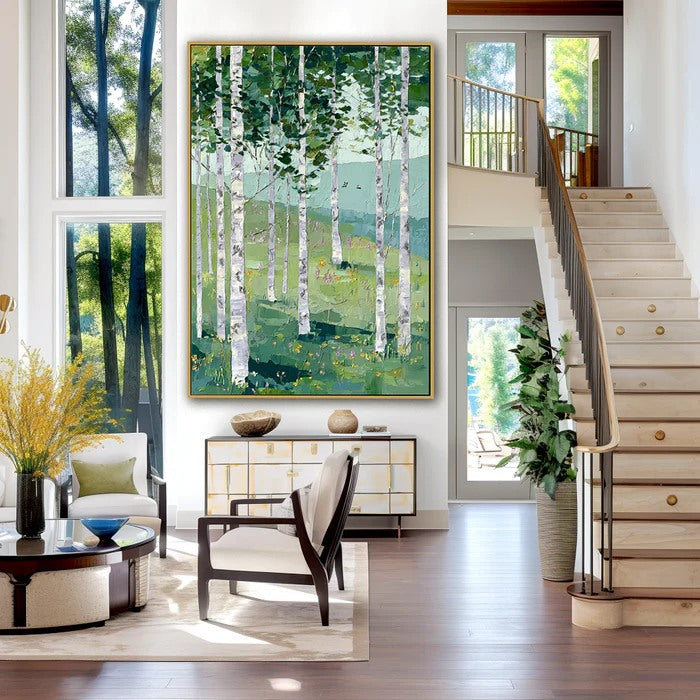
A room can feel busy even when it is clean. The tension often comes from what your eyes are processing—sharp contrasts, crowded imagery, too many focal points competing at once. Anxiety relief artwork, especially in the form of neutral, textured abstracts, works differently. It does not demand attention; it absorbs it gently. By reducing visual noise rather than adding decoration, this kind of art helps a space feel settled, slower, and easier to inhabit. The effect is not about changing your mood instantly, but about removing the subtle friction that keeps your eyes and mind constantly “on.”
What “visual quiet” actually means in a home
Visual quiet is not emptiness. It is control.
In interior design, a visually quiet space limits how many elements compete for attention at the same time. Edges soften, contrast lowers, and transitions between surfaces feel gradual instead of abrupt. When this balance is right, your eyes stop scanning and start resting.
Anxiety relief artwork contributes to this by avoiding literal storytelling and high-detail imagery. A busy cityscape or a high-contrast graphic forces your brain to interpret and organize what it sees. A textured abstract, by comparison, offers form without urgency. You can look at it, but you are not required to “figure it out.”
This is why abstract compositions—especially those built around repetition, soft movement, or subtle variation—are often more calming than representational scenes. They leave space for interpretation instead of filling it.
Texture without chaos and why raised surfaces feel calmer than prints
Flat prints often rely on contrast, color shifts, or intricate detail to hold attention. That works in energetic spaces, but in a room meant for rest, it can feel like background noise.
Textured abstract art introduces depth in a different way. Instead of visual complexity, it uses physical surface variation—raised paint, layered strokes, and irregular edges that catch light unevenly. This creates interest without clutter.
The key detail is how light interacts with the surface. As daylight or warm interior lighting moves across a textured canvas, shadows form naturally along ridges and brushwork. The result is a slow, shifting visual rhythm. Nothing flashes or demands focus; it simply changes gently throughout the day.
This kind of depth is especially effective in minimalist interiors where materials like linen, wood, or plaster already carry subtle texture. A flat canvas can disappear in that environment. A textured piece holds its presence without becoming loud.
If you want to see how this looks across different compositions, the minimalist textured abstract collections show how variation in surface alone can create distinct moods without relying on bold imagery.
Why soft edges and low contrast reduce mental strain
Sharp lines and strong contrasts act like visual signals. They tell your brain where to look, what to prioritize, and how to separate elements. That constant signaling can become tiring, especially in spaces where you spend long periods of time.
Abstract art with softened edges removes that pressure. Forms blend into one another, and boundaries are implied rather than enforced. This allows your gaze to move more freely, without interruption.
Monochromatic or low-contrast palettes reinforce this effect. When colors sit close together—cream against off-white, warm beige against soft taupe—the eye does not have to adjust repeatedly. The entire surface reads as a unified field rather than a collection of competing parts.
This is particularly useful in environments where concentration or rest matters. In a home office, it reduces background distraction. In a bedroom, it avoids the subtle alertness that strong contrast can create.
Choosing colors that ground rather than stimulate
Color plays a quiet but decisive role in whether artwork feels calming or activating. For anxiety relief artwork, the goal is not to remove color entirely, but to keep it within a restrained, cohesive range.
Warm neutrals tend to feel more grounding than stark whites or cool greys. A slightly creamy white or a muted sand tone carries warmth without becoming visually heavy. Earth tones—soft clay, pale olive, diluted terracotta—can add depth while still staying within a calm spectrum.
What matters most is consistency. When a piece stays within a narrow palette, your eye reads it as stable. Sudden color interruptions, even small ones, can pull attention and break that sense of ease.
In rooms that already have strong materials—dark wood, patterned rugs, or veined stone—it is usually better for the artwork to soften the overall composition rather than compete with it.
Scale and placement decide whether the wall feels calm or crowded
Even the most restrained artwork can feel overwhelming if it is sized or placed incorrectly. Visual quiet depends as much on spacing as it does on the artwork itself.
A single larger piece often works better than multiple small ones. One canvas creates a clear focal point and leaves the surrounding wall as breathing space. Several smaller frames, even if individually minimal, can create a fragmented effect that keeps the eye moving.
Placement height also matters. When artwork sits too high, it disconnects from the furniture and starts to feel like a separate layer. When it aligns more closely with eye level or anchors to a sofa or bed, the composition feels integrated and stable.
A common mistake in “calming” interiors is adding multiple neutral pieces across one wall in an attempt to fill space. Instead of feeling serene, the wall becomes visually busy because the eye has to jump between each frame. Reducing the number of elements often has a stronger calming effect than reducing their color.
Leaving intentional empty space around the artwork is not a missed opportunity—it is part of the design. That negative space is what allows the texture and subtle detail to be appreciated without pressure.
Adapting anxiety relief artwork to different rooms
The same principles apply across the home, but the balance shifts depending on how the room is used.
In a bedroom, artwork should almost recede into the background. Low contrast, soft transitions, and horizontal compositions tend to feel more restful above a bed. The goal is not to create a focal point you study, but a surface that supports stillness.
In a home office, the artwork can carry slightly more structure, but it should still avoid sharp contrasts or complex imagery. A textured abstract behind or beside a desk can provide visual depth without pulling focus away from work.
Living rooms sit somewhere in between. Here, a larger textured piece can anchor the space, especially if furniture and materials are already layered. The artwork becomes a stabilizing element that ties everything together without adding noise.
Where textured minimalist art fits and where it may not
Textured, neutral abstracts are not universal solutions. In highly expressive or maximalist interiors, they can feel too restrained or even unfinished. Rooms that rely on bold color stories or graphic patterns may need artwork that participates in that energy rather than softening it.
They also require some sensitivity to lighting. Because texture depends on shadow, completely flat lighting can reduce their impact. Even a slight side light—from a window or a warm lamp—helps reveal the surface variation that makes them effective.
For spaces designed around calm, however, this approach aligns naturally. Collections focused on understated palettes, such as neutral and calm wall art selections, are often chosen not for what they add, but for what they remove—visual tension, unnecessary detail, and competing focal points.
Creating a supportive environment rather than a promise
Anxiety relief artwork does not treat anxiety, and it should not be expected to. What it can do is shape the environment you move through every day. By reducing visual clutter, softening contrast, and introducing depth without chaos, it creates a setting that asks less of your attention.
That shift—from stimulation to steadiness—is subtle but meaningful. Over time, it can make a room feel easier to return to, easier to stay in, and easier to disconnect within.