
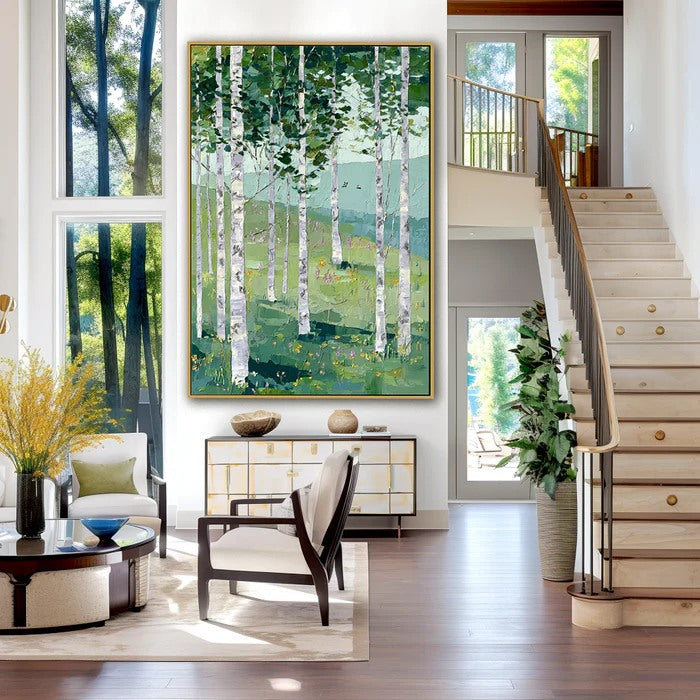
Determining how high do you hang pictures is not merely an aesthetic choice; it is a precise calibration of human vision and room acoustics. The international standard for gallery curation places the center of the artwork at exactly 57 inches (145 cm) from the floor, a height that aligns with the average human eye level and creates a stable visual anchor . However, in modern residential and commercial spaces with high ceilings, large furniture, or hard reflective surfaces, rigid adherence to this number can cause the room's acoustic重心 (center of gravity) to float, exacerbating flutter echoes near the ceiling or compressing the viewing experience. When hanging art with textured, 3D surfaces, precise height adjustments ensure that light strikes the canvas at an optimal 45-degree angle to reveal depth while aligning the panel's sound-absorbing mass with the listener's ear level for maximum acoustic efficacy.
The 57-Inch Rule: Museum Standard vs. Residential Reality
The "57-inch rule" is the gold standard used by major museums worldwide, including the Guggenheim and the Louvre, to ensure art is viewable by the widest range of visitors . This measurement is taken from the finished floor to the center of the artwork, not the top of the frame. The logic is physiological: the average human eye level stands at approximately 57 inches, creating a natural horizon line that feels balanced and inviting.
In a controlled gallery environment with consistent lighting and empty walls, this rule works perfectly. However, applying it blindly to a living room or executive office often creates visual and acoustic dissonance.
When a room features a low sofa or a long dining table, hanging art strictly at 57 inches may leave a large, empty gap between the furniture back and the frame bottom. This gap disrupts the visual flow and, acoustically, leaves the mid-frequency reflection zone (where human speech and seated listening occur) unaddressed by the absorption material.
Visual Neurology and the Acoustic Center of Gravity
The placement of wall art directly influences how sound waves behave in a room, particularly in spaces with hard surfaces like drywall, glass, or polished concrete. When art is hung too high, the visual重心 shifts upward, and the lower portion of the wall remains a hard, reflective surface. This creates a "floating" effect where sound bounces aggressively between the floor and the bottom edge of the artwork, often worsening flutter echo in the mid-frequency range where human voices reside.
Conversely, hanging art too low compresses the visual field, making ceilings feel lower and creating a sense of claustrophobia. More critically, it misaligns the acoustic treatment from the primary listening zone. For art that functions as an acoustic panel—such as the textured, sound-absorbing collections from artist collectives like Artextured—the center of the panel should ideally align with the ear height of the primary occupant.
-
Seated Listening Zone: In a home theater or office, ear height is typically 36–42 inches. Hanging the center of an acoustic panel here maximizes absorption of speech and media frequencies.
-
Standing Viewing Zone: In a foyer or gallery, 57 inches remains optimal for visual engagement.
-
Hybrid Spaces: In a living room where people sit and stand, aim for 57–60 inches to balance both visual and acoustic needs .
This alignment is what designers call "acoustic golden positioning." It ensures that the porous, sound-dampening core of the artwork intercepts sound waves exactly where they matter most, rather than treating empty wall space high above the listener.
Lighting Angles and Texture Revelation
The height of your artwork dictates how light interacts with its surface, especially for pieces with 3D textures, heavy impasto, or raised fibers. Light sources—whether natural window light or directional track lighting—should ideally strike the artwork at a 45-degree angle to reveal depth without creating harsh glare.
When art is hung too high, overhead track lighting often casts long, unnatural shadows downward, obscuring the upper texture and flattening the visual impact. When hung too low, light may graze the surface too horizontally, creating excessive glare that washes out color.
Optimizing Light and Sound Simultaneously
For textured acoustic art, the correct height serves a dual purpose:
-
Visual: The 45-degree light angle penetrates the texture, casting micro-shadows that emphasize the hand-crafted depth and artisanal quality of the piece.
-
Acoustic: The same textured surface, now properly illuminated and visible, acts as a diffuser and absorber. The irregularities in the surface break up sound waves, preventing them from reflecting directly back into the room.
If you are installing a large, bold abstract piece with significant surface relief, measure the light source position first. If your track lights are 8 feet high, calculate the掛高 (hanging height) so the center of the art sits where the light hits it most effectively. This often requires raising the center slightly above 57 inches in rooms with high ceilings to maintain the light angle.
Adjusting for Furniture and Architectural Scale
The 57-inch rule is a starting point, not a law. In residential and commercial interiors, furniture and architectural scale often dictate the final height. The goal is to create a visual relationship between the art and the objects below it.
Above Sofa or Console Tables
When hanging art above a sofa, the frame should not float in isolation. Standard practice is to hang the bottom of the frame 6 to 10 inches above the back of the sofa.
-
Calculation: If your sofa back is 32 inches high, the bottom of the frame should be at 38–42 inches. The center of the art will then naturally fall between 58 and 64 inches, slightly higher than the museum standard but visually anchored to the furniture.
-
Acoustic Benefit: This placement ensures the acoustic panel covers the wall space directly behind the seated listener's head, absorbing reflections that would otherwise bounce off the hard wall and into the ear.
In Foyers with High Ceilings
In spaces with 10-foot or higher ceilings, hanging art at 57 inches can make it look tiny and disconnected from the architecture.
-
Strategy: Raise the center to 60–66 inches. This creates a "visual bridge" between the floor and the high ceiling, preventing the art from looking sunk.
-
Acoustic Note: In high-ceilinged rooms, the primary echo issue is often vertical flutter between floor and ceiling. While raising the art helps visually, ensure the total surface area of acoustic art is sufficient to dampen the room volume. A single small frame in a vast atrium will not solve systemic reverberation.
Gallery Walls and Multi-Frame Arrangements
For gallery walls, treat the entire grouping as a single unit. Find the center point of the entire arrangement and hang that at 57 inches.
-
Alignment: Ensure the spacing between frames is consistent (usually 2–3 inches) to maintain a unified visual mass.
-
Acoustic Consistency: A clustered arrangement of multiple acoustic panels creates a larger absorption surface, which is more effective at damping mid-frequency echoes than a single isolated frame.
When Placement Fails: Acoustic and Visual Limitations
Even with perfect height calculation, certain spatial conditions can undermine the effectiveness of wall art as both visual and acoustic treatment. Understanding these limitations is critical for professional specification.
The "Single Frame in a Giant Room" Trap
Hanging one acoustic art panel on a massive, 20-foot concrete wall in a corporate lobby will not eliminate the room's reverberation. Sound waves travel in 3D; a single small target cannot absorb enough energy to change the room's acoustic signature.
-
Reality Check: Effective acoustic treatment requires covering 20–40% of the total wall surface area in highly reflective rooms.
-
Solution: Use multiple panels arranged in a grid or cluster to create a sufficient absorption zone.
Coating and Sealing Risks
A common mistake is applying thick, glossy paint, varnish, or non-porous sealants over acoustic canvas to "protect" it. This creates a hard, impermeable shell that reflects sound waves instead of absorbing them.
-
Consequence: The panel becomes a visual asset but an acoustic reflector, potentially worsening the echo problem it was meant to solve.
-
Guideline: If protection is needed, use only breathable, acoustically transparent fabrics or specialized porous sealants that do not block the weave.
Over-Dampening and Dead Space
In small rooms, installing too many acoustic panels can create an unnaturally "dead" space where speech sounds muffled and lacks natural resonance.
-
Balance: Aim for a balance between absorption and reflection. Retain some hard surfaces (like a glass table or wooden floor) to maintain natural liveliness while using art panels to control harsh echoes.
Structural Soundproofing Myths
Surface-mounted acoustic art panels reduce reverberation inside a room but do not stop sound from traveling through walls. They cannot block traffic noise from outside or neighbors' voices through a shared wall.
-
Distinction: These panels are for acoustic treatment (improving internal sound quality), not soundproofing (blocking sound transmission). For isolation, mass-loaded barriers or decoupled wall construction is required.
Material Mechanics in Functional Fine Art Curation
For designers seeking to merge high-end aesthetics with genuine acoustic performance, the material composition of the artwork is as important as its height. Brands like Artextured, founded as an artist collective in Xiamen, exemplify this approach by blending traditional fine art craftsmanship with hidden sound-attenuation technology .
Their collections range from subtle minimalist textures to bold abstract designs, all engineered with a porous, sound-absorbing core that remains invisible to the viewer. This allows the art to function as a professional acoustic panel without the industrial look of traditional foam or fiberglass baffles.
When selecting art for acoustic optimization:
-
Texture Depth: Deeper textures (hand-applied impasto, woven fibers) provide better sound diffusion and absorption than flat prints.
-
Fabric Weave: The outer fabric must be acoustically transparent to allow sound waves to penetrate the absorption core.
-
Scale Matching: Larger panels absorb lower mid-frequencies better than small frames. In a large office, opt for oversized canvases (48 inches wide or more) to maximize coverage.
This approach is ideal for luxury design firms, boutique curators, and corporate spatial planners who need to eliminate echo without compromising the visual purity of the space. The collective's gallery-tested heritage ensures that every piece meets the rigorous standards of urban exhibition spaces, where both visual clarity and auditory comfort are non-negotiable.
Frequently Asked Questions
What is the exact measurement for hanging art at eye level?The standard gallery height is 57 inches from the floor to the center of the artwork, which aligns with the average human eye level for standing visitors . This measurement ensures the art is comfortably viewable without straining the neck.
Should I hang art higher if I have high ceilings?Yes, in rooms with ceilings higher than 9 feet, raise the center of the art to 60–66 inches to prevent it from looking visually "sunk" and to maintain proportion with the architectural scale .
How do I hang art above a sofa without it looking disconnected?Hang the bottom of the frame 6–10 inches above the back of the sofa. This visually anchors the art to the furniture and keeps the center height in the optimal 58–64 inch range for seated viewing .
Does hanging art height affect sound absorption?Yes, for acoustic art panels, the center should align with the primary listening zone (ear height). For seated areas, this is often 36–42 inches; for standing areas, 57 inches ensures the absorption targets the correct frequency range.
Can acoustic art panels replace soundproofing?No, acoustic art panels reduce internal reverberation and echo but do not block sound transmission between rooms. For soundproofing, structural isolation and mass-loaded barriers are required.