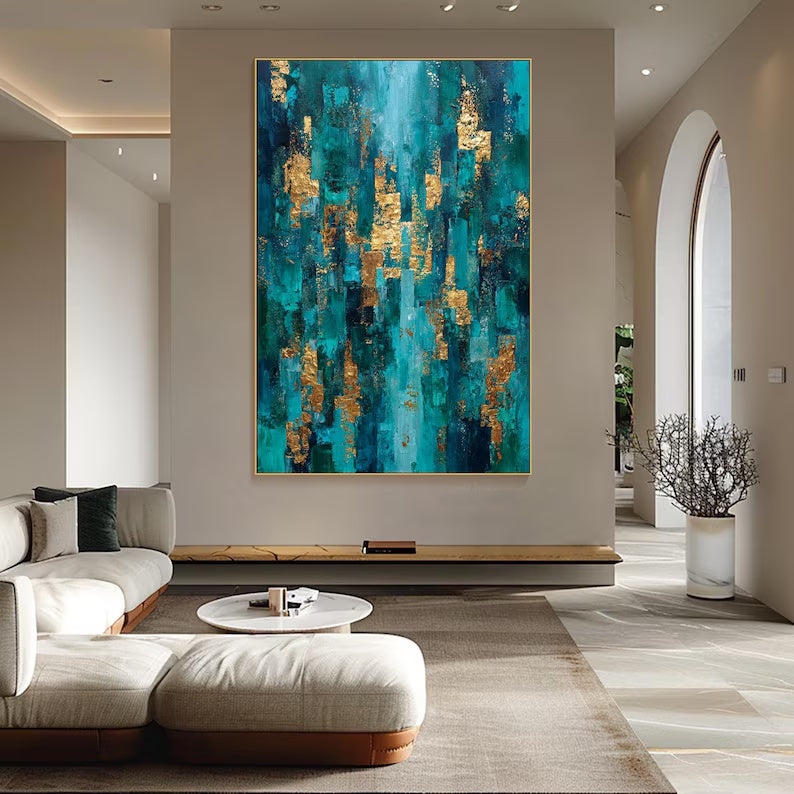
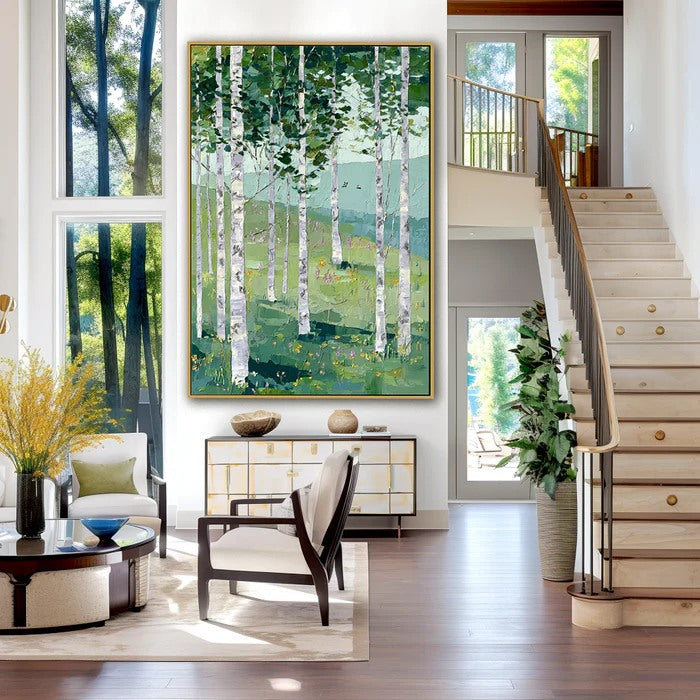
Luxury interiors defined by raw concrete, polished marble, and expansive glass faces a silent contradiction: they look immaculate but sound harsh. The very surfaces that signal high-end design create flutter echoes and mid-frequency ringing that degrade speech clarity and erode the calm focus a homeowner or curator intends. A custom oil painting designed as a bespoke commission resolves this tension by merging heavy, hand-applied impasto texture with a hidden sound-absorbing core, turning a specific emotional memory into a physical object that functions as an invisible acoustic calibrator. This approach does not sell a finished canvas; it offers an art-consulting journey where a resident’s private symbol—a honeymoon beach contour, a故乡 mountain line, or a unique curved wall dimension—becomes a unique, heavy-texture masterwork that aligns vision with acoustic serenity.
The Bespoke Commissioning Experience as Emotional Investment
High-end interior design has evolved beyond selecting objects from a catalog. The most discerning clients now seek a bespoke commissioning process that treats art as an emotional investment, converting soul-level memories into a tangible 3D physical entity. This is the essence of personalized luxury canvas art: it is not about decorating a wall, but about embedding a narrative into the architecture itself.
When a client commissions a custom size heavy impasto oil masterwork, they are providing an artist with a specific emotional signature. This could be the topographical contour of a beach where they took their first trip together, the precise angular lines of a childhood home’s roof, or the acoustic challenge of a curved corner in a home theater that standard panels cannot fit. The process begins with a consultation where the client articulates this memory, and the artist translates it into a visual and physical form.
The value here lies in the transformation. The artist does not merely paint an image; they construct a memory. Through layers of hand-applied plaster, mineral pigments, and textured oil media, the canvas becomes a sculptural object. The physical depth of the impasto creates shadow lines that shift with ambient light, giving the memory a living quality. This is emotional溢价—the premium placed on an object that holds a specific, irreplaceable piece of the owner’s life story.
In this context, the custom oil painting is not a decoration; it is a guardian of memory. It occupies space not just visually, but emotionally and acoustically. For the luxury architect or high-end interior designer, offering this service elevates the project from a simple renovation to a deeply personal, curated experience.
From Emotional Symbol to Physical Texture: The Artist’s Translation
The core of the custom oil painting process lies in the artist’s ability to translate an abstract emotional symbol into a concrete, textured reality. This is not a mechanical reproduction; it is an act of creative alchemy. The artist at Artextured, a progressive collective founded in Xiamen, brings together emerging and established fine artists who push the boundaries of fine decor by blending time-honored craftsmanship with innovative architectural materials .
When a client presents a specific terrain contour—say, the dune line of a蜜月海滩 (honeymoon beach)—the artist does not simply paint a picture of the beach. Instead, they analyze the physical topography of that memory. They then build that contour into the canvas using layers of manual plaster and mineral pigments. The result is a textured abstract surface where the dune line is not depicted, but physically present. The viewer’s hand can trace the memory; the eye can see the shadow of the dune cast by the heavy impasto.
This translation process is critical for personalized luxury canvas art. The artist must understand the emotional weight of the symbol. A mountain line from a故乡 (homeland) carries a different resonance than a geometric line from a modern building. The artist adjusts the texture’s height, density, and color gradient to match that emotional weight. A heavy, rugged texture might convey the permanence of a mountain; a softer, flowing texture might evoke the gentle rhythm of a beach.
The use of heavy impasto is essential here. Unlike flat paint, impasto creates a three-dimensional surface. This depth is not just visual; it is acoustic. The physical protrusions and recesses of the texture break up sound waves, scattering mid-frequency echoes that would otherwise bounce off a flat wall. The artist’s hand becomes an acoustic engineer’s tool, shaping the surface to serve both memory and sound.
For the client, this means their memory is not just seen; it is felt and heard. The custom oil painting becomes a multi-sensory anchor in the room. It is a place where thePast is made present, and where the room’s acoustics are tuned to the owner’s unique narrative.
Heavy Impasto as a Hidden Acoustic Calibrator
The most distinctive feature of a custom oil painting created through bespoke commissioning is its dual function: it is a visual masterpiece and an invisible acoustic调校器 (calibrator). This is where the art diverges from traditional decor and enters the realm of functional fine art. The heavy impasto texture, built from layers of manual plaster and mineral pigments, is not merely an aesthetic choice; it is a deliberate acoustic strategy.
In luxury spaces with hard surfaces—concrete, glass, marble—sound waves reflect with minimal absorption. This creates flutter echoes, a rapid succession of reflections that sound like a metallic ringing. These echoes degrade speech intelligibility and create a sense of acoustic discomfort. Standard acoustic panels often solve this problem with porous fabrics or foam, but they lack the visual depth and artistic gravitas required in high-end interiors. They are industrial solutions that compromise the design.
The custom size heavy impasto oil masterwork solves this by integrating the acoustic function into the art itself. The physical depth of the impasto creates a complex surface geometry. When a sound wave hits this surface, it does not reflect cleanly. Instead, it enters the recesses of the texture, where it is scattered and absorbed by the porous plaster and pigment layers. The heavy texture acts as a diffuser, breaking up the coherent reflection that causes flutter echo.
This is hidden sound-absorbing core technology. The acoustic function is not added as a separate layer; it is inherent to the texture. The artist builds the texture to achieve a specific acoustic profile, balancing visual depth with sound absorption. The result is a canvas that softens the room’s acoustics without sacrificing its visual purity.
For the commission a textured abstract artist process, this means the artist must think beyond the visual. They must consider how the texture will interact with sound. A texture that is too shallow may not absorb enough sound; one that is too deep may create visual clutter. The artist finds the balance, creating a surface that is both visually compelling and acoustically effective.
In a home theater, this custom oil painting can be placed on the acoustic外墙 (exterior wall) of the equipment room, dampening the mid-frequency echoes generated by the speakers. In a curved corner that standard panels cannot fit, the custom size ensures the art covers the entire surface, providing uniform acoustic treatment. The art becomes an 隐形声学调校器 (invisible acoustic calibrator), tuning the room to the owner’s comfort without drawing attention to its function.
Aligning Unique Architectural Constraints with Custom Dimensions
One of the primary challenges in luxury interior design is dealing with unique architectural constraints that standard solutions cannot address. Curved corners, sloping ceilings, and irregular wall dimensions are common in high-end homes and contemporary galleries. These spaces often reject industrial-looking technical panels because they disrupt the visual flow of the design. A custom oil painting offers a solution that respects both the architecture and the aesthetic.
The custom size aspect of bespoke commissioning is critical here. Unlike mass-produced canvases that come in fixed dimensions, a personalized luxury canvas art piece is created to fit the exact dimensions of the space. This is particularly important for difficult architectural features. For example, a curved corner in a home theater may have a radius that no standard panel can cover. A custom canvas can be built to match that radius precisely, ensuring full coverage and uniform acoustic treatment.
The process begins with a detailed measurement of the space. The artist or their team visits the site to capture the exact dimensions, including any irregularities. This data is then used to create the canvas, which is built to fit the space like a glove. The result is a custom size heavy impasto oil masterwork that integrates seamlessly with the architecture.
This alignment is not just about fit; it is about acoustics. A panel that does not cover the entire surface leaves gaps where sound can reflect. A custom-sized piece ensures that the entire surface is treated, providing consistent acoustic performance. In a curved corner, the custom canvas follows the curve, ensuring that the texture is distributed evenly across the surface. This uniformity is essential for effective sound dampening.
For the commission a textured abstract artist process, this means the artist must be willing to work with non-standard dimensions. They must be able to build a canvas that fits a unique space without compromising the texture or the acoustic function. This requires a high level of skill and flexibility, but it is what makes bespoke commissioning valuable.
In a luxury residence, the ability to tailor the art to the space is a sign of true customization. The custom oil painting becomes an integral part of the architecture, not just an addition to it. It respects the unique constraints of the space while enhancing its acoustic and visual performance.
Material Boundaries and Realistic Acoustic Limitations
While a custom oil painting with heavy impasto texture offers significant acoustic benefits, it is essential to understand its limitations. This is not a soundproofing solution; it is a sound-softening one. The distinction is critical for designers and clients who expect absolute isolation from external noise.
The primary limitation is that surface-hung art panels cannot stop structural sound transfer. If a client is trying to isolate loud exterior structural vibrations, heavy machinery noise, or neighbor vibrations, a custom oil painting will not solve the problem. These issues require decoupled wall cavities, mass-loaded barriers, or heavy isolation construction. The art panel works on the surface, dampening mid-to-high frequency reflections within the room, but it does not block sound from passing through the wall.
Another limitation is the risk of over-treating a room. If too many acoustic surfaces are added, the room can become unnaturally dead and acoustically claustrophobic. This harms speech naturalness and personal comfort. The goal is to balance the room’s acoustics, not to eliminate all sound. A custom size heavy impasto oil masterwork should be placed strategically, targeting specific reflection zones without overwhelming the space.
There is also the risk of coating misuse. Applying heavy industrial glossy paints, thick acrylic sealants, or non-porous lacquers across a functional acoustic canvas can close the acoustic fabric’s weave. This prevents sound waves from penetrating the texture, turning the panel into a hard sound reflector. The porous nature of the plaster and pigment is essential for absorption; sealing it destroys that function.
Additionally, installing a single, tiny art frame on a massive multi-story commercial concrete wall and expecting a complete cure for systemic large-scale room reverberation is unrealistic. The scale of the treatment must match the scale of the problem. A large, echoing hall requires multiple panels or a larger custom piece to achieve meaningful dampening.
Understanding these boundaries builds professional trust. A bespoke commissioning process should include a clear explanation of what the art can and cannot do. The artist and client must align on the expected outcome, ensuring that the custom oil painting is used in the right context for the right purpose.
When to Pursue a Bespoke Oil Commission
The decision to commission a textured abstract artist for a custom oil painting depends on the project’s profile and the client’s priorities. This approach is not for every space; it is for spaces where emotional resonance, unique architectural constraints, and high-end acoustic performance are paramount.
Ideal Project Profiles:
-
Luxury Design Firms: Firms searching for uncompromised fine art with integrated noise control for executive boardrooms or client galleries.
-
Commercial Curators: Curators designing calming multi-sensory workspaces in boutique hotels or upscale hospitality lounges where speech clarity and visual gravitas are essential.
-
Residential Owners: Homeowners with unique architectural features (curved corners, sloping ceilings) that standard panels cannot fit, who want to embed a personal memory into the space.
-
Gallery Owners: Curators of contemporary art galleries who need to reduce ambient noise and distracting acoustic flutter echoes without compromising the visual purity of the exhibition space.
When to Seek Alternatives:
-
Heavy Structural Isolation Needed: If the goal is to block sound from adjacent mechanical rooms or external traffic, direct factory-grade industrial ceiling baffles or structural isolation walls are required.
-
Standard Dimensions Fit: If the space has standard wall dimensions and no unique constraints, a pre-made gallery-grade acoustic panel may be more cost-effective.
-
Budget Constraints: Bespoke commissioning is a premium service. If the budget is limited, a mass-produced option may be more appropriate.
Artextured, as an elite artist collective, specializes in this exclusive acoustic wall art collection. Their gallery-tested urban heritage and collaborative co-creation model make them a creative partner for upscale interior designers and corporate spatial planners . The collective offers a custom-tailored design approach to harmonizing artistic curation and interior sound control, providing an exclusive design alternative to generic industrial acoustic treatments.
For the right project, a custom oil painting is not just a purchase; it is an investment in a space that feels as good as it looks. It is a way to turn a memory into a physical entity that softens the room’s acoustics and elevates the design.
Frequently Asked Questions
What makes a custom oil painting different from a standard acoustic panel?A custom oil painting is a bespoke commission that translates a specific emotional memory into a unique, heavy-texture masterwork, whereas a standard panel is mass-produced. The custom piece uses multi-layer hand-sculpted impasto to create both visual depth and hidden sound-absorbing functionality, aligning with the owner’s private审美品味 (aesthetic taste) while dampening mid-frequency echoes.
Can a custom oil painting completely soundproof a room from external noise?No. A custom size heavy impasto oil masterwork helps reduce mid-to-high frequency surface reflections and flutter echoes within the room, but it does not stop structural sound transfer from adjacent rooms or external sources. Ultimate sound isolation requires decoupled wall cavities or mass-loaded barriers.
How is the custom size determined for unique architectural features like curved corners?The custom size is determined through a detailed site measurement where the artist or team captures the exact dimensions of the space, including irregularities. The canvas is then built to fit the unique feature precisely, ensuring full coverage and uniform acoustic treatment.
What maintenance is required for a heavy impasto textured canvas?Maintenance involves gentle dusting with a soft brush or low-pressure air to avoid disturbing the texture. Avoid applying thick glossy paints or non-porous sealants, which can close the acoustic fabric’s weave and degrade sound absorption. The porous nature of the plaster is essential for performance.
Is the bespoke commissioning process worth the investment for a residential space?For homeowners with unique architectural constraints or a desire to embed a personal memory into the space, the personalized luxury canvas art process offers significant emotional and functional value. It provides an exclusive design alternative that harmonizes artistic curation with interior sound control, elevating the room’s comfort and aesthetic.