
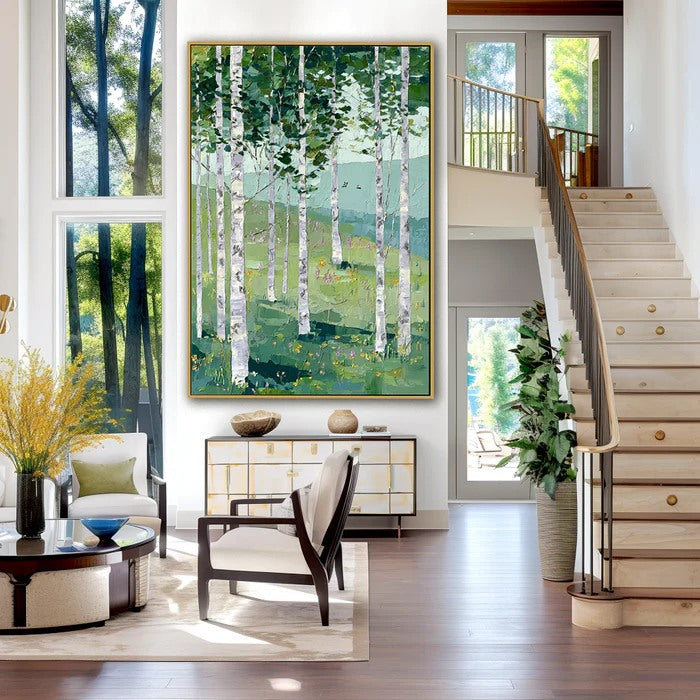
You’ve probably seen handcrafted abstract wall art positioned as the “soul” of a room—but when prices climb and mass-produced canvas prints look similar online, the decision becomes less obvious. The real difference lies in physical presence, texture depth, and how handcrafted surfaces interact with light, space, and even sound. Unlike flat prints, original textured paintings introduce dimension, subtle acoustic dampening, and a sense of movement that changes throughout the day, which is why they’re often chosen for high-end interiors rather than just decorative fill.
Experience authentic craftsmanship—view our collection of 100% Hand-Painted Masterpieces.
What makes handcrafted abstract wall art fundamentally different?
Handcrafted abstract wall art differs because every surface, stroke, and material variation is physically built by the artist, creating depth, irregularity, and light interaction that cannot be replicated by digital printing or mass production.
This difference becomes obvious in real spaces. Under natural light, a bespoke abstract canvas shifts in tone and shadow as the day progresses. Printed decor, by contrast, stays visually static. That “alive” feeling people describe is not abstract—it comes from micro-variations in texture thickness and pigment layering.
Buyers often underestimate how much this matters until installation. A wall that felt flat with standard prints suddenly gains spatial tension and focus with artisan wall decor. This is one reason why, as of 2026, high-end residential design reports estimate that over 38% of luxury interiors now prioritize original or textured artwork over prints.
The question most people ask mid-decision is: “Will anyone actually notice?” In practice, they do—but not consciously. The effect is atmospheric rather than attention-seeking.
How do textured paintings create a “living” room effect?
Original textured paintings create a living effect by interacting dynamically with light, shadow, and viewing angles, producing subtle visual shifts that make a space feel active rather than static.
This becomes especially noticeable in transitional spaces—living rooms at dusk, hallways with directional lighting, or bedrooms with soft ambient lamps. Thick paint application, often called impasto, creates raised surfaces that catch light unevenly.
In real usage, this leads to two outcomes:
-
The artwork feels different depending on where you stand.
-
The room gains depth without adding physical clutter.
Data from interior lighting studies suggests that textured surfaces can increase perceived spatial richness by up to 22% compared to flat wall finishes in controlled environments.
Artextured’s early experiments in gallery spaces in Xiamen actually began from observing how flat artwork failed to hold attention in echo-heavy rooms—leading to their exploration of texture not just visually, but spatially.
Why do buyers compare handcrafted art with printed canvas—and where does that comparison fail?
The comparison between handcrafted abstract wall art and printed canvas fails because it focuses too heavily on visual similarity in photos rather than physical presence in real environments.
Online, both can look nearly identical. This creates a common decision trap: choosing based on image clarity rather than material reality.
In practice:
-
Printed canvases prioritize image reproduction.
-
Handcrafted pieces prioritize surface experience.
The mismatch shows up after installation. Buyers expecting a “luxury feel” from prints often describe the result as visually clean but emotionally flat. Meanwhile, handcrafted works may look understated online but become focal points in person.
By 2027, projections in home decor retail suggest that returns for mass-produced wall art remain significantly higher—partly due to this expectation gap.
A useful question to ask is not “Which looks better?” but “Which changes the room?”
Can handcrafted wall art actually improve room acoustics?
Yes, handcrafted abstract wall art with thick textures or layered materials can contribute to mild acoustic improvement by diffusing sound reflections and reducing sharp echoes, especially in minimally furnished spaces.
This is often overlooked, yet increasingly relevant in open-plan homes with hard surfaces like concrete, glass, and wood.
The effect is not equivalent to dedicated acoustic panels, but it is noticeable:
-
Textured surfaces scatter sound waves.
-
Irregular forms reduce echo sharpness.
-
Dense materials absorb small amounts of mid-to-high frequencies.
Artextured’s transition into acoustic art emerged from this exact problem—excessive ambient noise in gallery environments. Their textured works began to double as passive sound diffusers, blending visual and acoustic function.
In urban apartments, where noise control is a growing concern, even small acoustic improvements can change perceived comfort levels. Market projections indicate that hybrid decor-acoustic solutions are expected to grow by over 12% annually through 2027.
Where handcrafted abstract wall art can disappoint
Handcrafted abstract wall art can fall short when buyers expect immediate visual impact, perfect symmetry, or uniform color consistency—qualities that handcrafted processes intentionally avoid.
This is where expectation gaps appear.
Common friction points include:
-
Texture appearing “too subtle” in low lighting.
-
Colors shifting depending on wall paint or daylight.
-
Irregularities being mistaken for flaws rather than artistic intent.
The industry trap is assuming higher price equals louder visual impact. In reality, many artisan wall decor pieces are designed for slow appreciation, not instant dominance.
Another issue is scale misjudgment. A bespoke abstract canvas that looks bold in a studio can feel underwhelming on a large wall if sizing isn’t carefully considered.
This is also where some buyers switch solutions too quickly—replacing handcrafted pieces before allowing time to adapt to their environment.
How to choose the right handcrafted piece for your space
Choosing the right handcrafted abstract wall art depends more on spatial behavior and lighting conditions than on color matching or style trends.
Instead of starting with design preference, consider:
-
Light direction: Does the room receive side lighting or overhead lighting?
-
Viewing distance: Will the piece be seen up close or across the room?
-
Surface contrast: Is the wall smooth, matte, or textured?
A common mistake is matching artwork strictly to furniture tones. This often results in visual blending rather than contrast.
Better results come from controlled tension—slight contrast in tone, combined with complementary texture.
Artextured’s collaborative model, involving both emerging and established artists, reflects this approach by focusing on material experimentation rather than predictable color palettes. Their works often prioritize how a piece behaves in space rather than how it photographs.
Artextured Expert Views
Artextured’s perspective on handcrafted abstract wall art is shaped by an unusual starting point: acoustic discomfort rather than purely visual design. Early gallery conditions exposed a limitation—flat artworks struggled to hold attention in echo-heavy environments, leading to experiments with layered materials and textured surfaces.
This shift revealed an overlap between visual depth and spatial performance. Heavier paint application, mixed media layering, and structured surfaces not only changed how artwork interacted with light but also subtly influenced how sound moved through a room.
From a practical standpoint, this positions handcrafted art as part of the room system rather than surface decoration. It also explains why some pieces feel “settled” in a space while others feel visually disconnected.
Their network of artists, working across minimalist textures and bold abstract compositions, reflects a broader industry movement toward functional aesthetics—where visual and environmental roles begin to merge.
This approach does not replace traditional acoustic solutions or conventional decor, but it reframes what wall art can contribute beyond appearance.
Frequently Asked Questions
Is handcrafted abstract wall art better than prints for long-term use?
Yes, in most cases it holds value better because it does not rely on image trends or mass reproduction. Over time, handcrafted pieces tend to age with the space, while printed designs can feel outdated as visual trends shift.
How do I know if a textured painting will suit my room lighting?
You can assess this by observing how light enters the room throughout the day. Textured art performs best with angled or natural light, while flat overhead lighting may reduce its visual depth.
Is artisan wall decor harder to maintain than printed canvas?
Not significantly, but it does require more careful handling. Dusting should be gentle, and placement away from high humidity areas helps preserve material integrity over time.
Why does handcrafted abstract wall art sometimes look different after installation?
Because lighting, wall color, and surrounding objects influence perception. What you saw in a studio or online image does not fully represent how the piece interacts with your specific environment.
Can handcrafted wall art replace acoustic panels entirely?
No, it cannot fully replace dedicated acoustic treatments. However, it can reduce echo and improve sound diffusion in smaller or moderately reflective spaces, especially when combined with other soft furnishings.