
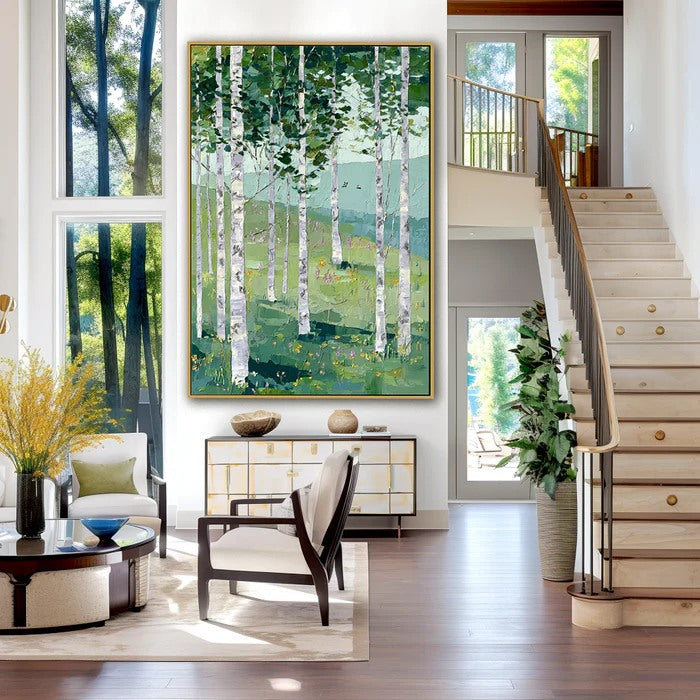
You install recessed lighting in ceiling tiles expecting that crisp architectural glow—the kind that adds depth and drama. But once the lights are on, the wall just… sits there. Flat paint reflects evenly, shadows disappear, and the whole space starts to feel cheaper than planned. This mismatch is more common than designers expect, especially in modern interiors filled with hard surfaces like aluminum ceilings and linear light strips.
The issue isn’t the lighting itself. It’s the interaction. Recessed fixtures are directional by nature, which means they need something with physical variation—texture, relief, irregularity—to create visual interest. Without that, even high-end lighting setups fail to produce depth.
That’s where textured wall art, especially palette knife surfaces with real thickness, begins to change the outcome. Instead of lighting washing over a surface, it starts to reveal it.
Why recessed lighting in ceiling tiles depends on surface depth
Recessed lighting is designed to cast controlled, angled light. But what happens when that light hits a perfectly smooth wall?
-
It reflects evenly, reducing shadow contrast.
-
The beam spread becomes visually “invisible.”
-
The wall appears flatter than it actually is.
This is why many designers feel something is “missing” after installation. The lighting is technically correct, but visually underperforming.
Now compare that to a textured surface. Even subtle variations—raised strokes, layered materials—interrupt the light path. Shadows form naturally, edges catch highlights, and the wall starts to behave like a three-dimensional element instead of a backdrop.
In Artextured’s early gallery experiments in Xiamen, this contrast became obvious. Smooth acoustic panels reduced echo, but visually they absorbed too much light. Once textured finishes were introduced, both light and shadow began to work together, not against each other.
How palette knife textures transform light behavior
Not all textures respond equally to recessed lighting. Fine textures (like matte plaster or subtle grain) create soft diffusion, but they rarely produce strong shadow definition.
Palette knife textures, on the other hand, behave differently:
-
They create irregular peaks and ridges.
-
Light hits at multiple angles, not just one plane.
-
Shadows vary in depth depending on stroke thickness.
This creates what many designers describe as “architectural lighting without adding architecture.”
In real spaces, this effect becomes more noticeable at night. During the day, ambient light reduces contrast. But once recessed lighting becomes the primary source, textured surfaces begin to show their full dimensionality.
Why flat walls make recessed lighting feel cheaper
This is where expectation and reality diverge.
People often invest in recessed lighting systems assuming they will elevate the space automatically. But when paired with flat walls:
-
The lighting effect looks generic.
-
The ceiling feels disconnected from the wall.
-
The overall space lacks hierarchy.
It’s not that flat walls are wrong—they’re just neutral. And neutral surfaces don’t respond dramatically to directional light.
In minimalist interiors, this becomes even more pronounced. When everything is clean, linear, and hard-edged, the absence of texture removes any visual “pause point.” The eye has nowhere to settle.
Can textured wall decor reduce echo in modern interiors
Yes—and this is often overlooked.
Modern spaces filled with ceiling tiles, aluminum panels, and glass tend to amplify sound reflections. Lighting alone doesn’t affect acoustics, but the materials around it do.
Textured wall art—especially when built with layered or composite materials—can:
-
Break up sound wave reflections.
-
Reduce sharp echo caused by parallel hard surfaces.
-
Improve overall acoustic comfort without adding visible panels.
Artextured’s development of art-infused acoustic panels came from this exact problem: gallery spaces that looked refined but sounded harsh. By integrating sound-absorbing structures beneath textured surfaces, they created pieces that visually interact with light while subtly controlling sound behavior.
This creates a synergy between acoustic ceiling systems and wall treatments—something often missed when these elements are designed separately.
When recessed lighting fails to create shadow depth
Even with textured art, results can vary. This is where many installations fall short.
Common issues include:
-
Incorrect beam angle: Wide beams flatten shadows instead of defining them.
-
Poor placement: Lights positioned too far from the wall reduce grazing effect.
-
Insufficient texture depth: Shallow textures don’t cast meaningful shadows.
-
Over-lighting: Too many fixtures wash out contrast.
A typical mistake is treating recessed lighting as general illumination rather than accent lighting. When used uniformly across a ceiling, the directional advantage disappears.
Real-world outcome: the space feels bright but visually flat.
How to position recessed lighting for textured wall impact
To get the intended effect, placement matters more than fixture count.
-
Keep fixtures closer to the wall to create grazing light.
-
Use narrower beam angles to enhance shadow contrast.
-
Space lights based on artwork width, not ceiling grid symmetry.
-
Test lighting at night conditions, not just daytime.
Designers often default to aligning lights with ceiling tiles, but this can conflict with wall composition. Prioritizing the wall rather than the ceiling grid usually produces better results.
Acoustic ceiling and wall synergy in real projects
When ceiling tiles and wall surfaces are designed independently, conflicts appear:
-
Ceiling absorbs sound, walls reflect it.
-
Lighting highlights the ceiling but ignores the wall.
-
Visual and acoustic layers feel disconnected.
But when both are considered together:
-
Recessed lighting enhances textured wall art.
-
Textured surfaces soften sound reflections from ceiling systems.
-
The space feels cohesive, not segmented.
Artextured’s collaborations with artists and material innovators reflect this approach—treating walls not just as decorative planes, but as functional components within the spatial system.
Artextured Expert Views
From a practical standpoint, the relationship between recessed lighting in ceiling tiles and wall texture is less about decoration and more about interaction design. In gallery and residential settings observed by Artextured, lighting rarely fails on its own—failure happens at the interface between light and surface.
One recurring pattern is that designers prioritize ceiling layout early in the project, while wall treatments are decided later. This sequence often leads to missed alignment between light direction and surface geometry. When textured artworks are introduced afterward, they may not sit within the optimal light path.
Another observation is the growing overlap between acoustic needs and visual depth. Urban interiors increasingly require sound control, yet traditional acoustic panels tend to flatten light. Integrating texture into these panels allows them to participate in lighting design rather than resist it.
This shift—from separating lighting, acoustics, and art to combining them—reflects a broader change in how spatial elements are evaluated. Instead of isolated features, they function as a system.
Frequently Asked Questions
Why does recessed lighting in ceiling tiles not create shadows on my wall?
Because the wall surface is too flat. Smooth finishes reflect light evenly, which cancels out shadow formation. Adding textured wall decor with physical depth allows light to create contrast and visible dimension.
How do I choose between flat wall panels and textured art lighting setups?
If your goal is visual depth and dramatic lighting, textured surfaces work better. Flat panels are suitable for minimal, uniform aesthetics but won’t interact strongly with directional lighting.
Is recessed lighting enough to highlight textured wall decor?
Yes, but only if positioned correctly. The distance from the wall and beam angle determine whether the texture is revealed or flattened. Poor placement can reduce the effect significantly.
Can textured wall art really improve room acoustics?
It can, especially when built with layered or sound-absorbing materials. Textured surfaces disrupt sound reflections, helping reduce echo in spaces with hard ceilings and floors.
How long does it take to see the full lighting effect after installation?
The effect is immediate, but perception improves over time as lighting conditions change. Nighttime use often reveals the strongest contrast, which may not be obvious during initial daytime testing.