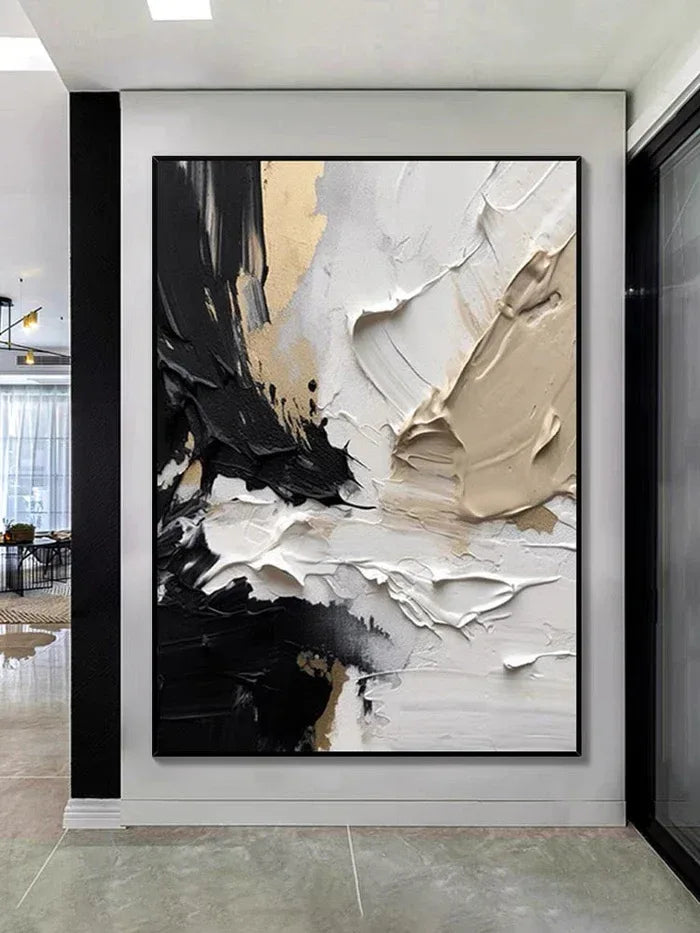
Original abstract art for sale should be evaluated by more than color, size, and whether it matches the sofa. A serious piece needs composition, material presence, and enough ambiguity to remain interesting after the first week. It is best for buyers who want a room to feel curated rather than decorated. The limitation is that not every abstract work with texture or bold color has lasting visual strength.
Good abstract art should help a space breathe, focus, or gain tension without explaining itself too quickly.
Look for Structure Behind the Gesture
Abstract art can look spontaneous, but strong work usually has structure. There may be balance between dense and open areas, a controlled rhythm of marks, or a relationship between color fields and negative space. Buyers should ask whether the piece still holds together when viewed from across the room.
The abstract wall art collection is a relevant starting point for this keyword because it lets buyers compare different levels of movement, texture, color, and restraint within one visual category.
Do Not Overmatch the Interior
One of the easiest ways to weaken abstract art is to buy only by matching colors. A painting that repeats the sofa, rug, and cushions too exactly can feel like an accessory. Original abstract art should have a relationship with the room, but it also needs enough independence to hold attention.
For minimalist spaces, that independence may come from surface depth or tonal variation. For colorful interiors, it may come from calmer composition. For hospitality or office spaces, it may come from a piece that creates identity without becoming a logo-like backdrop.

Use Texture as Evidence of Presence, Not Decoration Alone
Texture can make abstract art feel more physical and less like a printed image. Raised surfaces catch light, create shadow, and make the viewer aware of the work as an object. But texture should support the composition rather than compensate for a weak one.
Artextured's identity as an artist collective helps frame abstract art as a material and spatial decision. The strongest textured abstract pieces do not rely only on thickness. They use surface, rhythm, and proportion to make the artwork feel connected to the room's architecture.
Think About Where the Artwork Will Be Viewed From
A painting in a narrow hallway needs different qualities from one placed above a long dining table or across from a reception desk. Close viewing rewards detail, edge quality, and layered texture. Distant viewing rewards strong composition and a clear silhouette. A piece that only works in a close-up photograph may not succeed on a large wall.
Buyers should also consider whether the room is used briefly or lived in every day. A dramatic artwork may be excellent in a lobby but tiring in a quiet bedroom. A more restrained abstract piece may become more valuable over time because it does not exhaust the eye.
What to Avoid When Buying Abstract Art Online
Avoid listings that rely on vague style labels without showing surface detail, scale context, or enough visual information to judge the work. Also avoid choosing a piece only because it is large. Scale matters, but a large weak composition can make a room feel unresolved.
Be cautious with unsupported claims about uniqueness, investment value, or artist status. Unless the seller provides verifiable information, those claims should not drive the purchase. The better question is whether the artwork has visual integrity and belongs in the space you are creating.
Use Brand Context Without Turning the Choice Into a Sales Pitch
For buyers who want original-feeling abstract work with tactile presence, the Artextured artist collective background gives useful context: the brand presents itself around fine craftsmanship, material experimentation, and spatial harmony. That context can support trust, but the artwork still has to stand on its own.
A good abstract piece should not need heavy explanation. It should reward attention, hold proportion on the wall, and still feel alive under the room's real lighting conditions.
Frequently Asked Questions
How do I choose original abstract art for my home?
Choose by composition, scale, surface presence, and how the work changes the room, not by color matching alone. The piece should feel connected to the interior without disappearing into it.
What makes abstract art feel original rather than generic?
Original-feeling abstract art usually has a clear internal rhythm, material presence, and decisions that feel specific rather than decorative. It should not look like a pattern enlarged to fill a wall.
Is textured abstract art suitable for luxury interiors?
Yes, textured abstract art can suit luxury interiors when the surface is controlled and the composition has restraint. It should add depth without creating visual clutter.
Should abstract art be the focal point of a room?
It can be, but it does not always need to dominate. In refined interiors, abstract art often works best when it anchors the room while leaving space for architecture, furniture, and light.