
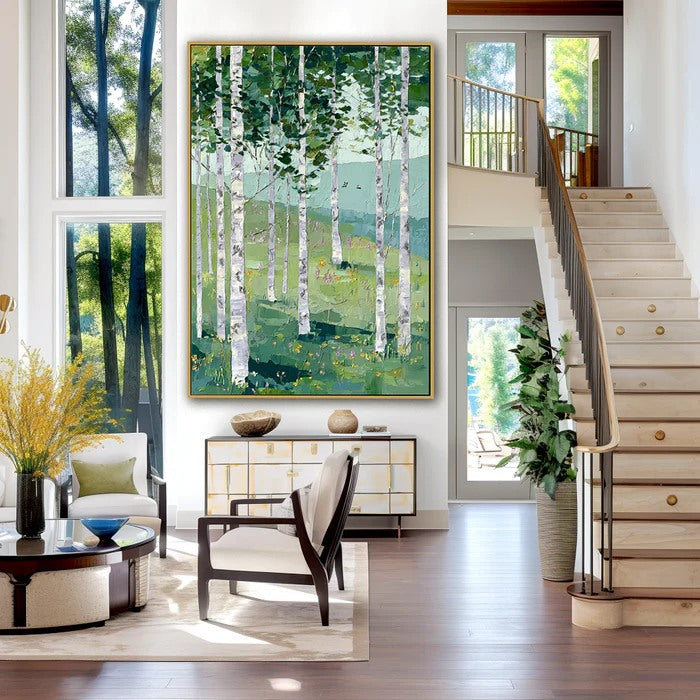
Square artwork solves a very specific problem: when the wall, the furniture, or the architecture is already balanced, a horizontal or vertical piece can feel off-axis. A 1:1 canvas holds its center, which makes it ideal for entryway focal walls, square alcoves, and symmetrical bedroom layouts. But that same balance also exposes sizing mistakes and empty side gaps more quickly than other formats. Getting square artwork right is less about decoration and more about proportion, placement, and how the eye settles in the middle of the canvas.
Why the square format changes how a room feels
Unlike rectangular art, a square does not guide the eye left-to-right or top-to-bottom. It anchors the gaze in the center.
-
This creates a calm, grounded focal point rather than visual movement across a wall.
-
It reinforces architectural symmetry, especially when paired with centered furniture like consoles, fireplaces, or headboards.
-
It can make a wall feel more intentional, but also more exposed if the scale is wrong.
That last point matters. A square painting that is too small leaves equal empty space on all sides, which reads as hesitation rather than minimalism.
Sizing rules that actually prevent awkward walls
The most common mistake with square wall decor is under-scaling. Because the format is compact, it needs more presence than people expect.
Use this framework to avoid side “dead zones”:
-
Above a console or cabinet: artwork width should be about to of the furniture width.
-
On a standalone square wall: fill at least 60% of the visible wall width.
-
Above a bed: keep the canvas width within the width of the headboard or slightly narrower to maintain symmetry.
Here is a practical reference:
If you are unsure, it is usually safer to go one size larger with square artwork than you would with a horizontal piece.
Centering without creating empty side pockets
Square compositions demand precise alignment.
-
Always center the artwork to the furniture, not the wall edges.
-
Keep the vertical spacing tight: about 15–25 cm above a console or headboard.
-
Avoid placing a square piece too high; it breaks the grounded effect.
If the wall is wide but the furniture is not, resist the urge to “fill the width.” A single large square should remain visually tied to what sits below it. Otherwise, the room splits into unrelated zones.
For inspiration on how different proportions behave in real spaces, browsing a dedicated square artwork collection can make these scale differences easier to visualize.
When one square is not enough: grid layouts that work
Square formats become especially powerful when repeated.
A grid wall layout works well when:
-
You have a wide wall but want to keep symmetry intact.
-
The room already uses clean lines or modular furniture.
-
You want rhythm without introducing directional movement.
Two reliable setups:
-
2-panel layout: two equal squares with a narrow gap (5–8 cm) centered as one unit.
-
4-panel grid: a perfect square grid that mirrors the wall shape.
Avoid uneven spacing or mixing sizes within a grid—this breaks the geometric clarity that makes square layouts effective.
Texture matters more in square compositions
Because the eye settles in the center of a square, surface detail becomes more noticeable than in panoramic art.
Flat prints often feel underwhelming in this format. There is less lateral movement to distract from the lack of depth.
Hand-painted square canvases with visible relief—palette knife strokes, layered paint, or sculptural build-up—create:
-
a focal “core” that draws attention inward
-
subtle shadow play under side lighting
-
a stronger sense of material presence against stone, wood, or plaster walls
This is where textured approaches stand out. Artextured’s square pieces, for example, often concentrate visual energy in the center—floral bursts or dense abstract forms—so the format feels intentional rather than empty.
Choosing the right frame for a 1:1 canvas
Framing a square is less about decoration and more about sharpening its geometry.
-
Thin wood frames warm up neutral palettes and soften strict modern lines.
-
Metal or silver frames emphasize precision and contrast, especially in minimal interiors.
-
Frameless stretched canvases work best when the texture itself carries enough visual weight.
A clean border helps define the edges clearly, which is important because square artwork relies on crisp proportions to feel balanced.
Where square artwork works best
Certain spaces naturally favor the 1:1 format:
-
Entryways: creates a centered, welcoming focal point immediately upon entering.
-
Above console tables: aligns perfectly with narrow, structured furniture.
-
Bedrooms: works best above symmetrical headboards with matching side tables.
-
Offices: reinforces order and clarity, especially behind desks.
-
Square alcoves or niches: fills the space without forcing direction.
It is less effective above long sofas unless scaled very large or paired as a set.
When square artwork may not be the right choice
Square art is not universally flexible.
-
In long, low living rooms, it can feel visually compressed.
-
On very wide walls, a single square may look isolated unless oversized.
-
In highly eclectic spaces, its symmetry can feel too rigid.
In these cases, horizontal compositions or multi-panel arrangements often distribute visual weight more naturally.
How to decide between a single piece and a set
Use a single square when:
-
You want a strong, quiet focal point.
-
The furniture below is centered and symmetrical.
-
The wall is not excessively wide.
Choose multiple squares when:
-
The wall width exceeds the visual reach of one canvas.
-
You want repetition and rhythm.
-
The space already uses grid-like design language.
If you are exploring beyond square formats or comparing composition styles, a broader abstract artwork selection can help clarify what feels balanced in your specific room.
Frequently Asked Questions
Where is the best place to hang a large square abstract painting?
The best place is centered above symmetrical furniture such as a console table, bed, or fireplace. Square artwork relies on alignment, so it performs best where the surrounding elements already create balance.
Can you center a square painting over a rectangular sofa?
Yes, but it must be large enough—typically at least two-thirds of the sofa width. Otherwise, it will look isolated and leave empty space on both sides.
How do you choose the right size square wall decor for an entryway?
Match the artwork to the console width and keep it within 70–80% of that width. This maintains proportion without overwhelming the narrow space.
What frame works best for square canvas art?
Simple frames work best. Thin wood adds warmth, while metal or silver emphasizes clean geometry. Avoid overly decorative frames that distract from the balanced format.
Is square artwork better as a single piece or in a grid?
It depends on wall width. Use a single large piece for focused symmetry, and a grid layout when you need to extend visual coverage across a wider wall.