
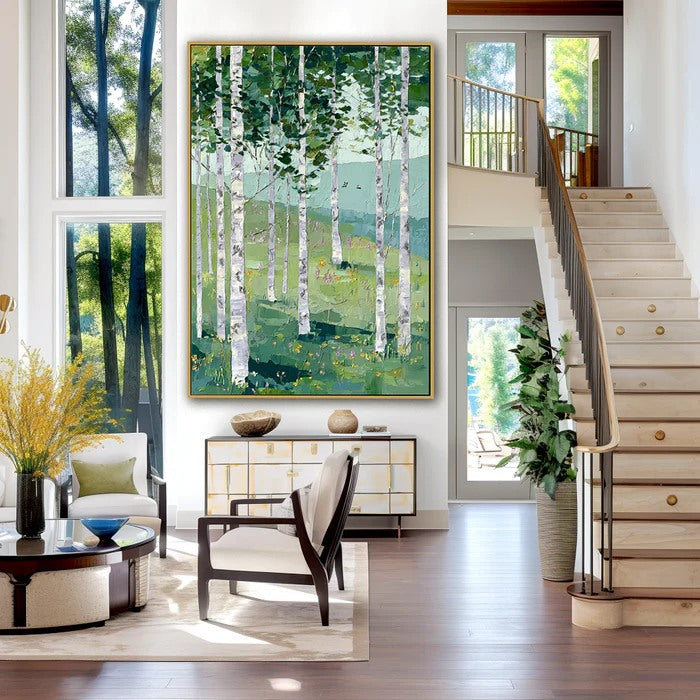
Vertical composition in art shapes how the eye travels through a space, guiding attention along a top-to-bottom axis that emphasizes height, presence, and visual continuity. In practical terms, it uses tall formats, elongated forms, and upward movement to create a sense of elevation and structure. In interiors—especially those with hard architectural surfaces—this approach does more than organize imagery; it subtly alters how a room feels, anchoring tall walls while softening the visual and acoustic fragmentation that often accompanies open, reflective environments.(Edited on June 8, 2026)
The Directional Force Behind Vertical Composition
Vertical composition is not simply about turning a canvas upright. It is a deliberate structuring of visual weight along a vertical axis.
This directional logic influences perception in three key ways:
-
It encourages the eye to travel upward, reinforcing height and spatial drama.
-
It stabilizes narrow or tall wall sections that might otherwise feel empty or disconnected.
-
It creates a visual pause between floor and ceiling, which can reduce the sense of echoing emptiness in minimally furnished rooms.
In gallery environments with high ceilings, vertically oriented works often act as visual anchors, preventing the eye from drifting aimlessly across expansive blank surfaces.
When Height Becomes the Subject
Certain subjects naturally demand vertical composition because their essence lies in elevation.
Common examples include:
-
Architectural forms such as towers or columns.
-
Natural elements like waterfalls, cliffs, or tall trees.
-
Human figures positioned to emphasize posture or presence.
In each case, a horizontal format would compress the subject’s impact. Vertical framing preserves proportion and reinforces the subject’s upward momentum, making the viewer experience scale rather than simply observe it.
Vertical Framing and Viewer Movement
A vertically composed artwork changes how a viewer reads a surface. Instead of scanning left to right, the gaze travels in a slower, more deliberate vertical rhythm.
This shift has spatial implications:
-
In narrow corridors or compact rooms, vertical art can elongate perceived height.
-
Behind a seated subject, such as in a streaming or office setup, it creates a structured backdrop that frames the body naturally.
-
In larger rooms, repeated vertical elements can create a visual cadence that organizes otherwise chaotic wall expanses.
Designers often pair vertical artworks with directional lighting to accentuate this movement, allowing shadows and highlights to reinforce the upward flow.
Balancing Vertical Tension Without Losing the Viewer
A purely vertical pull can feel unstable if not controlled. The eye may exit the composition too quickly, especially in tall, minimal works.
To maintain balance, artists and designers often:
-
Introduce subtle horizontal interruptions, such as texture shifts or tonal breaks.
-
Use layered depth to slow the eye’s movement, encouraging it to linger.
-
Anchor the lower portion of the composition with visual weight to prevent upward drift.
In interior applications, furniture placement plays a similar role. A low console or desk beneath a vertical piece can ground the composition, creating a stable visual base.
Vertical Composition in Acoustic Environments
The relationship between vertical composition and acoustics is often overlooked but highly relevant in modern interiors. Tall, hard walls tend to reflect sound unevenly, particularly in rooms with limited furnishings.
Vertically oriented acoustic artwork can help organize both sound and perception:
-
Taller panels increase the surface area available for absorbing mid-to-high frequency reflections along the height of a wall.
-
Continuous vertical coverage can reduce flutter echoes that travel between parallel surfaces.
-
Visually, these panels prevent treated walls from appearing fragmented or overly technical.
In gallery-origin practices, such as those developed by Artextured, vertical compositions emerged not only as an aesthetic choice but as a response to real echo challenges within tall exhibition spaces. By integrating sound-absorbing structures into vertically expressive artworks, the wall becomes both a visual narrative and a functional acoustic surface.
Where Vertical Composition Can Go Wrong
Despite its strengths, vertical composition is easy to misuse in both art and interiors.
Common pitfalls include:
-
Installing a single narrow piece on a large wall and expecting it to visually or acoustically stabilize the space.
-
Overextending vertical emphasis in already tall rooms, making the environment feel more cavernous rather than intimate.
-
Ignoring adjacent reflective surfaces, such as glass or polished stone, which continue to disrupt both visual balance and sound behavior.
-
Applying non-breathable coatings or finishes to textured or acoustic artworks, reducing their ability to interact with sound waves.
There is also a perceptual risk. Too many vertical elements placed too close together can create visual rigidity, making a space feel constrained instead of elevated.
Integrating Vertical Art into Real Spaces
Effective use of vertical composition depends on context, not just format.
-
In residential settings, a single large vertical piece can define a focal wall, especially in living rooms with higher ceilings.
-
In workspaces or streaming environments, vertical panels behind the subject create a structured visual frame while subtly improving clarity.
-
In commercial or hospitality spaces, repeated vertical works can guide movement and reinforce architectural rhythm.
The most refined implementations treat vertical composition as part of a broader spatial system—aligned with lighting, furniture, and acoustic considerations rather than applied as an isolated decorative choice.
Frequently Asked Questions
Is vertical composition only about using a tall canvas format?No, it is about structuring visual elements along a vertical axis. Even within a square or horizontal format, strong vertical alignment can dominate how the image is perceived.
Does vertical composition make a room feel bigger?It can make a room feel taller, but not necessarily larger overall. The effect depends on ceiling height, wall proportion, and how the composition interacts with surrounding elements.
Can vertical artwork improve acoustics in a space?If the artwork incorporates sound-absorbing materials, it can help reduce reflections along the wall it covers. However, overall acoustic improvement depends on placement and total coverage.
Where should vertical art be placed for the strongest effect?It works best on uninterrupted wall sections where height is visually apparent—behind seating areas, along corridors, or on focal walls with minimal competing elements.
Is vertical composition suitable for small rooms?Yes, when used carefully. A single well-proportioned vertical piece can enhance perceived height, but overcrowding with multiple tall elements can make the space feel compressed.