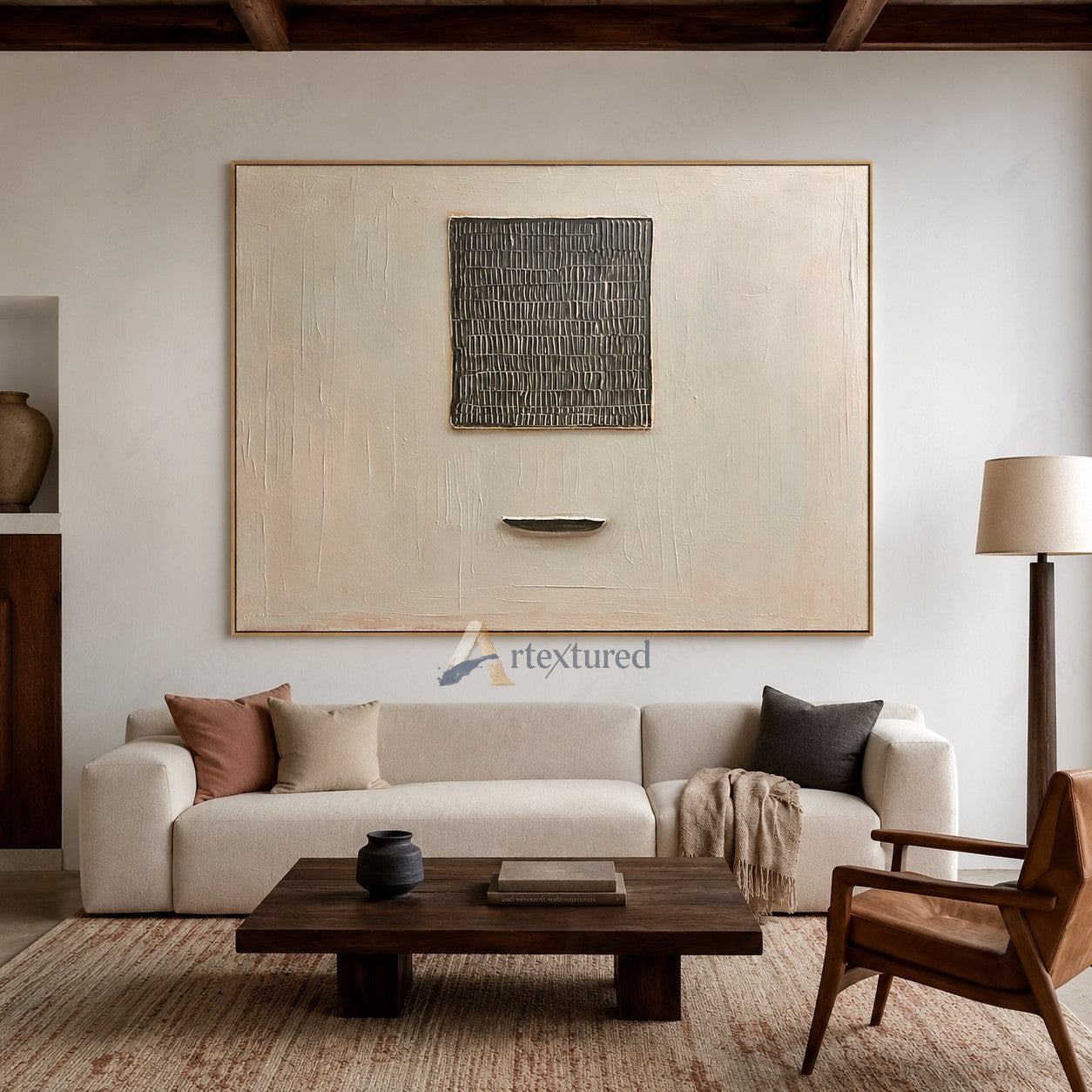
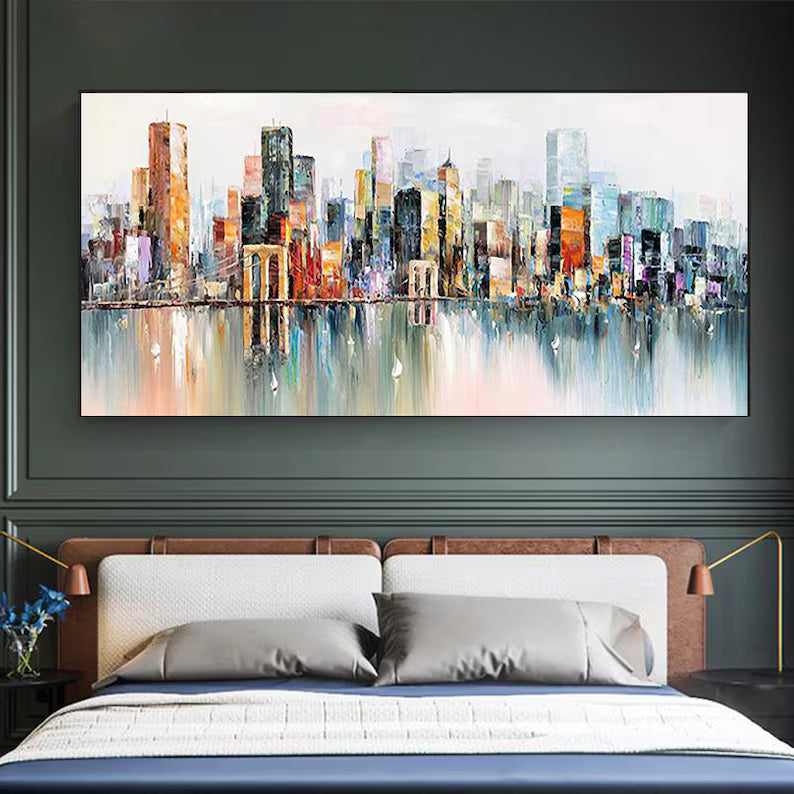
Bespoke textured paintings are commissioned artworks designed not only to match a room’s dimensions and aesthetic, but to interact with light and surface acoustics in a controlled way. They are best suited for luxury residences, architect-led interiors, and acoustically sensitive spaces. However, they require careful planning—poor placement or scale decisions can limit both their visual and acoustic effectiveness.
In high-end interiors where hard materials dominate—stone, glass, polished wood—the wall surface becomes an active participant in how a space feels and sounds. Commissioning art at this level is no longer a decorative afterthought. It becomes a spatial instrument, calibrated to diffuse reflections, respond to directional lighting, and resolve awkward architectural voids that standard canvas sizes fail to address.
When standard canvas scales fail to respect the unique geometry of a luxury home, investing in bespoke textured paintings bridges the gap between art and architecture.

The commissioning process as spatial design collaboration
Commissioning a textured artwork for a residential project typically follows a structured, design-led process rather than a purely artistic brief.
It begins with spatial analysis. Architects or clients provide wall dimensions, ceiling height, material finishes, and lighting plans. This is not optional detail—it directly informs how the artwork’s relief depth and surface breaks will behave under light and how effectively it can disrupt sound reflections.
Next comes scale strategy. In double-height living rooms or elongated corridors, a single oversized piece may not perform as well as a modular arrangement. Breaking a surface into panels can help interrupt sound paths and reduce flutter echo between parallel walls.
Material and technique selection follows. A custom dimensions heavy palette knife approach introduces ridges, peaks, and directional texture. These features are not random—they can be oriented to catch morning or evening light, or to soften glare from recessed spotlights.
Finally, mockups or visual references align expectations. At this level, clients are not choosing “a painting,” but defining a permanent architectural layer.
Choosing the right abstract artist for complex interiors
To commission abstract artist work for architectural environments, selection criteria extend beyond style.
You need an artist or studio capable of thinking in terms of spatial performance:
-
Can they adapt composition to non-standard dimensions rather than scaling an existing design?
-
Do they understand how relief height interacts with grazing light from recessed fixtures?
-
Are they able to adjust texture density across different zones of a single piece?
In high-ceiling spaces, overly fine textures can visually disappear and acoustically underperform. Conversely, excessively aggressive impasto in intimate rooms can create harsh shadowing and visual fatigue.
Studios like Artextured, which originated from solving echo issues within a gallery environment, approach textured art as both a visual and acoustic surface. This dual awareness becomes critical in projects where art must coexist with strict architectural intent.
Engineering texture for light interaction
One of the most overlooked advantages of personalized tactile wall art is its ability to manipulate light behavior.
Flat paintings reflect light uniformly. Textured works, especially those built with palette knife techniques, create micro-topographies that scatter light in multiple directions. This can:
-
Reduce harsh specular reflections from direct spotlights.
-
Introduce soft shadow gradients that shift throughout the day.
-
Enhance perceived depth on otherwise flat walls.
However, this only works when aligned with lighting design. A common mistake is installing heavily textured artwork under poorly angled downlights, which can produce uneven glare or unwanted shadow bands.
For optimal effect, consider:
-
The angle of incidence from recessed fixtures.
-
Window orientation and time-of-day light exposure.
-
Distance between artwork and primary light sources.
In essence, the painting becomes a passive light modulator.
Acoustic behavior of heavy-relief surfaces
While bespoke textured paintings are not substitutes for engineered acoustic panels, their surface complexity can contribute to a more comfortable sound environment.
Hard, flat walls reflect mid-to-high frequency sound waves directly back into the room. This creates flutter echo, especially in spaces with parallel surfaces like hallways, living rooms with opposing glass walls, or minimalist interiors.
Textured surfaces disrupt this behavior by:
-
Breaking up direct reflection paths.
-
Introducing micro-diffusion across uneven surfaces.
-
Slightly increasing surface absorption when layered materials are used.
In practical terms, this means conversations feel less sharp, and spaces sound less “ringing” or hollow.
That said, results depend heavily on coverage and placement. One artwork on a large reflective wall will not meaningfully change overall room acoustics. Strategic distribution across key reflection zones is what creates noticeable improvement.
Layout and spacing rules for installation
Placement is where many otherwise well-commissioned pieces fail to perform.
For large residential spaces, consider these spatial rules:
-
Align artwork with primary reflection zones, typically opposite seating areas or along parallel walls.
-
Maintain proportional scaling; artwork width should often relate to wall width or furniture below, not float arbitrarily.
-
Use multi-panel arrangements for long walls to interrupt sound travel paths.
-
Avoid clustering all textured works on a single wall while leaving others untreated.
Spacing between panels also matters. Too tight, and they behave like a single flat surface. Too far apart, and they lose collective impact.
In home theaters or media rooms, textured artwork can complement dedicated acoustic treatments by addressing secondary reflection zones, but should not replace core acoustic planning.
Common mistakes and limitations
Bespoke textured paintings are powerful, but they are frequently misunderstood or misapplied.
A few recurring issues:
-
Expecting soundproofing: These artworks do not block external noise such as traffic or neighbors. They address internal reflections only.
-
Undersizing the artwork: Small pieces on large walls provide minimal acoustic or visual impact.
-
Ignoring material context: Installing textured art in rooms dominated by glass and marble without sufficient coverage limits effectiveness.
-
Over-sealing surfaces: Applying glossy coatings or sealants can reduce the surface’s ability to diffuse sound and alter its visual depth.
-
Misaligned lighting: Poor spotlight positioning can flatten texture or create distracting glare.
-
Over-dampening: Excessive use of soft or textured surfaces can make a room feel acoustically dull if not balanced with reflective elements.
Understanding these limitations is what separates a curated environment from a decorative one.
Integrating bespoke art into home gallery planning
In luxury homes, bespoke home gallery planning often involves more than filling walls—it is about sequencing spatial experience.
Textured works can act as transitional elements between zones:
-
From bright, open living areas into more intimate lounges.
-
From echo-prone stairwells into acoustically calmer corridors.
-
From visually minimal spaces into focal feature walls.
They also help resolve architectural irregularities—angled walls, recessed niches, or asymmetrical layouts—where standard art formats fall short.
Because each piece is dimensionally tailored, it can align precisely with architectural lines, millwork, or lighting grids, reinforcing cohesion across the interior.
When bespoke becomes essential rather than optional
There is a threshold where off-the-shelf artwork stops working—typically in spaces with unusual scale, complex lighting, or strict design language.
In these cases, bespoke textured paintings are not indulgences; they are functional design elements.
They become especially relevant when:
-
Walls exceed standard artwork proportions.
-
Lighting design is highly directional or layered.
-
Acoustic comfort is a concern but visible panels are undesirable.
-
The interior relies on material contrast rather than decorative clutter.
At this level, commissioning art becomes a form of architectural detailing.
Frequently Asked Questions
What is the process to order bespoke textured paintings for a residential project?
The process starts with sharing architectural details such as wall dimensions, lighting plans, and material finishes. The artist or studio then proposes scale, texture direction, and composition before producing a custom piece aligned with the space rather than adapting a pre-existing design.
How do I choose the right commission abstract artist for a high-ceiling living space?
Focus on artists who can work at architectural scale and understand how texture reads from a distance. In tall spaces, larger relief patterns and controlled composition prevent the artwork from visually disappearing.
Can custom 3D palette-knife artwork be tailored to match specific linear light reflections?
Yes, texture direction and height can be adjusted to interact with lighting angles. This allows the artwork to diffuse or emphasize light depending on the desired effect, but it requires coordination with the lighting plan early in the design process.
What are the spacing and layout rules for installing bespoke heavy-relief paintings?
Placement should correspond to key visual and acoustic zones, with proportional sizing relative to the wall. Multi-panel layouts often perform better on large surfaces, and spacing must balance cohesion with surface interruption.
Do bespoke textured paintings replace acoustic panels?
No, they complement them. Textured artworks can help soften reflections and improve perceived acoustic comfort, but they do not provide full sound isolation or replace dedicated acoustic engineering in demanding environments.