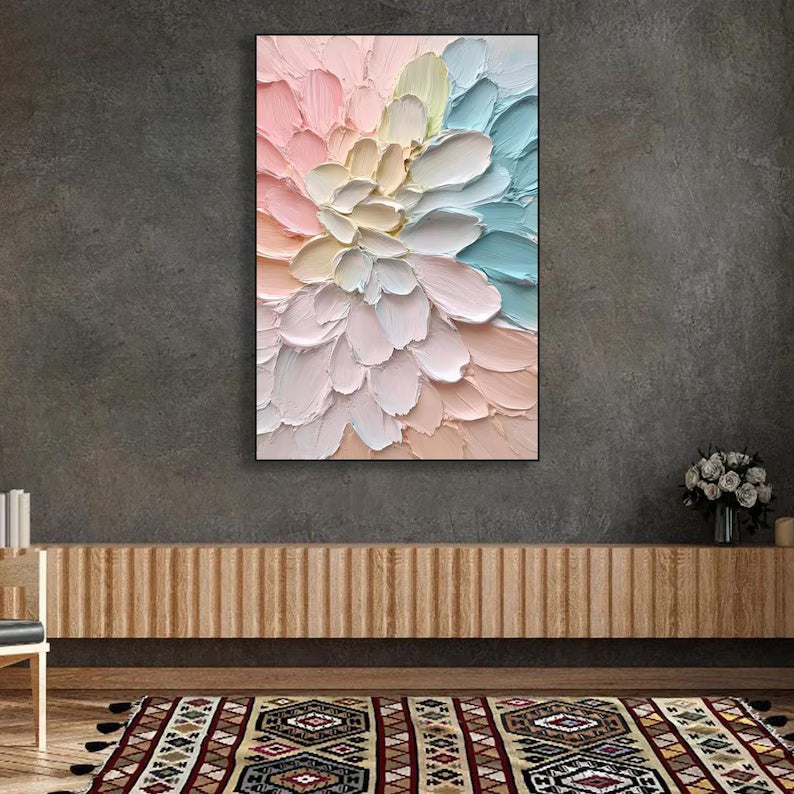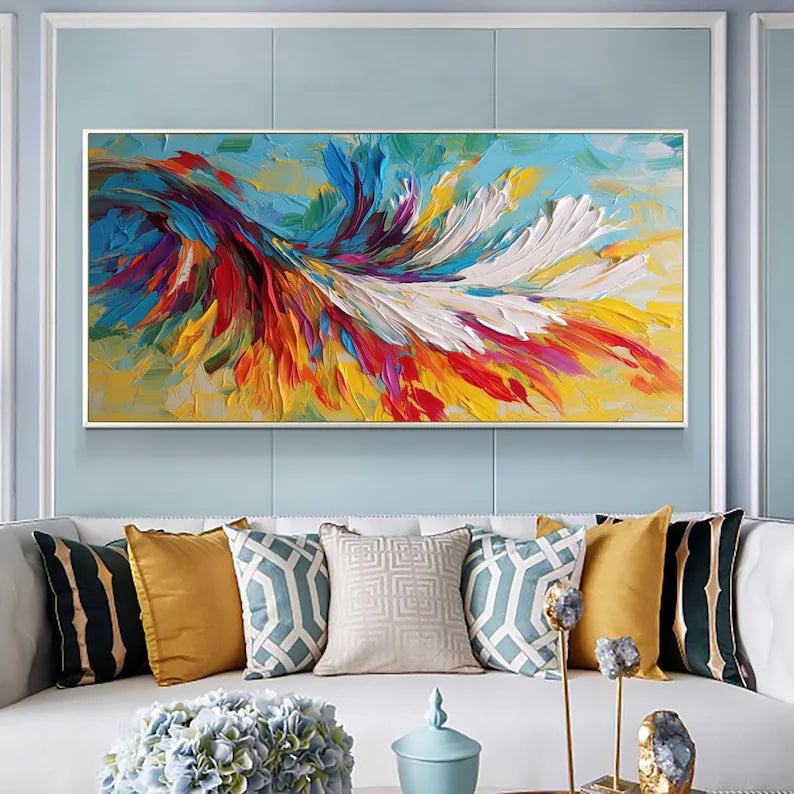
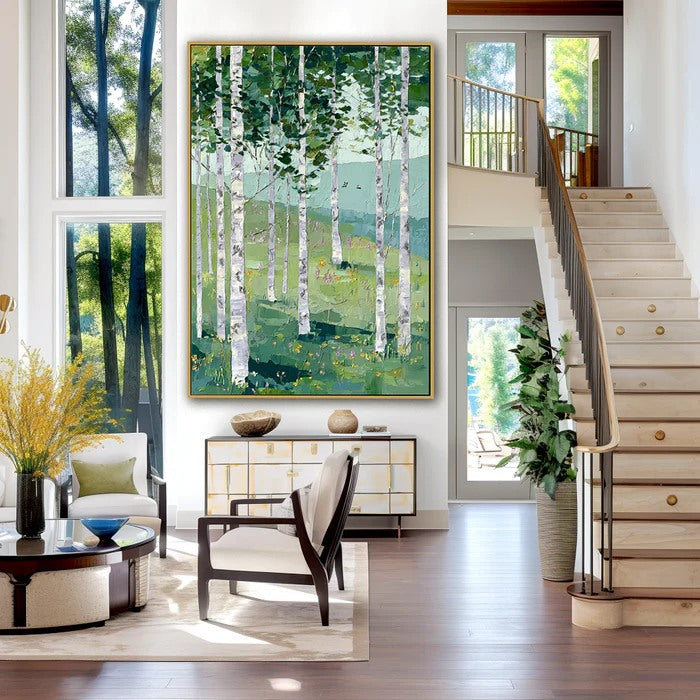

Gallery quality textured art is not defined by appearance alone; it is a structural system built to carry dense material layers, resist environmental stress, and maintain visual depth under architectural lighting. It is best suited for luxury interiors—double-height living rooms, hotel lobbies, and expansive feature walls—where scale, light, and longevity matter. The limitation: it requires proper wall support, lighting calibration, and spatial planning to perform as intended.
In high-end interiors, texture is not decoration—it is mass, surface physics, and long-term stability. The difference between true gallery-grade work and mass-produced decor becomes visible within months: cracking surfaces, sagging canvases, and flattened light response. For designers and developers specifying oversized textured wall decor, the question is not style, but structural credibility.
Designing an expansive interior requires more than just scaling up size; it demands true gallery quality textured art built to handle shifting spatial lighting.

The Structural Reality Behind Heavy Textured Surfaces
Heavy impasto is not simply “thick paint.” It is a layered system where binder strength, pigment load, and substrate tension must remain in equilibrium.
In authentic gallery-grade work, the surface is engineered to hold weight without micro-fracturing. As thickness increases, internal stress also increases. Inferior compositions—often seen in decorative pieces—lack the polymer or mineral cohesion required to absorb subtle movement caused by humidity shifts or temperature changes.
This is why genuine museum-grade mineral paint thickness behaves differently. It does not crumble under pressure or develop hairline cracks along drying lines. Instead, it cures into a cohesive structure that can tolerate minor flex without surface failure.
A common specification hesitation among designers is weight versus durability. Lighter pieces are easier to install, but they often sacrifice structural integrity. Heavier works, when properly constructed, signal material density and long-term resilience.
Canvas Tension and Load Distribution at Scale
Oversized textured wall decor introduces a problem rarely discussed in retail art: gravity over time.
As scale increases, so does the risk of canvas sagging. A large-format piece carrying dense material layers requires:
-
High-tension framing systems that resist bowing.
-
Reinforced stretcher bars to distribute load evenly.
-
Substrates that do not relax under prolonged weight.
Mass-market canvases often use lightweight frames that subtly warp within months, especially in climate-controlled luxury interiors where air conditioning cycles create micro-expansion and contraction.
The result is not immediate failure, but gradual distortion. The surface begins to dip, causing cracks at stress points and disrupting how light interacts with the texture.
This is why collectors and architects treat large-scale textured works more like structural installations than wall decor.
Light Interaction Across Multi-Layered Surfaces
One of the defining characteristics of gallery quality textured art is how it handles light.
In a double-height space or a lobby with directional lighting, texture becomes a dynamic surface. Peaks and ridges catch light, while recesses create shadow gradients. This interaction depends on:
-
Surface density and edge definition.
-
Pigment stability under UV and artificial lighting.
-
The angle and consistency of illumination.
Mass-produced pieces often use superficial texture that appears flat under strong lighting. The peaks collapse visually because the material lacks depth and rigidity.
In contrast, structurally sound impasto maintains its dimensionality. Light does not just hit the surface—it travels across it, creating a shifting visual field throughout the day.
A frequent design mistake is installing heavily textured work under diffuse lighting only. Without directional light, the dimensional value is lost, and the piece appears visually compressed.
Why Mass-Market Textured Art Fails Over Time
Cracking is the most visible symptom, but it is rarely the root issue.
Mass-produced textured paintings often fail because:
-
The binder cannot support the pigment load.
-
Layers are applied too quickly without proper curing.
-
The canvas lacks the tensile strength to hold the weight.
-
Environmental shifts cause uneven expansion across layers.
These failures are amplified in luxury interiors where materials like marble, glass, and concrete reflect and concentrate heat and light.
Over time, what begins as a visually appealing surface becomes fragmented. Edges lift, textures detach, and the artwork loses both structural cohesion and aesthetic clarity.
This is why high-end home art investment increasingly prioritizes material science over stylistic trends.
The Role of Material Composition in Longevity
At the upper end of the market, the conversation shifts from “what it looks like” to “what it is made of.”
Gallery-grade textured art often incorporates:
-
High-polymer or mineral-based binders for structural cohesion.
-
Pure, non-fading pigments that resist color shift under prolonged exposure.
-
Multi-layer curing processes that stabilize internal stress.
Artextured, an artist collective founded in Xiamen, approaches this from a gallery-tested perspective. Their work emerged from solving echo and material durability challenges within their own exhibition space, leading to textured compositions that balance visual depth with structural reliability.
This dual focus—material performance and spatial experience—is what separates decorative art from architectural art.
Placement Strategy in Large-Scale Interiors
Even the most structurally sound artwork can underperform if placed incorrectly.
In large spaces, placement should consider:
-
First reflection zones where sound and light converge.
-
Adjacent materials such as glass or stone that amplify reflections.
-
Viewing distance relative to texture scale.
A common oversight in hotel and residential projects is centering artwork purely for symmetry, ignoring how surrounding surfaces affect perception. In echo-prone environments, textured art can help soften mid-to-high frequency reflections, but only when coverage and positioning are adequate.
It is not a substitute for full acoustic treatment, but it can contribute to a more balanced sensory environment when integrated thoughtfully.
Limitations and Misuse in Real Projects
Gallery quality textured art is often misapplied because it is treated as a visual accessory rather than a structural element.
Typical issues include:
-
Installing a single oversized piece in a highly reflective room and expecting full acoustic improvement.
-
Mounting heavy works on insufficient wall support, leading to long-term instability.
-
Using delicate textures in high-humidity areas without considering material response.
-
Applying protective coatings that seal the surface and compromise its intended texture behavior.
-
Ignoring spotlight angles, which can create harsh glare or flatten dimensional contrast.
There is also a tendency to over-correct acoustics by adding too many absorptive surfaces, resulting in a space that feels unnaturally muted. Balance matters more than maximum absorption.
Understanding these limitations is what distinguishes a curated installation from a decorative afterthought.
A Material-First Approach to High-End Art Selection
For designers and developers, specifying gallery quality textured art is less about style and more about performance criteria.
A practical selection framework includes:
-
Structural integrity: Can the piece support its own material weight over time?
-
Surface behavior: Does the texture maintain depth under directional lighting?
-
Environmental resilience: How does it respond to humidity, temperature, and light exposure?
-
Spatial compatibility: Does it align with the scale and material palette of the room?
This approach reframes art as part of the architectural system rather than an overlay.
For large-format installations, especially in hospitality or luxury residential projects, the artwork becomes a permanent visual anchor. Its success depends on how well it integrates with the physics of the space.
Frequently Asked Questions
What materials define genuine gallery quality textured art?
Genuine gallery quality textured art is defined by high-strength binders, stable pigments, and reinforced substrates that support heavy layered applications. These materials work together to prevent cracking, fading, and structural failure, especially in large-scale or high-light environments.
Why are gallery quality paintings often heavier than decorative pieces?
They are heavier because they contain denser material layers and stronger structural supports. This added mass reflects real material depth and durability, rather than lightweight fillers or superficial textures used in mass-produced decor.
How do oversized textured wall decor panels maintain structural integrity over time?
They rely on reinforced framing systems, balanced material composition, and controlled curing processes. Together, these factors help distribute weight evenly and reduce internal stress that can lead to sagging or cracking.
Do textured artworks improve acoustics in large rooms?
They can help soften mid-to-high frequency reflections and reduce flutter echo when used in sufficient quantity and placed strategically. However, they do not replace full acoustic treatment or structural soundproofing solutions.
Why do some textured paintings crack within a year?
Cracking usually occurs when the material system is unbalanced—either the binder is too weak, layers are applied too quickly, or the canvas cannot support the load. Environmental factors like humidity and heat can accelerate these failures.